
Business Contracts & Vendor Disputes · Coral Gables, FL
Your Vendor Ended the Contract Without Notice. What Now?
A sudden termination can disrupt operations, cash flow, and customer commitments. Here is how Florida business owners can begin to assess their position.
By Kristina E. Wilson · Published November 18, 2026
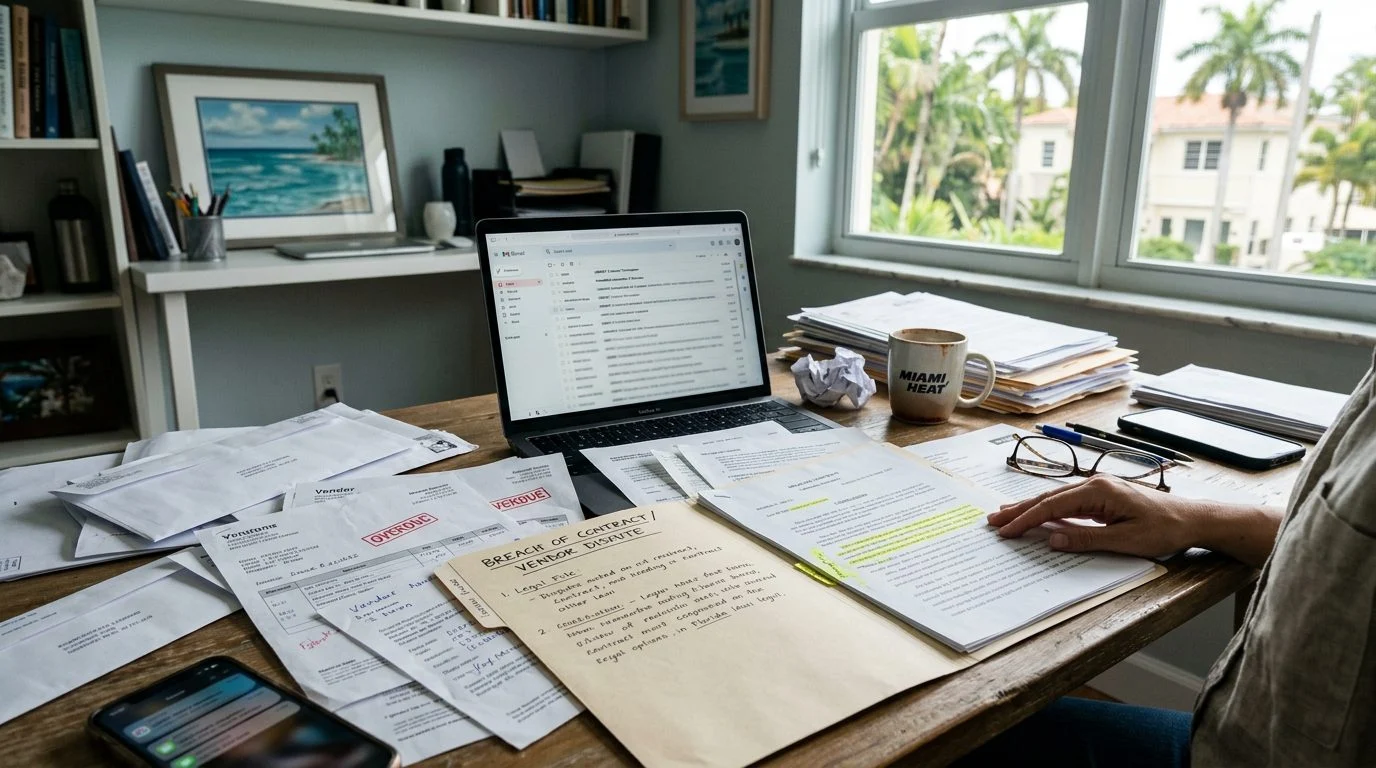
When a vendor ends your contract without warning, deliveries, projects, and payments can stop overnight. Whether that exit was allowed usually depends on what your contract says about termination and notice. A termination that skips a required step may be a breach, and that opens options you can weigh before anyone files suit.
What a No-Notice Termination Means for Your Business
A no-notice termination happens when a vendor ends your agreement without the advance notice the contract expects. It often hits in the middle of a project or a busy season, when you have the least room to absorb it.
The harm is practical first. Orders may not ship. Work may stop. You may have to pay a new provider more to fill the gap, or lose sales you can’t win back.
The legal question runs alongside it. Was the vendor allowed to end the deal this way? The answer comes from the contract’s words and from what actually happened, not from the label the vendor puts on its decision.
This page covers general Florida principles and the questions to answer first. Use it to organize your facts before you respond to the vendor.
If a vendor ended your contract without warning, you may have a claim worth reviewing, and our team can talk it through with you. Talk it through with our team — the first consultation is free, confidential, and carries no obligation.
Start With the Termination and Notice Terms in Your Contract
Your termination and notice clauses answer the first question. Read them before you send the vendor anything.
Look for these items:
- Termination for convenience: a right to end the deal for any reason, usually after a stated number of days’ notice.
- Termination for cause: a right to end the deal only after a stated problem, such as a missed deadline.
- Notice method: the required delivery method, address, and person who must receive it. Check whether email counts.
- Cure period: a window that lets the other side fix the problem before termination takes effect.
- Renewal and minimum-term language: rules that control how long obligations last.
- Dispute clause: mediation, arbitration, venue, or governing law. Under Fla. Stat. § 682.02, a written agreement to arbitrate is generally valid and enforceable.
Under Fla. Stat. § 671.205, past dealings can help explain your agreement. Courts first try to read the written terms and the parties’ past dealings as consistent with each other. Only if that reading is unreasonable do clear written terms win over that practice, and a course of performance can show that a written term was waived or modified. Fla. Stat. § 671.205
Gather the signed agreement, amendments, purchase orders, and any emails or texts about the change. For a closer look at one common exit path, see canceling a contract in Florida.
Was the Termination a Breach? Material, Minor, and Anticipatory Breach
A termination that ignores the contract’s terms may be a breach. The seriousness of the breach matters, so ask whether the vendor broke the core promise of the deal or only a small part of it.
A minor breach misses a smaller part. The label changes what remedies are realistic.
Anticipatory breach happens when a party makes clear it won’t perform before the due date. For contracts for the sale of goods, Fla. Stat. § 672.610 lets the other side, when a party repudiates a performance not yet due that will substantially impair the value of the contract, wait a commercially reasonable time or pursue a remedy now. It can also suspend its own performance. Chapter 672 covers the sale of goods, so check whether your agreement is for goods or services.
The vendor’s stated reason doesn’t decide the question alone. The contract’s language and the facts of what happened do.
What You Can Do Before Filing a Lawsuit
Most early steps start with good records and a clear written demand. Waiting can cost you options.
- Preserve evidence now. Save emails, texts, invoices, delivery logs, and a dated timeline of events.
- Send a written demand. Name the contract terms at issue and say what you want, such as reinstatement, a cure, or payment. For contracts for the sale of goods, Fla. Stat. § 672.609 lets you demand adequate assurance of performance in writing when reasonable grounds for insecurity arise. After receiving a justified demand, failing to provide adequate assurance within a reasonable time, not exceeding 30 days, is a repudiation of the contract.
- Negotiate an exit. Transition terms, credits, or a payment plan can limit your losses.
- Consider mediation. Fla. Stat. § 44.102 directs courts, upon request of one party, to refer filed money-damages cases to mediation if the requesting party can pay the mediation costs or they can be equitably divided, with listed exceptions. Fla. Stat. § 44.102 reads: “(2) A court, under rules adopted by the Supreme Court: (a) Must, upon request of one party, refer to mediation any filed civil action for monetary damages, provided the requesting party is willing and able to pay the costs of the mediation or the costs can be equitably divided between the parties, unless: 1.”
- Avoid self-help. Don’t withhold payments on your own before you review the contract.
If you want to undo the deal entirely, that is called rescission.
What Damages a Business May Be Able to Recover
A business usually seeks the money it lost because of the breach. The contract may limit some categories, and your records decide how much you can prove.
- Incidental costs: expenses tied to the problem, such as rush shipping or emergency labor.
- Consequential losses: indirect harm, such as lost sales. Many contracts limit or exclude these, so read the damages language closely.
Keep replacement invoices, bids you requested, sales reports, and notes on what you did to limit the loss. These records shape any damages discussion.
The amount depends on the contract terms and the evidence. No one can predict a number from general information.
Florida Deadlines and Why Timing Matters
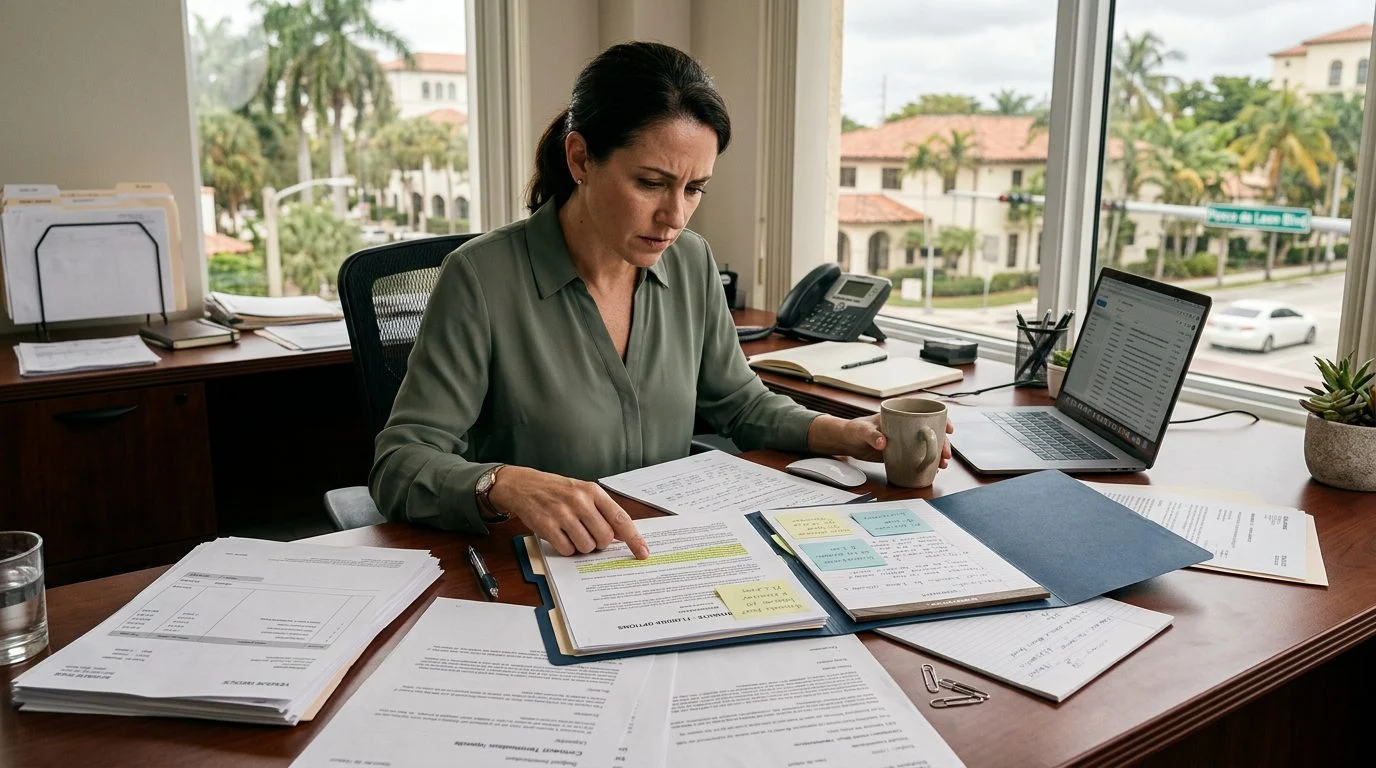
For a written contract, Florida’s general statute of limitations gives five years to sue. Other deadlines can run sooner, so don’t wait.
- Limitations period: Fla. Stat. § 95.11 sets five years for an action on a written contract.
- Contract shortcuts: under Fla. Stat. § 95.03, a contract provision that sets a shorter time to sue than the statute allows is void.
- Goods you accepted: under Fla. Stat. § 672.607, you must notify the seller of a breach within a reasonable time after you discover or should have discovered it, or you may be barred from any remedy.
Track two dates: when you learned of the termination and when your losses began. Delay also weakens evidence and makes replacement costs harder to prove.
Venue matters too. Fla. Stat. § 47.011 says actions are brought where the defendant resides, where the cause of action accrued, or where the property in litigation is located. That rule doesn’t apply to actions against nonresidents.
Not sure what your next step is?
Talk it through with our team — the first consultation is free, confidential, and carries no obligation.
How KEW Legal Handles Vendor Termination and Contract Disputes
KEW Legal focuses on business contract and vendor disputes. The firm acts as outside general counsel for businesses that need ongoing legal support. It has offices in Coral Gables and Sunny Isles Beach and serves business owners and investors across Miami-Dade, Broward, and South Florida.
Kristina E. Wilson is the responsible lawyer for this page. The firm’s lawyers include Kristina E. Wilson and Natalie Martinez.
A typical matter moves through a few steps:
- Review of the contract, amendments, and timeline.
- A written assessment of your options.
- A demand letter or negotiation strategy.
- Mediation, arbitration, or litigation only if earlier steps don’t resolve the dispute.
The firm reviews each matter on its facts rather than applying a template. No lawyer can promise a particular result in your dispute.
Frequently Asked Questions
Can a vendor end a contract without notice in Florida?
It depends on the termination and notice terms in your agreement. Review those terms first.
Do I have to keep paying a vendor who terminated without notice?
It depends on the contract. Don’t stop payments on your own until you’ve reviewed the agreement.
Is a verbal termination valid?
It may be, depending on what your contract requires for notice. Written notice requirements in the contract matter most.
Can I sue for losses from a vendor’s sudden exit?
A breach of contract claim may be available if the termination broke the contract. The amount you can recover depends on the contract and your proof.
How long do I have to act?
Notice periods and cure windows can be shorter, so act promptly.
Talk Through Your Contract With KEW Legal
If your vendor stopped performing or ended the agreement without warning, you may be weighing your next move right now. You don’t have to work through the notice clause, the damages, and the deadlines alone. Call 305-990-2300, send us a message, or schedule a consultation. The initial consultation is free, confidential, and comes with no obligation to continue.
How KEW Legal Works With Business Owners
Contract Review
We start by reading your agreement's termination, notice, and cure provisions alongside the communications that led to the vendor's decision.
Outside General Counsel
Our lawyers serve as ongoing legal counsel for owners and investors, so vendor issues are handled with the rest of your business needs in mind.
Practical Options
We explain the paths available under your contract and Florida law, including negotiation, a demand letter, or further proceedings, so you can choose a direction.
Miami-Dade and Broward
KEW Legal focuses on business law for clients in Coral Gables, Sunny Isles Beach, Miami, and throughout South Florida.
Review Before You React
Before you stop payments, withhold performance, or sign with a replacement vendor, review your agreement's termination and notice terms. A well-timed step can protect your position.
Common Questions Business Owners Raise
Was the termination valid?
The answer depends on what your contract says about termination, notice, and breach. We review those terms against the facts of your situation.
What about payments?
Whether to keep paying, pay under protest, or hold funds depends on the agreement and the circumstances. Please speak with a lawyer before making that decision.
Can we recover losses?
Losses from a sudden termination are evaluated case by case. We can help you document costs and assess the claims available to you.
How do we protect ongoing operations?
We help you plan transition steps, communicate carefully with your team and customers, and preserve important records.
Speak With Kristina E. Wilson at KEW Legal in Coral Gables. The First Consultation Is Free, Confidential, and Carries No Obligation to Continue.
Related practice areas
Request a Consultation
Fill out the short form and we will take it from there.