
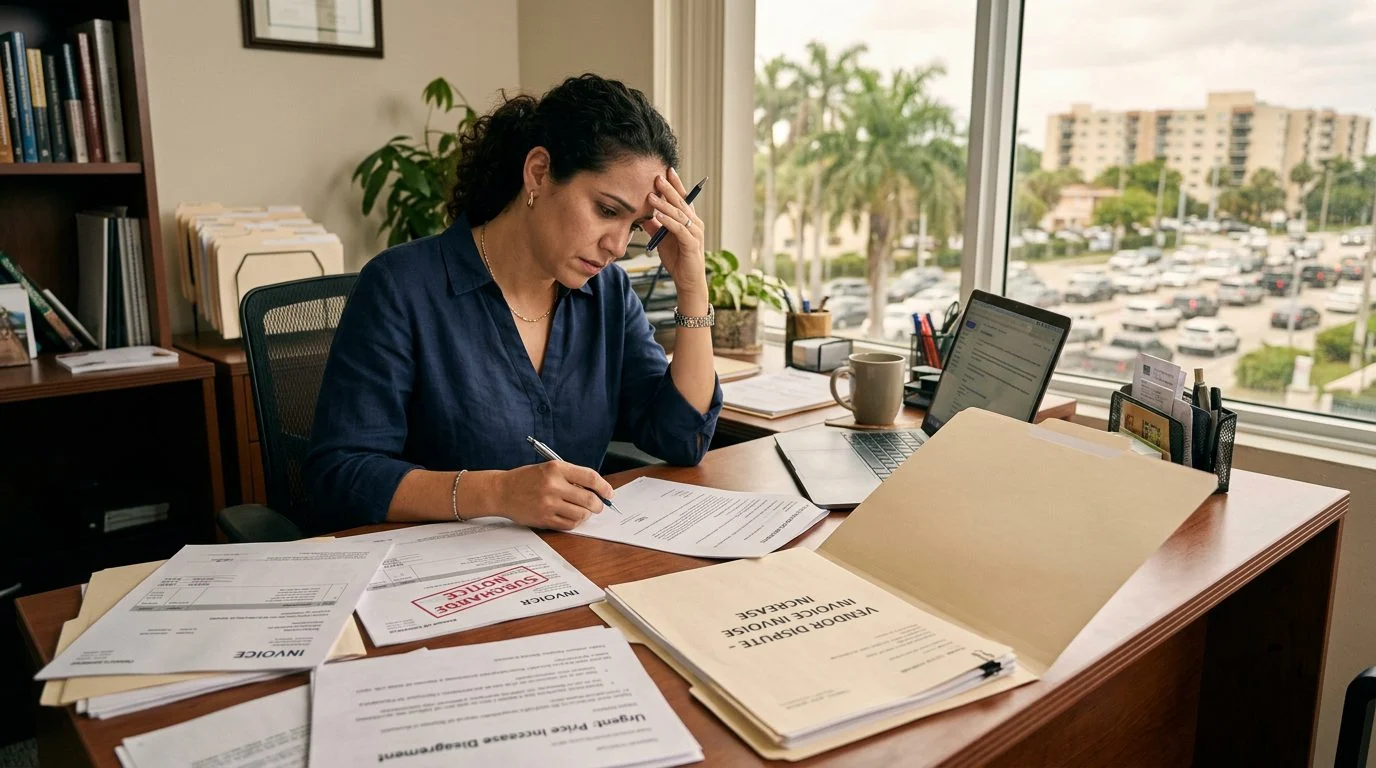
Business Contract & Vendor Dispute Attorney | Coral Gables & Sunny Isles Beach
Facing a Vendor Price Increase or Surcharge?
Outside general counsel for South Florida business owners who need to know what their agreement allows and how to respond in writing.
By Kristina E. Wilson · Published November 19, 2026
A vendor just raised your price in the middle of a contract, or added a surcharge you did not expect. When a vendor raises its prices partway through a deal, whether the increase is allowed usually depends on what your written agreement says.
Review the contract, the notice, and the reason the vendor gave. This page explains what to check and how these disputes usually move forward.
When a Vendor’s Price Increase or Surcharge Is a Contract Problem
A price increase becomes a contract problem when the vendor charges more than your agreement allows. Price terms are often found in the agreement itself, in a signed amendment, or in an adjustment clause. The invoice and the emailed notice do not settle that question on their own. The contract, purchase orders, renewal terms, and amendments do.
This page is written for Florida business owners, operators, and employers in Miami-Dade, Broward, and nearby areas. It covers increases from suppliers, service providers, and freight, fuel, and material vendors. The first step is to answer two questions: what did you agree to pay, and what events allowed that price to change?
If a vendor's higher price has you unsure whether to pay, we can review your agreement and notice with you and talk through your options. Talk it through with our team — the first consultation is free, confidential, and carries no obligation.

Reading the Price Clause: What to Check in Your Vendor Agreement
The price clause decides most vendor increase disputes, so read it word for word. Start by looking for these terms:
- Pricing type. Is the price fixed, set per unit, cost-plus, or subject to adjustment? Each type allows different changes.
- Index terms. Find the index named, the formula, how often it can change, and any cap or floor.
- Surcharges. Check whether fuel, freight, tariff, or regulatory surcharges are allowed, and what events trigger them.
- Notice. Confirm the required advance written notice, how it must be delivered, and whether it must state the reason.
- Amendment and integration. Look for a signed-writing requirement for changes, and for language that makes the written deal the whole deal.
- Fee terms. Check for an attorney fee clause, since it affects what a dispute can cost.
Notice terms raise a harder question. Florida’s Fourth District Court of Appeal has said courts do not favor treating a step as a condition precedent, meaning a step that must happen first. A Florida appellate opinion puts it this way: “As a general rule, conditions precedent are not favored, and courts will not construe provisions to be such, unless required to do so by plain, unambiguous language or by necessary implication” (Covelli Family opinion). A condition precedent is an act that must occur before a party has a right to immediate performance (Land Co. of Osceola County v. Genesis Concepts). So whether a vendor had to give notice first turns on the contract’s exact words.
Common Vendor Dispute Scenarios Florida Businesses Face
Most vendor disputes fall into a few patterns, and each raises its own question. Common ones include:
- A surcharge with no contract basis. The invoice adds a fee, but no term allows it, or the trigger does not match what happened.
- The wrong index. The vendor uses a different index, time period, or formula than the contract names.
- Short or retroactive notice. The increase starts before the notice period ends, or it reaches orders you already placed.
- A threat to cut off supply. The vendor says deliveries or service end unless you accept the new price.
- Months of silent payment. You paid the higher rate for a while and now want to dispute it.
- A force majeure claim. The vendor cites a clause about events outside its control. The question is whether that clause covers what happened.
For a supply threat involving goods, Fla. Stat. § 672.609 matters. When reasonable grounds for insecurity arise, you may demand adequate assurance of performance in writing. Until you receive it, you may suspend any performance for which you have not already received the agreed return, if that is commercially reasonable. Failing to give adequate assurance within a reasonable time, not exceeding 30 days, after a justified demand is a repudiation of the contract.
Silent payment carries its own risk. A course of performance can be relevant to show that a term was waived or changed, under § 671.205. Object in writing early, not after the third or fourth higher invoice.
How a Vendor Price Dispute Moves Forward
A vendor price dispute usually moves from document review to a written response, then to talks, and then to whatever dispute path the contract sets.
- Gather the documents. Collect the full contract, amendments, purchase orders, invoices, the vendor’s notices, payment history, and any emails or texts about pricing.
- Map the terms. Compare the price, notice, dispute, and fee clauses with what the vendor actually did.
- Choose a response. Options include a written objection, a request for the index or cost records, a negotiated resolution, or a demand letter.
- Use the contract’s dispute path. If talks fail, an arbitration clause may control. Under Fla. Stat. § 682.02, a written agreement to arbitrate is valid, enforceable, and irrevocable, except on grounds that exist for revoking any contract.
Time limits matter. Florida’s limitations statute, § 95.11, sets the periods for lawsuits other than for recovery of real property. Under § 95.03, a contract provision that sets a time to sue shorter than the statute allows is void. For goods you accepted, § 672.607 requires notice of breach within a reasonable time after you discover or should have discovered it, or you may be barred from any remedy.
Protecting Your Position While the Dispute Is Pending
Your conduct during a dispute can shape your options, so keep your position clear in writing. Start with these steps:
- Keep complete records of orders, deliveries, invoices, and payments.
- Answer vendor notices in writing. Cite the contract term you rely on and reserve your rights.
- Do not sign new acknowledgments or amendments that accept the higher pricing without a review.
- If you pay under protest, say so in writing at the time you pay.
- Treat withholding payment as a separate decision. Review the contract before you stop paying any invoice.
Fee risk runs both ways. Under § 57.105, a court must award a reasonable fee to the prevailing party, paid in equal amounts by the losing party and the losing party’s attorney, when the losing side knew or should have known that a claim or defense was not supported by the material facts. For a claim or defense that would not be supported by then-existing law, no monetary sanctions may be awarded if it was initially presented as a good faith argument for extending, modifying, or reversing existing law, or for establishing new law, with a reasonable expectation of success. A sanctions motion must be served first and may not be filed unless, within 21 days after service, the challenged paper, claim, defense, contention, allegation, or denial is not withdrawn or appropriately corrected. A contract’s fee clause can also cut both ways, because the same statute lets a court award fees to the other side when it prevails under that contract.
For related reading, see our page on supplier price increase disputes in Florida.
Frequently Asked Questions About Vendor Price Increases and Surcharges
Here are short answers to common questions about vendor price increases and surcharges.
Can a vendor raise prices in the middle of a contract?
The agreement may allow price changes through an index, a surcharge clause, a cost adjustment term, or a signed amendment.
Is a vendor’s invoice notice enough to change the price?
The contract’s notice terms and amendment requirements control.
Can I refuse to pay an unauthorized surcharge?
Whether withholding is appropriate depends on the contract and the facts, so review it before you stop paying.
Can I recover attorney’s fees in a vendor dispute?
Possibly. Section 57.105 can require a fee award against a losing party whose claim lacked support, and some contracts allow fees to the winner.
Do I need a lawyer for a small increase?
A small amount can still matter, especially if the vendor controls a supply you need. An early contract review helps you weigh the cost of a dispute against the amount at stake.
Not sure what your next step is?
Talk it through with our team — the first consultation is free, confidential, and carries no obligation.

Talk With KEW Legal About Your Vendor Price Increase
If a vendor’s new price is in front of you, you may still be deciding whether to pay, push back, or keep supplies moving. KEW Legal is a Florida business law firm with offices in Coral Gables and Sunny Isles Beach. The firm acts as outside general counsel for business owners and investors across Miami-Dade and South Florida, and it handles business contract and vendor disputes. Kristina E. Wilson is the responsible lawyer for this page.
The initial consultation is free, confidential, and carries no obligation to continue.
When you’re ready to talk, call 305-990-2300 or send your questions through our contact page. Bring the agreement, the vendor’s notice, and recent invoices so the review starts with the actual terms.
How We Handle Vendor Pricing Disputes
Contract Review
We review the price terms in your agreement, including any index, surcharge, or cost-adjustment clause and any amendment requirements.
Notice and Amendment Check
We examine how the vendor gave notice of the change and whether the contract called for a signed amendment.
Written Response Strategy
We help you decide what to say to the vendor, and when, so your position is documented clearly.
Ongoing Business Protection
As outside general counsel, we keep your vendor relationships, cash flow, and operations in view while the dispute is resolved.
Review Before You Pay or Sign
Before you pay a disputed increase, approve a surcharge on an invoice, or sign a new price amendment, have the contract reviewed.
Common Vendor Pricing Disputes
Mid-Contract Price Hikes
A vendor raises rates partway through a term and asks you to accept the new pricing without a clear basis in the agreement.
Surcharges on Invoices
Fuel, freight, materials, or service surcharges appear on bills without a clear reference to a contract provision.
Amendments Presented for Signature
A vendor sends a revised pricing document and asks for a quick signature to keep service running.
Disputed Index Adjustments
A price change tied to an index or cost formula is calculated in a way your business questions.
Have a Vendor Price Increase on the Table?
Let's Review It Together. The initial consultation is free, confidential, and carries no obligation to continue. Call 305-990-2300 or send us a message.
Related practice areas
Request a Consultation
Fill out the short form and we will take it from there.