

Employment Law for Employers | Coral Gables and Sunny Isles Beach
E-Verify for Florida Employers: Know Where Your Hiring Process Stands
KEW Legal helps business owners in Miami-Dade and South Florida review hiring practices, employment records and day-to-day compliance questions with Kristina E. Wilson and our team.
By Kristina E. Wilson · Published October 31, 2026
Florida law requires a private employer with 25 or more employees to use E-Verify for new hires. The state rule took effect July 1, 2023. This page explains who must comply, how the hiring steps work, and what records to keep. It is general information, not legal advice.
Short answer: when Florida requires E-Verify
Florida requires a private employer with 25 or more employees to use the E-Verify system for new hires. The duty comes from Fla. Stat. § 448.095. It applies to new employees hired beginning July 1, 2023.
The rule ties to that 25-employee line. Your headcount decides whether the state duty applies to you. Owners near the line should count carefully before they make the next hire.
If you're hiring now and your headcount sits near the 25-employee line, reach out to talk through your E-Verify and I-9 steps before your next start date. Talk it through with our team — the first consultation is free, confidential, and carries no obligation.
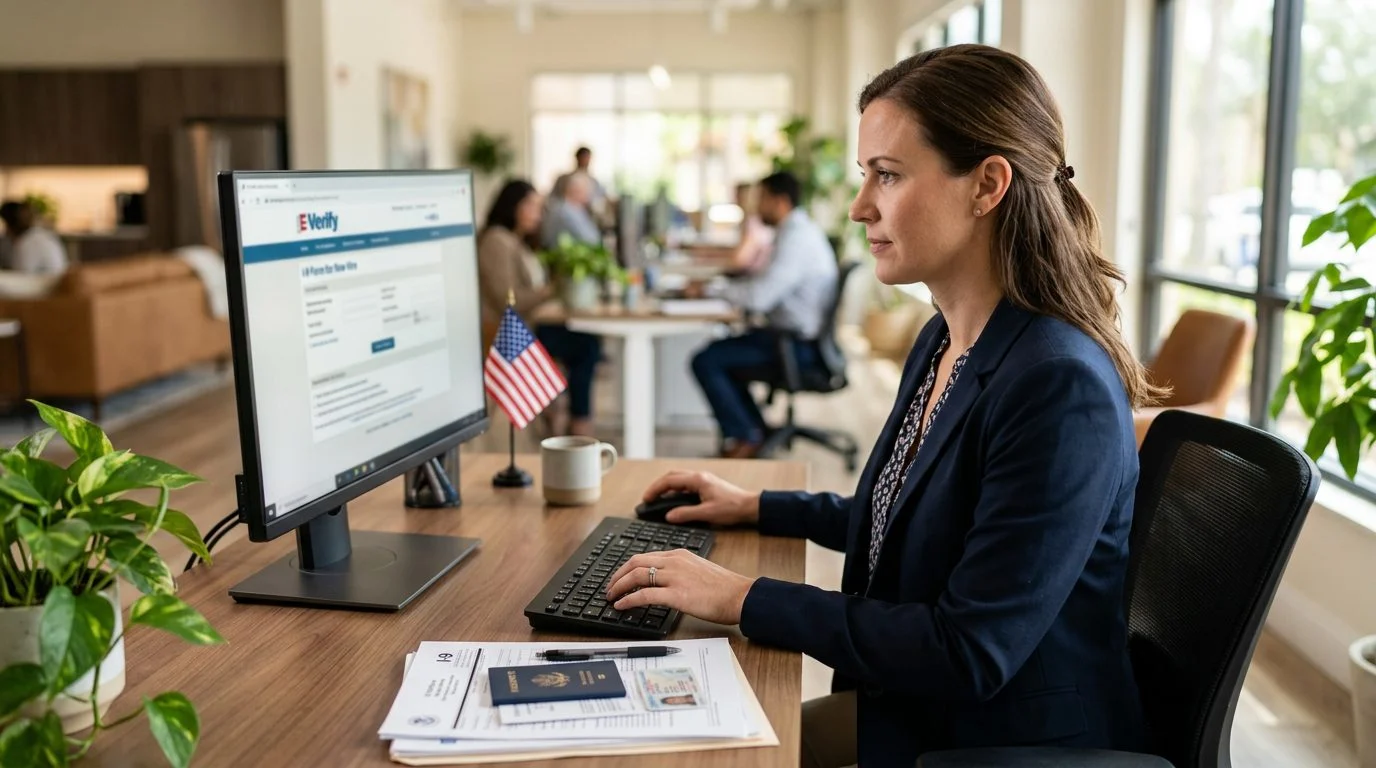
What Fla. Stat. § 448.095 requires of employers
A covered employer must verify each new employee’s work eligibility through E-Verify within 3 business days after the first day the new employee begins working for pay.
The statute works alongside a second rule. Under Fla. Stat. § 448.09, it is unlawful to knowingly employ, hire, recruit, or refer for work in Florida a person who is not authorized to work under federal immigration law.
Knowledge matters. Under § 448.095, an employer may not keep employing a worker after it learns that the person is or has become an unauthorized alien. The employer’s own records can help show what it knew and when.
Federal anti-discrimination law applies to hiring too. The U.S. Equal Employment Opportunity Commission publishes guidance for employers on those duties.
How to count the 25-employee threshold
Counting employees is a fact question. The result depends on how your workforce is set up, and it can change over time.
Start with your payroll records. Count the people who fill permanent positions and perform labor or services under your control or direction as employees, and separate out true independent contractors. Review how part-time and seasonal workers appear on your payroll.
Headcount moves. Growth, turnover, and acquisitions can push a business over the line, or below it. Recheck the count before each hiring cycle, not only once a year.
If you use an employee leasing company, the statute addresses that setup. An employee leasing company licensed under state law can, through a written agreement with the client company, place the primary verification obligation on the client company. Absent a written agreement, s. 448.095(2)(f) makes the employee leasing company responsible for compliance with s. 448.095, while s. 448.09 makes it unlawful to knowingly employ, hire, recruit, or refer a person not duly authorized to work.
Hiring steps covered employers should follow
A covered employer must run each new hire through E-Verify, and use Form I-9 only if E-Verify is unavailable for 3 business days after the new employee begins working for pay and the employer cannot access the system to verify employment eligibility. Treat both steps as part of the normal hiring process.
Begin with the Form I-9. Collect the identity and work authorization documents the form requires. Then create the E-Verify case for the new employee.
Keep the process the same for every hire. Use the same steps for every job title, location, and hiring manager.
Plan for an outage. If E-Verify is unavailable for 3 business days after the new employee first begins working for pay, and you cannot access the system, use Form I-9 to verify eligibility instead.
Records to keep on file
Keep a copy of the documentation provided and any official verification generated for every new hire for at least 3 years. Store the records securely, and tell your managers where they are kept.
Document any outage as it happens. Under Fla. Stat. § 448.095, if the E-Verify system is unavailable for 3 business days after the first day that the new employee begins working for pay and an employer cannot access the system to verify a new employee’s employment eligibility, the employer must use the Employment Eligibility Verification form (Form I-9) to verify employment eligibility. An employer must document the unavailability of the E-Verify system by retaining a screenshot from each day which shows the employer’s lack of access to the system, a public announcement that the E-Verify system is not available, or any other communication or notice recorded by the employer regarding the unavailability of the system. A public announcement that E-Verify is down also works. So does another recorded communication about the outage.
Review your files on a regular schedule. Gaps are easier to fix during a routine check than during an inspection or a dispute. Write down the review date so it doesn’t slip.
Consequences of noncompliance
Knowingly employing an unauthorized worker can bring penalties under Florida law. The penalties escalate when violations repeat.
Under Fla. Stat. § 448.09, a violation leads to one year of probation. The employer must also report to the state each quarter to show compliance.
A second violation within 24 months of an earlier one can bring license action. The statute sets tiers by the number of unauthorized workers. Suspension of licenses runs up to 30 days for one to ten workers, and up to 60 days for eleven to fifty. Revocation applies for more than fifty.
Workers face penalties too. An alien who is not duly authorized to work by the immigration laws of the United States and who knowingly uses a false identification document, or fraudulently uses another person’s identification document, to get a job commits a third-degree felony under the same statute.
Treat E-Verify and I-9 compliance as routine hiring work. Fixing a problem after it surfaces costs more time and money.
Not sure what your next step is?
Talk it through with our team — the first consultation is free, confidential, and carries no obligation.

Next steps for your hiring plan
Florida’s E-Verify rule is one piece of workplace compliance. Hiring, handbooks, contractor arrangements, and employment records all carry legal risk. KEW Legal acts as outside general counsel for business owners across Miami-Dade and Broward. That work includes employment questions for employers.
What if E-Verify is unavailable when I hire someone? If the E-Verify system is unavailable for 3 business days after the first day that the new employee begins working for pay and the employer cannot access the system, the employer must use the Employment Eligibility Verification form (Form I-9) to verify employment eligibility (Fla. Stat. § 448.095).
Your facts still need a careful review.
If your business is hiring and your headcount sits near 25, we can review your steps with you. Call 305-990-2300 or send us a message. The first consultation is free, confidential, and carries no obligation to continue.
Written by Kristina E. Wilson, KEW Legal, with offices in Coral Gables and Sunny Isles Beach.
How KEW Legal supports employers
Employment law for employers
We advise employers on hiring, onboarding and workplace policies, including the paperwork and recordkeeping that come with them.
Outside general counsel
Our team serves as ongoing legal counsel for business owners, so employment questions get answered alongside contracts, leases and other company matters.
Employee issues handled early
We help owners think through employee concerns before they grow into disputes, with practical steps tailored to the business.
Serving South Florida
Our offices are in Coral Gables and Sunny Isles Beach, and we work with businesses across Miami-Dade and Broward Counties.
Review your hiring process before the next hire
Compliance questions are easier to address before a new employee starts work. If your hiring steps or records are unclear, talk with us before problems arise.
Ways we can help your business
Hiring compliance review
We look at your application, verification and recordkeeping steps and identify where they need attention.
Employee disputes
We guide employers through workplace conflicts, terminations and related concerns with a focus on clear documentation.
Ongoing business counsel
As outside general counsel, we help with employment matters alongside partnership, vendor, lease and succession questions.
Have a question about E-Verify or your hiring process?
Start with a free consultation. It is confidential and comes with no obligation to continue.
Related practice areas
Request a Consultation
Fill out the short form and we will take it from there.