
Employment Law for Employers | Coral Gables & Sunny Isles Beach
E-Verify Compliance for Florida Employers: Clear Steps Before Your Next Hire
Outside general counsel for South Florida business owners on hiring, verification and recordkeeping questions.
By Kristina E. Wilson · Published November 10, 2026
Does Florida Require E-Verify for Private Employers?
You’re adding staff, or your headcount is creeping toward a number that changes your duties. Does that mean you must use E-Verify?
Does Florida require E-Verify for private employers? Yes, the section requires an employer to verify each new employee’s employment eligibility; the complete current statute should be checked to confirm which employers are covered. The rest of this page explains how that threshold works, what counts as a new hire, and how to keep records.
If your next hire could push you past 25 employees, or you're already close to that line, reach out to KEW Legal. Talk it through with our team — the first consultation is free, confidential, and carries no obligation.
Short Answer: Yes, for Private Employers With 25 or More Employees
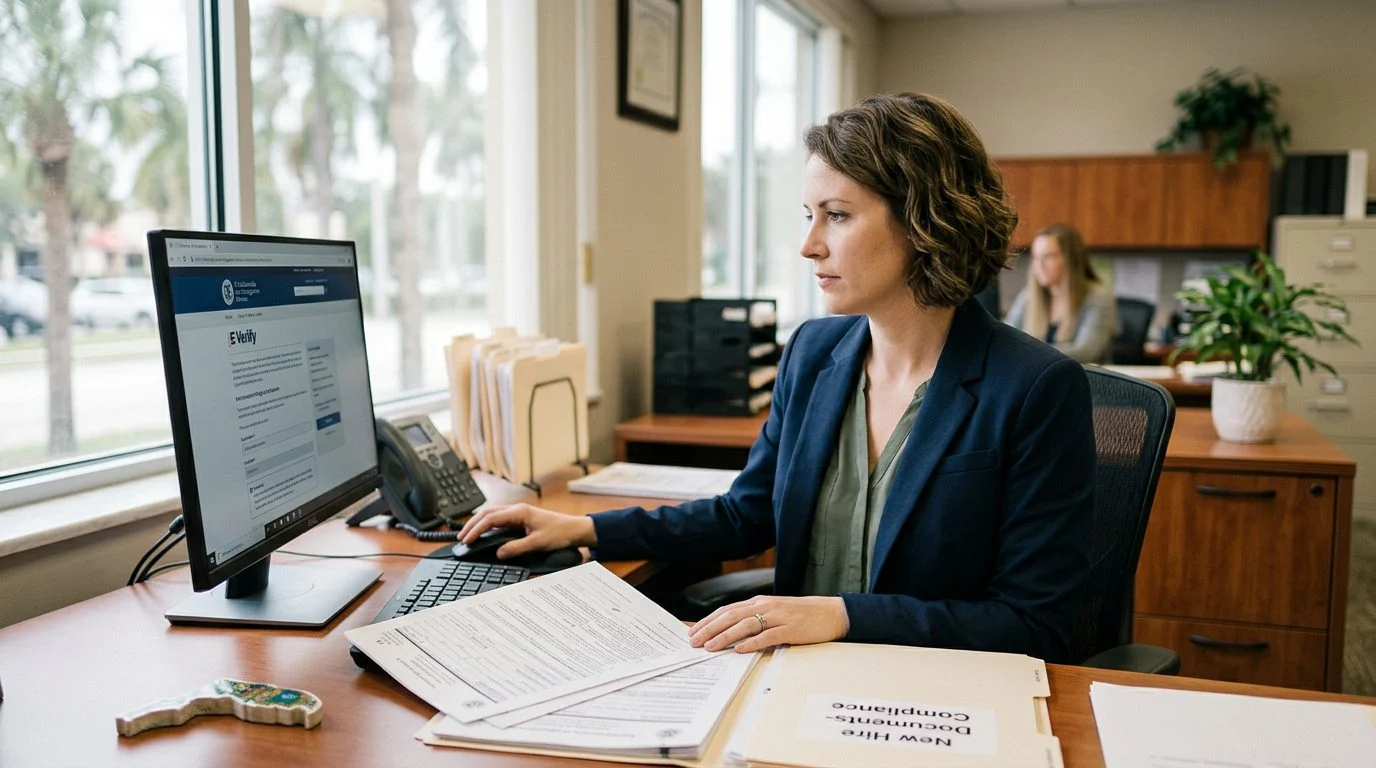
Yes. Under Florida law, an employer must verify each new employee’s employment eligibility within 3 business days after the first day that the new employee begins working for pay, as required under 8 C.F.R. s. 274a. Under § 448.095(2)(a), an employer must verify each new employee’s employment eligibility within 3 business days after the first day that the new employee begins working for pay. If the E-Verify system is unavailable for 3 business days after the first day that the new employee begins working for pay and the employer cannot access the system, the employer must use the Employment Eligibility Verification form (Form I-9) instead. The E-Verify requirements do not apply in any federal fiscal year in which the system is not funded by the Federal Government (Fla. Stat. § 448.095). The check is due within 3 business days after the new employee’s first day of paid work. Whether smaller employers are covered depends on the complete current text of § 448.095, which should be checked before relying on any exclusion. Florida law still bars knowingly employing a worker who is not authorized to work (Fla. Stat. § 448.09(1)). For the wider set of hiring, pay, discipline, and termination questions, see our Florida employer hiring guide.
How the 25-Employee Threshold Works
The mandate reaches a private employer that has 25 or more employees, so your headcount decides whether the duty applies. Start by counting the people the statute calls employees. The statute defines an employee as an individual who fills a permanent position and works under the control or direction of an employer that has the power or right to control and direct the employee in the material details of how the work is to be performed, in exchange for salary, wages, or other remuneration (§ 448.095(1)(b)).
Independent contractors, as defined in federal laws or regulations, hired to perform a specified portion of labor or services don’t count as employees. The statute excludes an independent contractor hired to perform a specified portion of the work. Mixed crews of staff and contractors can make the count tricky. When your number sits near 25, the answer depends on the facts.
Public agencies and their contractors have a separate duty. The statute requires public agency contracts to require E-Verify use by the contractor and its subcontractors (§ 448.095(5)(a)). Fla. Stat. § 448.095 reads: “A public agency or a contractor or subcontractor thereof may not enter into a contract unless each party to the contract registers with and uses the E-Verify system.”
What Counts as a New Hire
The duty attaches to new employees, not to everyone already on your payroll. The requirement applies to each new employee who begins working for pay, and the complete current statute should be checked to confirm which employers are covered. Check each file against that date when you review your records.
The clock starts on the first day the new employee works for pay, not on the offer date. Picture a shop that hires two people in the same week. Each hire gets its own deadline and its own record.
Use the start date as your reference point. It tells you which personnel files need an E-Verify record and when the check was due.
Deadlines and Documenting Compliance
Verify each new employee within 3 business days after the first day that person works for pay (§ 448.095(2)(a)).
If E-Verify is unavailable for 3 business days after that first day, and you cannot access the system, use Form I-9 instead (§ 448.095(2)(c)). You must also document the outage. The statute accepts:
- a screenshot from each day showing you could not access the system,
- a public announcement that E-Verify was not available, or
- any other recorded notice or communication about the outage.
Keep your proof in the same employee file as the Form I-9. For each hire, use a simple checklist: headcount, hire date, verification date, and where the proof is filed.
Related Florida Employer Questions to Review Together
Hiring checks sit beside other employer duties. Once an employer knows a person is an unauthorized alien, it may not keep employing that person (§ 448.095(2)(e)).
Under § 448.09, a violation brings a 1-year probation with quarterly reports to the Department of Commerce. A violation within 24 months of a previous one can lead to suspension or revocation of licenses.
The EEOC’s employer guidance covers those duties. The statute also requires enforcement without regard to race, color, or national origin (§ 448.095(7)(a)).
Quick Answers
Does Florida require E-Verify for every employer?
The section also requires public agencies to require in any contract that contractors and subcontractors register with and use the E-Verify system to verify the work authorization status of all new employees.
When did the requirement start?
The complete current text of the statute should be checked for the date the requirement took effect for covered private employers.
How soon must E-Verify be completed?
Within 3 business days after the new employee’s first day of paid work.
What if E-Verify is down?
Use Form I-9 and keep a record of the outage.
Not sure what your next step is?
Talk it through with our team — the first consultation is free, confidential, and carries no obligation.

Talk With KEW Legal About Your Headcount and Hiring Plans
If your next hire could push you past 25 employees, or you’re already close to that line, reach out to KEW Legal. We can review how the rule applies to your workforce and your hiring plans.
KEW Legal is a Florida business law firm with offices in Coral Gables and Sunny Isles Beach. We work with business owners across Miami-Dade and South Florida. The first consultation is free, confidential, and carries no obligation to continue.
Call 305-990-2300 or send us a message. Kristina E. Wilson is the responsible lawyer for this page.
How KEW Legal Supports Employers
Practical Hiring Review
We help you map out how new hires are verified, documented and kept on file so your process is consistent from one hire to the next.
Employer-Focused Counsel
Our team advises business owners and managers on employment questions that arise during hiring, staffing changes and day-to-day operations.
Contracts That Carry the Obligation
We review vendor and staffing agreements so responsibilities for verification are clearly assigned between your business and its partners.
Confidential Conversations
Every first consultation is confidential and comes with no obligation to continue, so you can discuss your situation openly.
Handle Verification Carefully
Verification errors can create exposure for an employer. Review your hiring documentation process with counsel rather than relying on a checklist alone.
Key Areas Employers Ask Us About
Hiring Workflow
Questions about when and how verification fits into your onboarding process, and how to keep that process consistent across your team.
Recordkeeping
Guidance on organizing and retaining hiring records so your documentation is complete and easy to review.
Vendor and Staffing Agreements
Contract language that allocates verification duties between your business and the staffing firms or contractors you use.
Employee Concerns
Advice on handling employee questions or disputes that come up during verification, with attention to fairness and documentation.
Talk With KEW Legal Before You Hire
Related practice areas
Request a Consultation
Fill out the short form and we will take it from there.