

Employment Law for Employers | Coral Gables and Sunny Isles Beach
Counsel for Florida Employers With Remote Staff
Remote work can raise questions about where your people are, what policies apply, and how to act when a problem starts. Here is how our team helps you plan ahead.
By Kristina E. Wilson · Published November 17, 2026
Owners looking for a remote employee attorney Florida employer can rely on need clear answers first. Remote work raises questions about pay records, final pay, workplace policies, and separation decisions. If you run a business in Florida and need a business law firm, KEW Legal has offices in Coral Gables and Sunny Isles Beach. The firm acts as outside general counsel and represents the employer. Kristina E. Wilson is the responsible lawyer for this page.
What Remote Employee Legal Issues Involve for Florida Employers
Remote employee legal issues are the pay, policy, and employment questions that come up when staff don’t work in your office. A home office has no front desk and no time clock. That gap is where many problems start.
This service is for owners, managers, and HR leaders of businesses in Miami-Dade, Broward, and nearby areas who have remote staff. KEW Legal works for the employer, not the employee. You can bring the firm in for a single question, or keep it on as outside general counsel for contracts, leases, partnerships, and staffing decisions.
Owners who review remote terms early have more time to close gaps before a dispute begins. A policy written for an office may not fit a laptop at a kitchen table.
If a remote employee has raised a pay concern or threatened a claim, our team can walk you through the next steps before you respond. Talk it through with our team — the first consultation is free, confidential, and carries no obligation.
Remote Employee Issues KEW Legal Handles
KEW Legal advises employers on pay, separation, policy, and threatened-claim questions for remote staff. Common matters include:
- Remote pay and timekeeping: how hours are tracked and recorded when there is no office clock-in.
- Final pay and accrued vacation: what is owed at separation, checked against your written policies and the facts.
- Pay discussion and social media rules: policies that match what you can lawfully require.
- Threatened lawsuits: the first written response to a remote employee who threatens to sue.
- Agreements and handbooks: remote work terms, confidentiality, and equipment policies.
- Termination decisions: documentation and written notices for remote staff.
Florida’s minimum wage has a set schedule. The Florida Constitution sets it at $15.00 per hour on September 30, 2026 (Florida Constitution, art. X, § 24). Under the Florida minimum wage statute, the Department of Commerce calculates each inflation adjustment on September 30, and each adjusted rate takes effect the following January 1 (Florida minimum wage statute). Later inflation adjustments take effect each January 1 (Florida minimum wage statute). Before bringing a claim for unpaid minimum wages, the employee must first give the employer written notice of the intent to sue, and the employer has 15 calendar days after receiving that notice to pay the total amount of unpaid wages or otherwise resolve the claim. If the employer does not, and the employee prevails, the employee can recover unpaid back wages, liquidated damages in the same amount (extra money on top), and attorney’s fees and costs. If the employer proves good faith and reasonable grounds for believing its act was lawful, the court may, in its sound discretion, award no liquidated damages or an amount not to exceed the unpaid minimum wages (Florida Constitution, art. X, § 24).
When Employees Work Outside Florida
An employee’s primary place of work can decide whether a Florida rule applies, and the answer depends on the facts of each setup. Florida’s covered noncompete statute applies to an employee who maintains a primary place of work in Florida, and to a covered noncompete agreement with an employer whose principal place of business is in Florida and which agreement is expressly governed by Florida law. The section applies to a covered noncompete agreement with a covered employee who maintains a primary place of work in Florida, regardless of any applicable choice of law provisions (Fla. Stat. § 542.45). The statute can apply in two ways: when the covered employee maintains a primary place of work in Florida, regardless of any choice-of-law provision, or when your principal place of business as the covered employer is in Florida and the agreement is expressly governed by Florida law.
When a remote hire lives and works outside Florida, we review these points first:
- where the employee lives and works day to day
- where the business is based and where pay is run
- what the written agreements say about work location and governing law
A business with staff in several states should set these terms before a dispute starts. Changing terms during a disagreement is harder than setting them early.
Policies and Agreements That Reduce Remote Work Risk
Clear written remote terms that match real practice reduce disputes about hours, pay, equipment, and confidential information. Start with four areas.
- Remote work policy: expected hours and availability, how work time is recorded, expense reimbursement, and equipment return.
- Remote work agreement: work location, pay terms, and what the employer and employee owe each other.
- Confidentiality and property terms: data security, company files, and equipment kept at home.
- Restrictive covenants: a court will not enforce a restrictive covenant unless it is in a writing signed by the person against whom enforcement is sought (Fla. Stat. § 542.335). If a restraint is overbroad, a court modifies it to what is reasonably necessary.
Handbooks need the same care. Under Florida law, policy statements in a handbook do not create enforceable contract rights unless the manual uses specific language showing the parties agreed it is a separate employment contract (Quaker Oats Co. v. Jewell). Review the handbook each time remote practices change.
How the Process Works, Step by Step
The process starts with a call, moves to a document review, and ends with a plan you approve before anything changes. Here is the path.
- Initial call: Describe the situation, the employee’s work location, and any letter, demand, or deadline you’ve received.
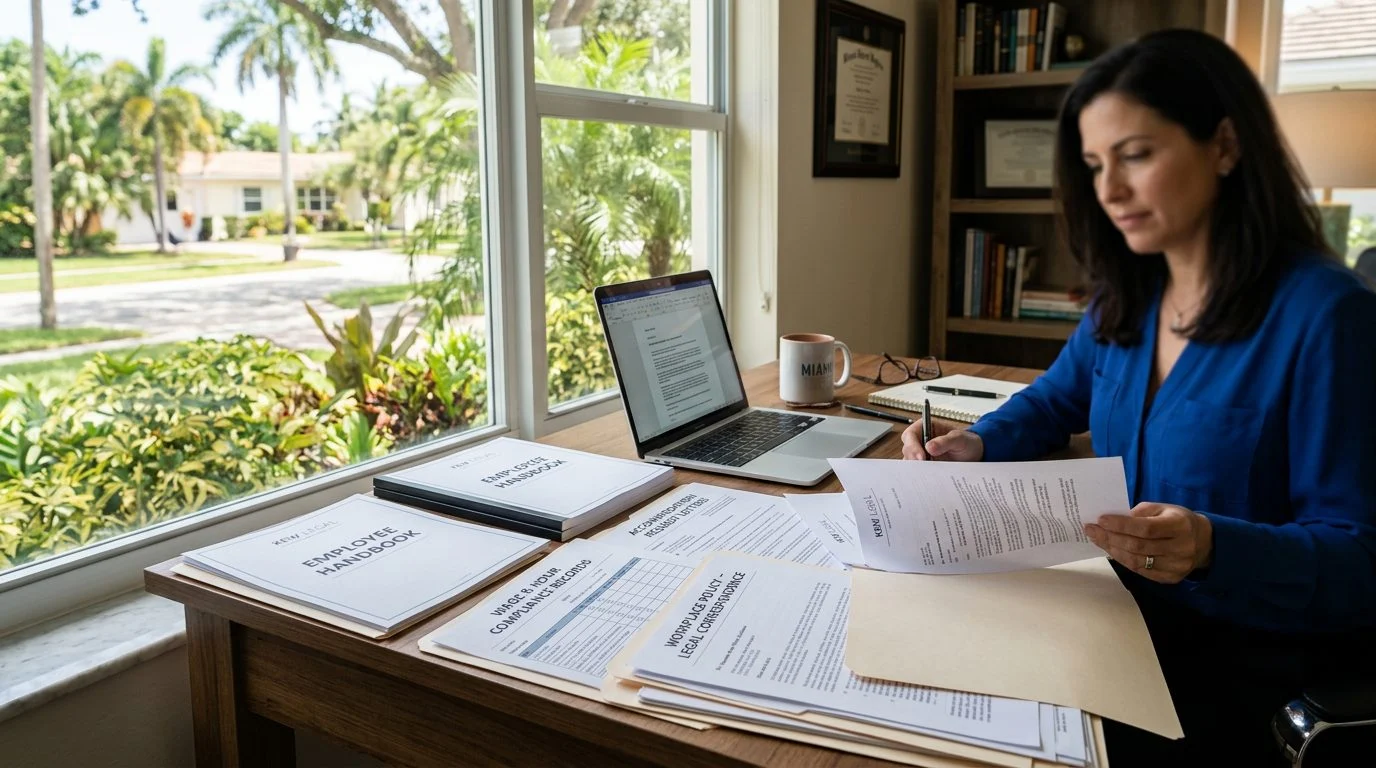
- Document review: We review employment agreements, remote work terms, pay and timekeeping records, handbooks, and any written complaint.
- Written assessment: We explain your options and the risks on each path.
- Agreed action: This may be a response letter, a policy update, a payment correction, or talks with the employee’s representative.
- Ongoing counsel: If you want a standing advisor for future staffing decisions, the firm can stay on as outside general counsel.
Dates matter. An employee who claims retaliation under Florida’s whistle-blower law may sue within 2 years after discovering the action or within 4 years after it was taken, whichever is earlier (Fla. Stat. § 448.103). Under Fla. Stat. § 448.103(1)(c), an employee may not recover in any action if he or she failed to notify the employer about the illegal activity, policy, or practice as required by s. 448.102(1), or if the adverse action was based on a reason other than the employee’s exercise of a right protected by the act. A whistleblower claim also depends on the statute’s own conditions, including the employee’s notice to the employer under § 448.102(1).
Florida is an employment-at-will state. An at-will employee can be let go at any time, but not for a reason the law prohibits, such as retaliation or unlawful discrimination (Laguerre v. Palm Beach Newspapers, Inc.). Timing is set after the document review.
Why Employers Work with KEW Legal on Remote Staffing Issues
KEW Legal is a Florida business law firm offering remote employee attorney Florida employer services from offices in Coral Gables and Sunny Isles Beach. It serves Miami-Dade and South Florida.
- Responsible lawyer for this page: Kristina E. Wilson.
- Another lawyer at the firm: Natalie Martinez.
- Focus: Our lawyers focus on business and employment matters for employers.
The outside general counsel model lets one firm review your contracts, leases, partnerships, and staffing questions together. You don’t have to start over with a new firm for each issue. Our team reviews the documents you share, explains the options and risks in plain terms, and keeps you informed at each step.
Not sure what your next step is?
Talk it through with our team — the first consultation is free, confidential, and carries no obligation.
Frequently Asked Questions About Remote Employee Legal Issues
Short answers to the most common remote staffing questions are below.
Do I need a lawyer if an employee works from home in another state?
Ask before a problem starts. Where the employee lives and works can affect which rules apply, so review the facts first.
Can I update my remote work policy now?
Policy changes should be reviewed for how they affect current staff and how written notice is given. Review the change before you roll it out.
What should I do if a remote employee threatens to sue?
Don’t ignore it. Save the records and call before you respond in writing.
Is final pay different for remote staff?
Location and pay facts both matter. We review your records and policies before you pay or respond.
Can I hire a remote employee attorney Florida employer for a single question?
Yes. Matters can be a single question or ongoing outside general counsel work.
Talk With KEW Legal About Your Remote Staff Questions
If a remote employee has raised a pay concern, threatened a claim, or left, you can talk through your options before you respond. Those are the moments when an early call gives you more time to decide.
Call 305-990-2300 or send us a message to schedule a consultation at our Coral Gables or Sunny Isles Beach office. The first consultation is free, confidential, and carries no obligation to continue. Bring your agreements, pay records, and any letter you received. The firm reviews what you share and reports back on your options and next steps.
How KEW Legal Supports Remote Employers
Remote Work Policies
We review or draft written remote work policies so your expectations, equipment rules and reporting standards are clear and consistent.
Out-of-State and Cross-Border Staff
We look at where an employee lives and works, since those facts can change which rules may apply before you make a decision.
Employee Issues
We advise on performance concerns, discipline, scheduling disputes and separations involving remote team members.
Outside General Counsel
Our team can serve as an ongoing point of contact for everyday employment questions, so you are not starting from scratch each time.
Review Before You Roll Out Changes
A new or updated remote work policy can affect current employees in ways that are easy to overlook. Review the change with counsel before you announce it, and plan how written notice will be given.
Common Questions Remote Employers Ask
Do I need a lawyer if an employee works from home in another state?
Ask before a problem starts. Where the employee lives and works can affect which rules apply, so review the facts first.
Can I update my remote work policy now?
Policy changes should be reviewed for how they affect current staff and how written notice is given. Review the change before you roll it out.
What if a remote employee raises a concern?
Document the facts, avoid hasty decisions, and talk with counsel about how to respond in a way that protects your business.
Talk With KEW Legal About Your Remote Team. The First Consultation Is Free, Confidential and Without Obligation to Continue.
Related practice areas
Request a Consultation
Fill out the short form and we will take it from there.