
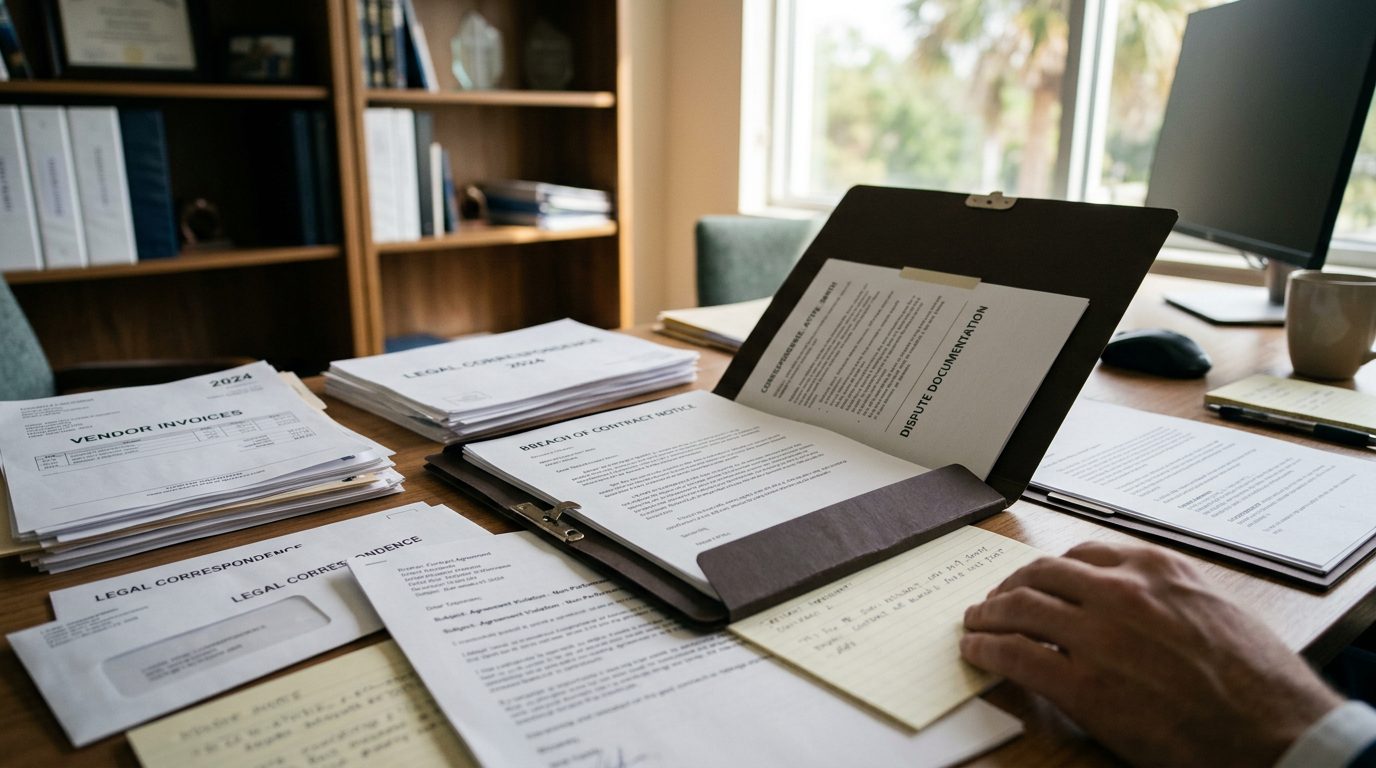
Florida Business Contracts | Coral Gables & Sunny Isles Beach
Is Your Business Contract Void?
A plain-language guide from KEW Legal to the issues that can make a contract unenforceable, and how to review your own agreement with our business law attorneys.
By Kristina E. Wilson · Published October 20, 2026
Whether any of them applies depends on the facts and the documents.
This guide explains each ground in plain language. It is general information, not a conclusion about any contract you signed or are reviewing. These issues often arise in partnership and vendor disputes.
What the question usually means: void versus voidable
Many search results treat these two words as if they mean the same thing. They don’t.
A voidable agreement stays in place until the party with the right to challenge it acts. If that party never acts, the contract can end up binding anyway. That is why timing matters.
The six grounds below are a general framework. They help you ask the right questions. They do not decide whether any particular agreement is void, voidable, or enforceable.
If a contract you're questioning is affecting your business, you don't have to sort out the grounds alone. Reach out to KEW Legal to talk through your agreement and your options. Talk it through with our team — the first consultation is free, confidential, and carries no obligation.
1. Illegal purpose or subject matter
A contract with one illegal term is different.
Business owners sometimes sign agreements with side arrangements that break the law. Read every attachment, rider, and side letter with that in mind. One side term can put the whole deal at risk.
2. No meeting of the minds: missing offer, acceptance, or essential terms
A contract needs an offer, an acceptance, consideration, and enough detail on the essential terms. The Florida Supreme Court applies these basic requirements even to oral contracts, as stated in St. Joe Corp. v. McIver.
When a key term is too vague to enforce, the fight often becomes whether the parties ever agreed on it.
Sales of goods follow a more flexible code. A contract does not fail just because some terms are left open, if the parties meant to contract and there is a reasonably certain basis for a remedy, under § 672.204.
Counteroffers, revised drafts, and unsigned changes cause the most common disputes. Each side may believe a deal closed on different terms. Keep every draft and message, because the sequence often decides whether an agreement was formed. Under § 672.207, a definite and seasonable acceptance operates as an acceptance even when it adds different terms, unless the acceptance is expressly conditional on assent to the additional or different terms.
3. Lack of legal capacity
Under § 743.07, the disability of nonage is removed for all persons in this state who are 18 years of age or older, and they shall enjoy and suffer the rights, privileges, and obligations of all persons 21 years of age or older, except as otherwise excluded by the State Constitution immediately preceding the effective date of this section and except as otherwise provided in the Beverage Law.
Those questions depend on evidence, and they are rarely settled quickly.
Authority is a related issue. If someone signs for a company, partnership, or LLC, a dispute can arise over whether that person had power to bind the entity. Check who signed, in what role, and what the entity’s governing documents allowed.
4. Fraud, duress, or undue influence
A false statement about revenue, liens, or the condition of a business can matter.
Both depend heavily on the facts.
Timing is the key trap. Under Flaherty v. Flaherty, a party may in some circumstances be found to have ratified a voidable contract when, after learning the facts that could support rescission, that party does not act to rescind it, and the outcome depends on the specific facts involved. Save every message and payment record from that period.
5. Mistake that goes to the heart of the deal
A mistake usually undoes a contract only when both sides share it and it concerns a basic fact the deal depends on.
The Fourth District explained in Waterside at Boynton Homeowners’ Ass’n v. Southern Homes of Palm Beach, LLC that rescission for mutual mistake is available only if the mistake is mutual and the fact is of the essence of the contract. A mistake about a side detail, or an error made by one party alone, generally will not support that remedy.
As a Florida appellate court has explained, the term ‘mutual mistake of fact’ is one of law, and the equitable remedy of rescission is available only if the mistake is mutual and the fact is of the essence of the contract (Waterside at Boynton Homeowners’ Ass’n v. Southern Homes of Palm Beach, LLC).
A small typo in a term rarely undoes a whole deal. A wrong belief about what is being sold can matter far more. Whether a mistake counts depends on the facts and on which party carried the risk of being wrong.
Not sure what your next step is?
Talk it through with our team — the first consultation is free, confidential, and carries no obligation.
6. Missing consideration or a required writing
A promise generally needs something of value exchanged for it. Some agreements also must be in a signed writing to be enforced.
Florida’s statute of frauds, under § 725.01, bars enforcement of certain agreements unless they are in writing and signed by the party to be charged, or by someone lawfully authorized. Fla. Stat. § 725.01 reads: “unless the agreement or promise upon which such action shall be brought, or some note or memorandum thereof shall be in writing and signed by the party to be charged therewith or by some other person by her or him thereunto lawfully authorized.” The listed categories include agreements not to be performed within one year, contracts for the sale of lands, and leases for longer than one year. Fla. Stat. § 725.01 reads: “unless the agreement or promise upon which such action shall be brought, or some note or memorandum thereof shall be in writing and signed by the party to be charged therewith or by some other person by her or him thereunto lawfully authorized.”
The Florida Supreme Court said so in DK Arena, Inc. v. EB Acquisitions I, LLC.
For sales of goods priced at $500 or more, § 672.201 requires a record sufficient to show a contract was made, signed by the party against whom enforcement is sought or by that party’s authorized agent or broker, with limited exceptions. An electronic signature has the same force as a written one under § 668.004, unless otherwise provided by law.
Why the facts decide the answer, and what to gather now
Time limits also matter. Florida’s limitations statute, § 95.11, sets deadlines for bringing claims. A contract clause that shortens those deadlines is void under § 95.03.
Courts can also refuse to enforce an unconscionable term. Under Basulto v. Hialeah Automotive, a court weighs both procedural unfairness in how the deal was made and substantive unfairness in its terms.
Start gathering the signed documents and every draft. Add emails and texts about the terms, payment records, and a dated timeline of key events. A Pinellas County vendor services agreement shows how conditions can work. It sets a 10-day deadline to meet security and insurance conditions and says the agreement becomes null and void if they are not met.
For broader context, read our Florida contract and vendor disputes guide and what voids a contract in Florida. KEW Legal also handles these matters through its business contract and vendor dispute attorney page.
Frequently asked questions
The outcome depends on the facts and on how quickly the injured party acts.
Does a contract need to be in writing?
Some must be, such as certain agreements under the statute of frauds. Many contracts are formed without a signed writing, but enforcing them can still depend on the facts.

Talk with KEW Legal about your agreement
If a contract you didn’t write is causing trouble, or a partner or vendor has stopped honoring its terms, you don’t have to sort it out alone. Deadlines and documents can feel overwhelming when a business is at stake.
KEW Legal is a Florida business law firm with offices in Coral Gables and Sunny Isles Beach. Kristina E. Wilson is the responsible lawyer for this page. Our team can review the facts of your situation with you. The first consultation is free, confidential, and comes with no obligation to continue.
Call 305-990-2300 or send a message through our contact page.
Six Grounds at a Glance
Lack of Capacity
Whether this applies depends on the facts.
Illegal Purpose
The purpose and terms of the deal matter.
Lack of Mutual Assent
Agreement requires a meeting of the minds on the essential terms. Confusion or mismatched understandings can raise questions.
Lack of Consideration
Enforceable contracts generally involve something of value exchanged between the parties. How this is documented can affect the analysis.
Fraud or Misrepresentation
Materially false statements made to induce a deal can affect whether the agreement holds up. The specific statements and context are key.
Duress or Undue Influence
Agreements signed under improper pressure or control may be challenged. Each situation turns on its own facts.
A Guide Is Not a Review of Your Contract
Whether any of these grounds applies depends on your specific documents, the parties' conduct and the surrounding facts. Reading general information does not replace a review of your agreement.
What to Gather Before Your Consultation
The Written Agreement
Bring every version of the contract, including drafts, amendments, exhibits and signature pages.
Related Communications
Emails, texts and letters about the negotiations, promises or terms can be important context.
Parties and Signers
Note who signed, on whose behalf, and whether any other owners, partners or investors were involved.
Performance History
Records of payments, deliveries, work performed and any disputes that have arisen so far.
Questions About a Contract? Start With a Free, Confidential Consultation. Call 305-990-2300.
Related practice areas
Request a Consultation
Fill out the short form and we will take it from there.