
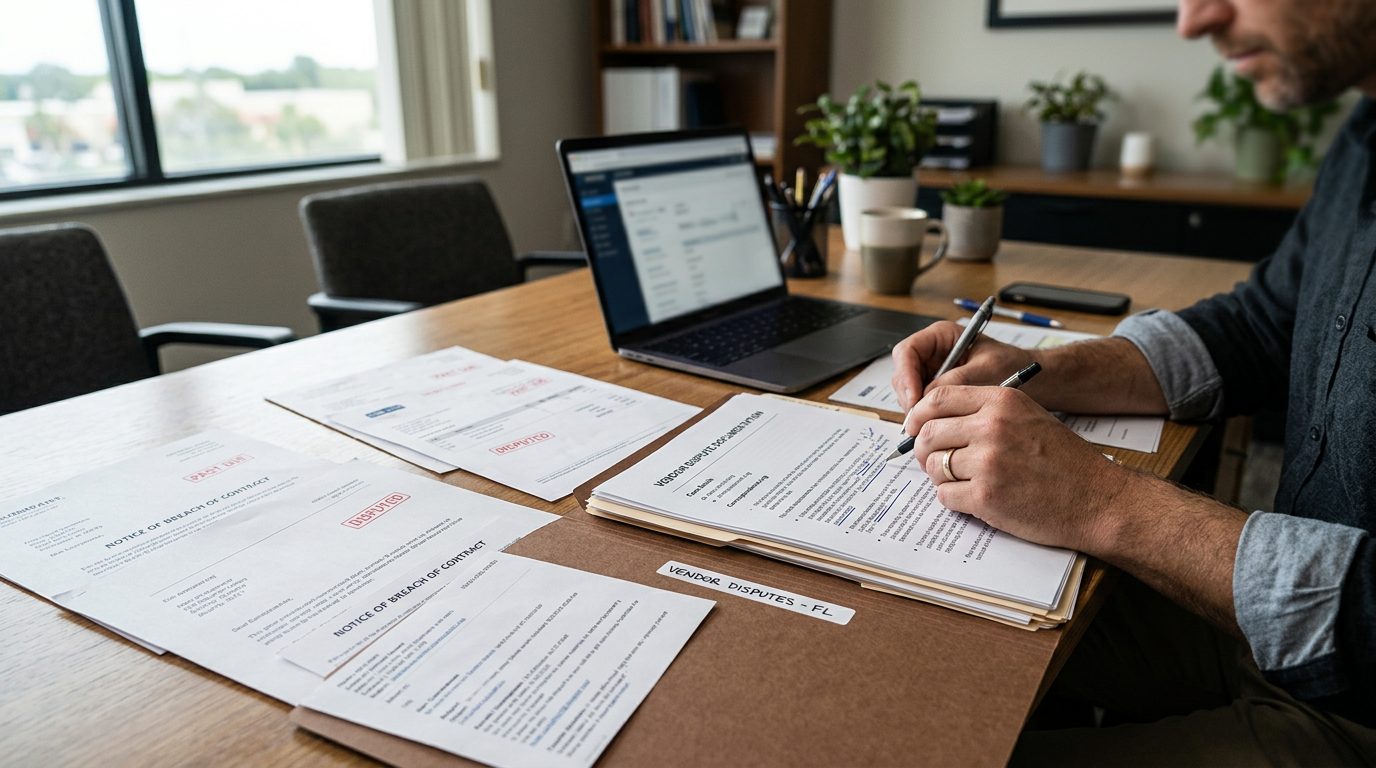
Vendor Disputes | Coral Gables and Sunny Isles Beach
Vendor Trouble? Start with the Contract in Hand.
KEW Legal works with business owners across Miami-Dade and South Florida on late deliveries, defective work and unpaid invoices, one documented step at a time.
By Kristina E. Wilson · Published October 15, 2026
How do you handle vendor disputes? Start by reading your contract and gathering every record of the deal. Then send written notice, try to settle, and move to mediation or court only if you have to. Each step has Florida rules that can help or hurt your position, so check them early.
This guide walks through that process for business owners and managers in Miami-Dade, Broward, and South Florida. It is general information, not advice about your specific contract. If a vendor missed deliveries, sent defective work, overbilled, or went silent on a deal, the steps below show what usually comes next.
What Counts as a Vendor Dispute?
A vendor dispute is a disagreement between your business and a supplier or service provider about how the deal was carried out. Common examples include late or missing deliveries, defective goods or poor work, scope creep, disputed change orders, invoice errors, and unpaid bills.
Most of these disputes come down to two things: what the agreement says, and what each side actually did. A clause that looks clear on paper can mean different things once the work starts. That is why you should not decide who is right from one email or one clause.
Florida’s sale-of-goods rules appear in the Florida Statutes, and Fla. Stat. § 672.102 provides that this chapter applies to transactions in goods. In a hybrid transaction, Fla. Stat. § 672.102 states that if the sale-of-goods aspects do not predominate, only the provisions that relate primarily to those aspects apply. Check the type of deal early.
If a vendor has missed deliveries, sent defective work, or is holding your payments, you do not have to sort out the contract alone. We can talk through your options. Talk it through with our team — the first consultation is free, confidential, and carries no obligation.

Start by Reviewing the Contract and Your Records
Start by pulling every document about the deal, then build a timeline. Gather the signed agreement, purchase orders, statements of work, invoices, delivery receipts, emails, texts, and payment records. A missing document can weaken a claim, so search your email and phone for the vendor’s name.
Next, read the contract with a checklist in hand. Look at the scope of work, delivery and performance standards, payment terms, warranty language, and any clause about notice or disputes. Note the dates each clause sets, since many deadlines run from them.
Then write a simple timeline. List what was promised, what happened, and when each side was told. Keep it factual. Note who said what, and whether the vendor ever agreed in writing to fix the problem.
Electronic signatures count too. Under Fla. Stat. § 668.004, an electronic signature may be used to sign a writing and has the same force and effect as a written signature, unless another law says otherwise.
When the Contract Itself May Be the Problem
Sometimes the first question is whether the contract can be enforced at all. Under Fla. Stat. § 672.201, a contract for goods priced at $500 or more generally is not enforceable unless there is a signed record showing a sale was made, although the statute recognizes several exceptions.
Between merchants, a written confirmation can count against the person who receives it. That person must object in writing within 10 days after receiving it, or the confirmation can satisfy the record rule. Mark that date on your calendar as soon as a confirmation arrives.
Other problems include missing essential terms, a missing signature, or someone signing without authority to do so. These questions turn on the document and the surrounding facts. One clause rarely settles them, so don’t assume either way from a single sentence.
Send Written Notice and Follow the Contract’s Process
Send written notice as soon as you spot the problem, using the method your contract names. Written notice creates a record and tells the vendor exactly what you expect.
Under Fla. Stat. § 672.607, a buyer who has accepted goods must notify the seller of a breach within a reasonable time after the buyer discovers or should have discovered the breach. Otherwise, the buyer can be barred from any remedy. The buyer also carries the burden of proving a breach in goods already accepted.
A solid notice usually names the agreement, describes the specific failure, states the fix you want, and sets a deadline. Keep the tone plain. Avoid admissions, insults, and threats you can’t back up, because those words can surface later.
Some contracts require notice to a named person or address, plus a cure period, before either side may end the deal or sue. If yours does, follow those steps exactly. Missing one can cost you a right you did not know you had.
Negotiation, Escalation, and Settlement Options
Direct talks followed by a written proposal are the usual first step. Start with a call or meeting, then put your offer in writing so both sides see the same terms.
Common options include a credit, a replacement or repair, a payment plan, a corrective action plan with dates, or a partial refund. Choose the option that fixes the business problem, not just the paperwork.
Some agreements include an escalation clause that requires executives from each side to meet before anyone takes further action. If your contract has one, follow it and keep a record of the meeting.
Any settlement should be in writing. It should say what each side gives up, what gets paid and by when, and whether the release of claims covers every issue or only some. A vague “we’re good” email leaves room for the dispute to return.
Mediation, Arbitration, and Court: How Formal Resolution Works
If talks fail, the dispute clause in your contract often decides the next step. The three main paths are mediation, arbitration, and a lawsuit.
In mediation, a neutral helps both sides negotiate, but the neutral does not decide the case. Florida’s confidentiality rules for mediation are popularly called the Mediation Confidentiality and Privilege Act, found in Fla. Stat. § 44.401.
Mediation can also be ordered by a court. Under Fla. Stat. § 44.102, a court must, on one party’s request, refer a filed civil action for monetary damages to mediation, provided the requesting party is willing and able to pay the costs or the costs can be equitably divided, unless an exception applies, such as an action to collect a debt, an action governed by the Florida Small Claims Rules, or a case the parties have agreed to resolve by binding arbitration.
Arbitration works differently. Under Fla. Stat. § 682.02, a written agreement to arbitrate is generally valid and enforceable. The court, not the arbitrator, decides whether that agreement exists. When one side asks the court to compel arbitration, the court must stay the court case on that claim, under Fla. Stat. § 682.03.
For a lawsuit, Fla. Stat. § 47.011 says actions go in the county where the defendant resides, where the cause of action accrued, or where the property in litigation is located. That section does not apply to actions against nonresidents.
Written settlement offers have their own rules.
Not sure what your next step is?
Talk it through with our team — the first consultation is free, confidential, and carries no obligation.
Florida Time Limits for Contract Claims
Florida sets a deadline, called a statute of limitations, for filing a contract claim. The periods for different types of claims are set in Fla. Stat. § 95.11. Don’t guess which period applies to you, because the type of agreement and the facts both matter.
The clock generally starts when the cause of action accrues. Under Fla. Stat. § 95.031, a cause of action accrues when the last element constituting it occurs. A late delivery, a defect found months later, and an unpaid invoice can each start the clock at a different time.
A contract clause that tries to shorten the time to sue is void, and Florida applies the same rule to contracts for the sale of goods, because Florida never adopted the UCC’s separate limitation section for sales of goods, so those claims are governed by the limitation periods in Fla. Stat. § 95.11. Under Fla. Stat. § 95.03, a contract provision that sets a period shorter than the applicable statute of limitations is void. A short filing window written into a vendor contract does not automatically control.
Delay also hurts. Waiting to send notice or to check the calendar can reduce your options, even when a claim is still alive. Check deadlines early, write them down, and don’t assume time is on your side. This page does not determine the deadline for any particular claim.

How KEW Legal Handles Vendor Disputes
KEW Legal is a Florida business law firm with offices in Coral Gables and Sunny Isles Beach. The firm acts as outside general counsel for business owners and investors across Miami-Dade and South Florida, including the business contract and vendor dispute work it covers on its practice pages.
Our team reviews the contract and records, explains notice and resolution options, and handles negotiation, mediation, and litigation as each matter requires. No outcome can be promised, because each dispute turns on its own contract and facts. Kristina E. Wilson is the responsible lawyer for this page, and the Coral Gables office is the firm’s point of contact for it. A matter may be referred to another lawyer or firm where appropriate.
If a vendor’s missed deliveries or unpaid invoices have you stuck, you do not have to work out the contract on your own. Call 305-990-2300 or visit the contact page to begin a free, confidential first consultation with no obligation to continue.
Frequently Asked Questions
What should I do first when a vendor misses deliveries?
Gather the contract, purchase orders, and delivery records, then send written notice the way your contract requires.
Can I withhold payment from a vendor who delivered defective work?
Possibly, but the answer depends on the contract, the notice you gave, and whether you accepted the goods. Check the contract before you withhold payment.
Is an oral agreement with a supplier enforceable in Florida?
It depends on the facts. For goods priced at $500 or more, Florida’s statute of frauds generally requires a signed record.
Do I have to go to court if my vendor contract has an arbitration clause?
Often, a court will order arbitration when a party asks, but the court first decides whether a valid agreement exists.
How do you handle vendor disputes when the contract has no notice clause?
Send a clear written notice anyway, and keep proof of when and how you sent it.
Four steps to organize a vendor dispute
Gather the paperwork
Pull the contract, purchase orders, invoices, delivery records and every message with the vendor so the timeline is clear.
Check the notice clause
Many contracts require written notice in a specific form and to a specific address. Review that language before you withhold payment or cancel an order.
Put your position in writing
A clear written demand that describes the problem, the contract term involved and the response you expect creates a record for every later step.
Plan the next step
Depending on the facts, the path may be negotiation, mediation or a formal claim. Decide on the approach with counsel before the dispute escalates.
Before you stop paying
Check the terms and the notice requirements first.
Common vendor dispute questions
What should I do first when a vendor misses deliveries?
Collect the contract, purchase orders and delivery records, then send written notice the way your contract requires.
Can I withhold payment for defective work?
Possibly, but the answer depends on the contract, the notice you gave and whether you accepted the goods or services. Each situation turns on its own facts.
Should I keep working with the vendor during a dispute?
That decision affects your rights and your leverage. Review the contract's termination and cure provisions before making changes to the relationship.
When does a demand letter help?
A well-drafted demand letter sets out the facts, the contract terms and what you want done. It often clarifies the dispute and can lead to a resolution without litigation.
Talk through your vendor dispute with KEW Legal. Your first consultation is free, confidential and comes with no obligation to continue.
Related practice areas
Request a Consultation
Fill out the short form and we will take it from there.