
Employment Law for Employers | Coral Gables and Sunny Isles Beach
Florida Employer Duties When a Worker Is Hurt at Your Venue
By Kristina E. Wilson · Published November 23, 2026
If an employee is hurt at one of your venues, the first question is which entity employed that worker. Florida law makes the employer responsible for securing workers’ compensation benefits, so the employing entity is the one that matters. When a contractor sublets work, though, the contractor is also responsible for the subcontractor’s employees on that work unless the subcontractor has secured coverage. Fla. Stat. § 440.10
For a multi-venue operator, that answer is rarely simple. Payroll, coverage and reporting have to line up with the right entity at every location. When they don’t, a gap can surface during a claim, a lender review or a sale.
What This Employer Workers’ Compensation Service Covers
It fits owners who need an employer workers’ compensation attorney in Miami-Dade or Broward County and run more than one entity.
The service includes:
- Review of workers’ compensation coverage for each employing entity
- Incident response steps: medical care, documentation, and preserving witness and video records
- Coordination with your carrier on reporting and claim questions
- Advice when a claim is disputed or a retaliation question comes up
Kristina E. Wilson is responsible for this page. KEW Legal has offices in Coral Gables and Sunny Isles Beach, and the firm’s lawyers include Kristina E. Wilson and Natalie Martinez.
Not sure what your next step is?
Talk it through with our team — the first consultation is free, confidential, and carries no obligation.

Which Entities and Employees Need Coverage Under Florida Law
Each entity that employs people needs coverage that matches its own workers. Florida’s rules turn on who employs the worker and where the work is done.
Every employer covered by Chapter 440 must secure compensation for its employees. An employer with employees working in Florida must also hold a Florida policy that uses Florida class codes, rates and rules. Noncompliance with this requirement is a felony of the second degree under Fla. Stat. § 440.10(1)(g).
A holding company, a management company and a new venue LLC can each employ people. If the policy names one entity but the payroll runs through another, the mismatch can surface when a claim is filed.
Entertainment staffing raises the most common questions.
When a contractor builds out a venue, Florida law requires the contractor to require each subcontractor to show evidence of workers’ compensation insurance. Fla. Stat. § 440.10 What a worker is called in a contract doesn’t settle the question alone. How the work is done matters.
The Florida Office of Insurance Regulation describes employers’ workers’ compensation obligations and the benefits they provide.
Your Duties When an Employee Is Hurt
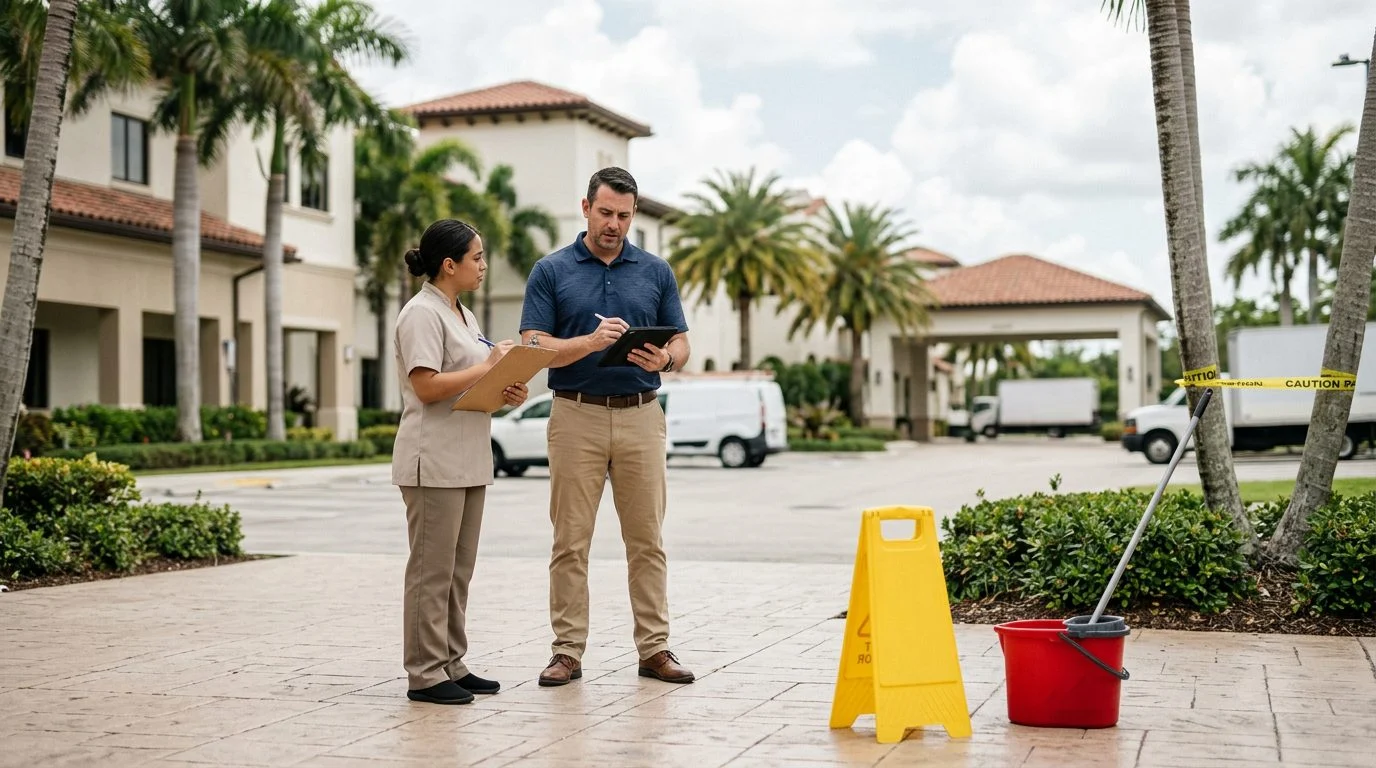
Your first duties are medical care for the worker and an accurate record of what happened. Start both right away, before video and memories change.
Your immediate steps:
- Get the worker medical care
- Write down the time, the location and what happened
- Identify witnesses
- Preserve video, shift schedules and staffing records
Report the injury to your workers’ compensation carrier promptly. Details that differ between locations or entities can cause trouble later, because the carrier and any dispute will compare the records.
Avoid these common missteps:
- Delaying the report
- Discouraging a worker from filing a claim
- Retaliating against the worker
- Speculating to the carrier before the facts are gathered
Florida law bars an employer from discharging, threatening, intimidating or coercing an employee because of a valid claim. Fla. Stat. § 440.205
What to Expect From Report to Resolution
The process moves from the first report to the carrier’s decision, then to medical care and benefits, and finally to resolution. Each stage needs its own records.
- First days after the injury: Document the incident, notify the carrier, and keep internal talk to the facts.
- Claim stage: The carrier accepts, denies or investigates the claim. You supply payroll, job descriptions and incident records.
- Medical and benefit period: You coordinate authorized care, work restrictions and return-to-work options, and track how absences affect staffing.
- Dispute or closure: If the claim is contested or settlement comes up, counsel reviews the record, the carrier’s position and the effect on your other locations.
Timelines vary with each claim, so no single schedule fits every case.
Keeping Employee Claims Separate From Guest Injury Exposure
Workers’ compensation covers injured employees. A guest’s injury usually runs through a different insurance policy under different rules. The Insurance Information Institute explains that this coverage compensates injured workers and protects employers from injury lawsuits.
Florida’s exclusive-liability rule is the key line. The exclusive protection also does not apply when an employer commits an intentional tort that causes the injury or death of the employee, which the employee must prove by clear and convincing evidence. Fla. Stat. § 440.11
The exceptions matter most when coverage is missing. If an employer fails to secure payment, the injured employee may choose to sue instead.
Aligned coverage and records make it easier to see which entity owes what after an incident. Review your insurance declarations and entity documents together, not one at a time.
Hotels and Northeast Expansion: Rules Change by Entity and by State
Each new property and each new state adds its own staffing, entity and coverage questions, so review them before the first hire. Hotels add housekeeping, front desk, maintenance and food service, and each carries its own injury patterns.
Florida’s rules don’t turn on headquarters alone. The separate rules for nonconstruction employers headquartered outside Florida and for construction work done in Florida are in Fla. Stat. § 440.10(1)(g), along with rules for executive supervisors who visit but aren’t in direct charge of a Florida location, for construction contractors’ permanent staff assigned to a Florida job, and for employees hired for a specific project in Florida. Section 440.11 instead addresses the exclusive liability of employers.
Other states run their own systems. Confirm coverage in each state before hiring starts, and confirm which entity employs staff at each new property.
If you use a professional employer organization for staffing, note that a Florida legislative review by OPPAGA addresses potential coverage gaps in those arrangements.
Not sure what your next step is?
Talk it through with our team — the first consultation is free, confidential, and carries no obligation.
Questions Owners Ask Before a Claim Arrives
Most of these questions turn on which entity employs the worker and what the policy covers.
Do I need workers’ compensation for a few part-time employees?
Whether you must carry it turns on your headcount and industry, so bring your staffing facts to KEW Legal before the next hire.
Can I fire someone who files a claim?
Florida law bars firing or coercing an employee for a valid claim. Laguerre v. Palm Beach Newspapers
Does ownership remove the coverage question for a family member or partner?
No. Ownership does not automatically remove the question, so the entity, payroll and role all need review.
Can I handle the report myself?
You have your own reporting duties, and a mistake in timing or detail can complicate the claim.
Does a claim raise insurance rates?
That turns on the carrier, the policy and the claim history, so review the policy before a claim occurs.

Working With KEW Legal on Employer Workers’ Compensation Matters
KEW Legal works as outside general counsel for business owners and investors. Workers’ compensation questions can be handled alongside the contracts, entity structure and property decisions already in motion.
KEW Legal focuses on employment law for employers, business contract and vendor disputes, partnership disputes, commercial leases and business succession across Miami-Dade and Broward County.
The initial consultation is free, confidential, and carries no obligation to continue.
If one of your employees has been hurt at a venue, or you’re about to open a location with new staff, call 305-990-2300 or send us a message to schedule a consultation with Kristina E. Wilson.
How KEW Legal Supports Employers
Employer-Focused Counsel
KEW Legal focuses on business law for owners and investors across Miami-Dade and South Florida, including employment matters that arise at work sites and venues.
Documentation Support
Our team helps you organize incident records, witness information, and workplace policies so your side of the story is clear from the start.
Outside General Counsel
We serve as an ongoing legal resource, so you can bring questions about staffing, safety practices, and claims to a counsel who already knows your business.
Act Promptly and Preserve the Facts
Secure the area, gather facts, and preserve records as soon as an incident occurs. Speak with counsel before making statements about fault or coverage.
First Steps After an Injury at Your Venue
Document the Scene
Photograph the area, note conditions, and collect names and contact details for anyone who saw what happened.
Notify the Right Parties
Inform your insurance carrier and the appropriate internal contacts, and route communications about the incident through one designated person.
Review Before You Respond
Avoid informal admissions, and bring the incident file to KEW Legal so your next communications are measured and accurate.
Our initial consultation is free, confidential, and carries no obligation to continue. Call 305-990-2300 or send us a message to get started.
Related practice areas
Request a Consultation
Fill out the short form and we will take it from there.