
Business Law · Coral Gables and Sunny Isles Beach
Recording a Supervisor's Call in Florida: What Business Owners Need to Know
Secret recordings, workplace conversations and the steps to take when one comes to light, explained by the KEW Legal business law team.
By Kristina E. Wilson · Published November 25, 2026
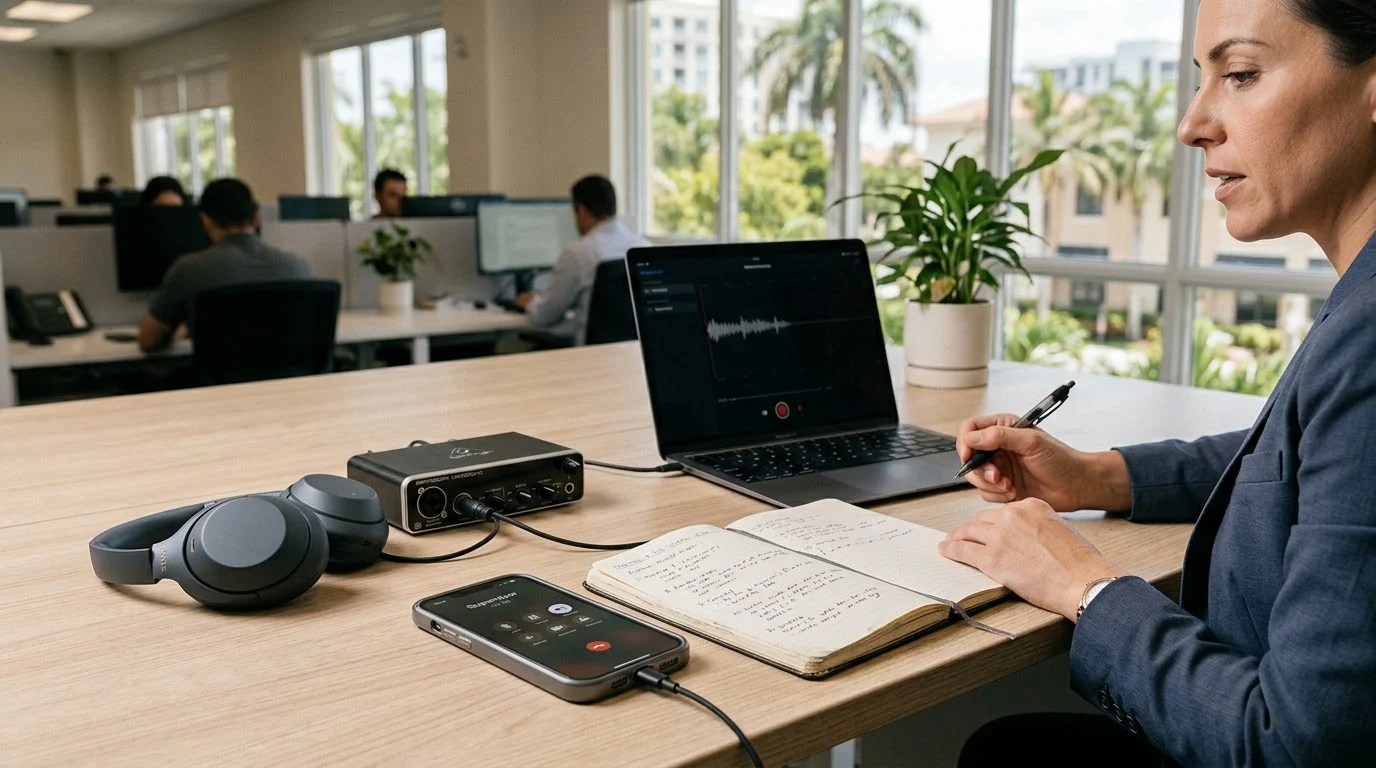
You may have just learned that an employee recorded a call with a supervisor. Or you may be wondering whether you can record calls at your own business. Is it legal for an employee to record a call in Florida? Generally, no.
Florida’s wiretap statute, Fla. Stat. 934.03, bars intentionally intercepting, or trying or getting someone else to intercept, a wire, oral, or electronic communication, except as the chapter otherwise provides. The exception the statute spells out for a party to a communication is written for law enforcement officers gathering evidence of a criminal act.
It is general information, not advice on your specific facts.
Quick Answer: Florida’s Wiretap Rule for Phone Calls
Florida’s wiretap law generally bars anyone from secretly recording a phone call. The statute covers any person who “intentionally intercepts, endeavors to intercept, or procures any other person to intercept” any wire, oral, or electronic communication, except as otherwise provided in the chapter, including when all of the parties to the communication have given prior consent to such interception.
The rule reaches the person who does the recording. It is not limited to the company. An employee who records a supervisor is “any person” under the statute, so the employee’s job does not decide the question.
The statute also covers anyone who procures another person to intercept a call. An employer that asks a worker to make a recording may fall within that language too.
If an employee's recording has you unsure what to do next, our team at KEW Legal can talk through the facts with you before any decision is made. Talk it through with our team — the first consultation is free, confidential, and carries no obligation.

Why a Supervisor’s Phone Call Falls Under the Same Rule
A supervisor’s call is still a phone call. The statute’s wording is general and does not single out managers or employees. A supervisor’s title does not change the analysis.
Imagine a team lead named Ana and her manager, Greg. Greg describes a plan to cut Ana’s hours during a phone call. Ana starts recording without telling him.
Ana took part in the call, but being on the call is not the exception the statute quotes. That exception is written for law enforcement officers collecting evidence of a crime.
The same logic applies to employers. A manager who records a call with an employee faces the same statutory question as the employee does.
In-Person Conversations and Oral Communications
Yes, the statute also covers oral communications, so face-to-face talk can raise the same question. The statute lists wire, oral, and electronic communications side by side. In-person conversations are not left out.
Penalties and Civil Claims for an Unlawful Recording
A person whose communication was unlawfully intercepted can sue. Under Fla. Stat. 934.10, the civil remedies include actual damages of not less than $100 a day for each day of violation or $1,000, whichever is higher.
The same section allows punitive damages and a reasonable attorney’s fee plus litigation costs.
Because the statute reaches anyone who procures an interception, both the employee who recorded and an employer who directed the recording can face these claims.
Can an Employer Use an Unlawfully Made Recording in Discipline?
The statute makes it unlawful to intentionally use the contents of a communication “knowing or having reason to know” it was obtained through an unlawful interception, under Fla. Stat. 934.03.
So an employer should not treat the recording as a shortcut to discipline. How the recording was made, what it contains, and what the employer already knew all shape the risk.
A safer approach is to document the underlying conduct separately. Useful records include performance notes, schedules, emails, and statements from people who saw the conduct firsthand.
Before any discipline, termination, or separation, have the decision reviewed. Make sure the reasons match the records you already have.
Recording Your Own Calls and Workplace Monitoring
An employer that records its own calls with employees or customers is subject to the same statute. The rule is not limited to employees. A recording made without a lawful basis can create the same exposure described above.
Many employers use a greeting at the start of a call or a written notice in a policy. These steps help only if they match what actually happens. A notice saying calls are not recorded, when they are, creates a credibility problem in any later dispute.
Written call and device policies should be checked for consistency with Florida law. They should also match how the business really records and stores calls.
Not sure what your next step is?
Talk it through with our team — the first consultation is free, confidential, and carries no obligation.
Retaliation Risk When the Recorded Call Involved a Complaint
Retaliation is a separate question from the recording. Under Fla. Stat. 448.102, an employer may not take retaliatory action against an employee who objects to, or refuses to take part in, a practice that violates a law, rule, or regulation.
Discrimination complaints carry their own protections. See 42 U.S.C. 2000e-3 and Fla. Stat. 760.10, which bar retaliation against someone who opposed an unlawful practice.
Timing matters. A lawsuit under Fla. Stat. 448.103 generally must be brought within 2 years after discovering the action or within 4 years after it was taken, whichever is earlier.
Imagine a manager named Dana who plans to fire an employee a week after that employee complained about unpaid overtime. Dana’s stated reasons and the timeline will be reviewed together.
Can an employer fire an at-will employee in Florida?
Under Florida’s at-will framework, an employer can generally end employment, but it cannot do so for a reason the law forbids, such as retaliation or unlawful discrimination.

Talk With KEW Legal About Your Situation
KEW Legal is a Florida business law firm with offices in Coral Gables and Sunny Isles Beach. The firm acts as outside general counsel for business owners and investors across Miami-Dade and South Florida, including employment questions for employers. Kristina E. Wilson is the responsible lawyer for this page.
Call 305-990-2300 or send a message through the contact form.
La consulta inicial es gratuita, confidencial y sin compromiso de continuar. (The initial consultation is free, confidential, and carries no obligation to continue.)
How KEW Legal Helps Business Owners
Employment law for employers
KEW Legal focuses on employment law for employers, including workplace disputes that involve employee conduct and communications.
Outside general counsel
Our lawyers act as outside general counsel for business owners and investors who need ongoing guidance across their operations.
Miami-Dade and Broward
Our offices in Coral Gables and Sunny Isles Beach serve business owners and investors across Miami-Dade and South Florida.
Confidential first consultation
Your first consultation is free, confidential, and carries no obligation to continue.
Pause Before You Record or Respond
Before you record a conversation at work, or decide how to respond to one you have learned was recorded, talk with counsel about the specific facts. Acting quickly without reviewing the situation can create problems for your business.
Workplace Recording Questions We Handle
Recording at your own business
Owners often ask whether they can record calls with employees, vendors or partners. The answer depends on the facts, the parties and the type of communication involved.
An employee recorded a supervisor
When a recording surfaces in a dispute, a business needs a clear view of how it may be used and what questions it raises about workplace policies.
Partnership and vendor disputes
Recordings can become evidence in disputes between co-owners, partners or vendors. Early review helps protect your position.
Policies and documentation
Written policies on communications and monitoring help set expectations for employees and reduce confusion when conflicts arise.
Have a recording question about your business? Your first consultation is free, confidential and comes with no obligation to continue.
Related practice areas
Request a Consultation
Fill out the short form and we will take it from there.