

Business Law · Coral Gables and Sunny Isles Beach
When a Former Employee Won't Return Company Property
Laptops, client files, keys and equipment can stay out of reach once someone has left your business. Here is how owners and employers in South Florida can respond with a clear plan.
By Kristina E. Wilson · Published November 27, 2026
Your former employee has left, and the laptop, phone, keys, or files are still missing. That is a stressful spot for any business owner.
When an employee refuses to return company property in Florida, start by documenting what is missing. Then send a clear written demand.
When a Former Employee Keeps Your Company’s Property
A former employee who still holds company equipment, files, or inventory creates a property problem. That problem is separate from the reason the job ended.
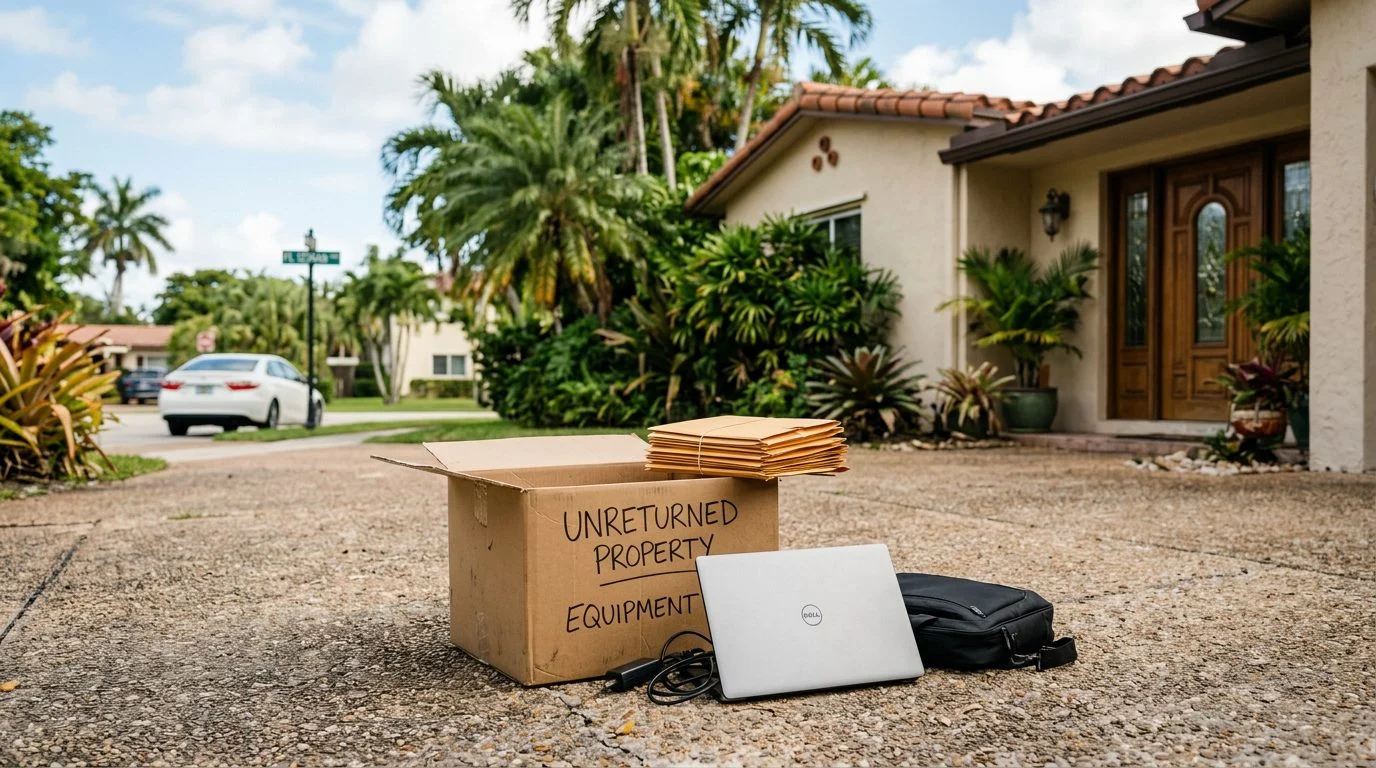
Common items include company laptops and phones, keys and access cards, tools, paper files, and stock. Login credentials can be the most urgent item, because they may still reach company accounts.
A calm, documented response usually works better than an angry one. Every message you send may later be read by a court or by the other side.
The facts of each case shape the next step. For a broader view, read our guide to employment issues for Florida employers.
If a former employee still has your company's laptop, files, or keys, you don't have to sort out the next step alone. Our team at KEW Legal can talk it through with you. Talk it through with our team — the first consultation is free, confidential, and carries no obligation.
Start With an Inventory of What Is Missing
Start by listing each missing item in enough detail that someone else could identify it. For each item, record:
- The make and model
- The serial number or asset tag
- Any accounts or passwords tied to the device
- Where the employee was assigned to use it
Next, pull the records that show the company gave the item to this employee. Useful records include issue logs, sign-out sheets, IT asset records, and purchase records.
Write down two dates: when the employment ended, and when you first asked for the property back. These dates matter later, because legal time limits can run from when a claim arose.
Sort the list into three groups: company property, personal property, and company data. Each group may need a different request.
Data needs extra care. Florida defines a trade secret as information, including a formula or compilation, that gets independent economic value from not being generally known or readily ascertainable by proper means, and that is the subject of efforts reasonable under the circumstances to keep it secret. See Fla. Stat. § 688.002. A customer list or formula may fall under that definition.
Review the Written Agreements and Policies You Already Have
Your written agreements are the first place to look for what the employee agreed to return.
Pull the offer letter, the employment agreement, the handbook, and any device, equipment, or confidentiality agreement the employee signed. Look for a return-of-property clause, an exit checklist, and an acknowledgment page with the employee’s signature.
A handbook line may not be enforceable on its own. In Quaker Oats Co. v. Jewell, the court explained that manual policy statements are generally not enforceable contract rights. The exception is a manual with specific language showing it is a separate employment contract.
Policy wording has limits too. The NLRB guidance on employer union rights says handbook rules must not interfere with employees’ federally protected rights. A return-of-property rule should focus on company equipment.
If your signed paperwork is thin, note the gap now. Then update your policies for the future.
How Florida’s At-Will Doctrine Affects Property Disputes
Florida is an at-will employment state, so either side can usually end the job at any time. The Florida Supreme Court restated this rule in Gessner v. Southern Co. in 2026.
At-will status has a limit. In Laguerre v. Palm Beach Newspapers, the court explained that an at-will employee may be let go at any time, but not for a reason the law prohibits. Retaliation and unlawful discrimination are examples.
Keep the two questions apart. At-will status explains why the job ended. The property question asks what the employee agreed to return and what the company owns.
If the employee raised a complaint before leaving, have the timing reviewed before you send a demand. A property demand that looks like payback for a complaint can start a separate dispute.
What a Former Employee Demand Letter Is and Who Needs One
A demand letter is a written request. It names the property, states your ownership, sets a return deadline, and explains the next step if the property doesn’t come back.
Include these details:
- Your company’s name
- The employee’s name and last known address
- An itemized list with serial numbers
- The date the property was issued
- The return deadline and return method
- Your contact information
Send the letter in a way that proves delivery, and keep a copy in the company file. A clear written record helps if the matter reaches court. For more on letter content, see our former employee demand letter guide.
Florida’s civil theft statute adds a step if the facts fit a theft. Before filing a damages action under Fla. Stat. § 772.11, the injured person must make a written demand for $200 or the treble damage amount of the person liable. If the recipient complies within 30 days after receiving it, that person gets a written release from further civil liability for that act. The claimant must prove the case by clear and convincing evidence.
How the Response Process Usually Works
A typical response moves in a simple order. The letter is delivered, the former employee answers or stays silent, and you either get the property back or take the next step.
Some people return equipment after one written request. Others need a second letter or a firm deadline. Plan for both.
Keep every communication in writing. Log each phone call with the date, the time, and a short summary. A written log is the safer record.
If the employee returns only part of the property, write down exactly what you received. Also write down what is still missing.
Not sure what your next step is?
Talk it through with our team — the first consultation is free, confidential, and carries no obligation.
Legal Options If the Property Is Still Not Returned
If the property is still missing after a clear demand, a lawyer can talk through civil claims and court options.
One claim is conversion. Your written demand becomes important evidence here.
Replevin is a court process for recovering specific property. Small claims court is another option for lower-value property. The right route turns on the property’s value, whether it can be identified, where the former employee lives, and what the agreements say.
Location matters. Under Fla. Stat. § 47.011, actions are brought in the county where the defendant resides, where the cause of action accrued, or where the property in litigation is located. That section does not apply to actions against nonresidents.
If the former employee moved out of state, Florida’s jurisdiction statute may still reach them. Fla. Stat. § 48.193 covers breaching a contract in Florida by failing to perform acts the contract required here.
Deadlines and Mistakes to Avoid
Legal claims have filing deadlines, and the clock may start sooner than you expect. Under Fla. Stat. § 95.031, a cause of action generally begins when its last element occurs. Florida also sets different time limits for different actions under Fla. Stat. § 95.11.
Avoid self-help. Don’t take personal belongings or personal accounts to force a return. Don’t publicly accuse the former employee of theft. Keep statements factual and consistent with your written record.
Don’t threaten criminal charges to pressure a return. That tactic can create a separate problem for your business.
Florida courts can also shift legal fees. The motion must be served first. The other side then has 21 days to withdraw or correct the challenged claim before the motion is filed.
Can I sue a former employee for company property in Florida?
Florida law may allow a claim, but the right claim turns on the facts and the written agreements. A lawyer can review those details with you.
Do I need a demand letter first?
For a damages action under Florida’s civil theft statute, a written demand is required before filing. A clear demand is also useful evidence for other claims.
Does at-will employment let a former employee keep company equipment?
At-will status explains why the job ended. It doesn’t, by itself, decide who owns the equipment.
Talk Through Your Situation With KEW Legal
If the property is still with a former employee, you’re weighing whether to escalate. Each next step can affect your business, so you don’t have to weigh it alone.
KEW Legal is a Florida business law firm with offices in Coral Gables and Sunny Isles Beach. We advise business owners and employers in Miami-Dade County, Broward County, and South Florida. Kristina E. Wilson is the responsible lawyer for this page.
Call 305-990-2300 or send us a message.
The initial consultation is free, confidential, and with no obligation to continue.
How KEW Legal Approaches These Matters
Review the Paperwork First
We look at employment agreements, confidentiality and non-solicitation terms, handbook policies and any records showing what was issued to the employee and when.
Protect Confidential Information
Our focus is on limiting the risk to your client relationships, trade secrets and business data while the matter is addressed.
Measured Communication
We prepare a written demand that states what property is missing and what you need returned, so the request is clear and documented.
Outside General Counsel Support
For ongoing employment and business needs, our lawyers work with owners and management as outside general counsel, not only when a dispute arises.
Before You Contact the Former Employee
Avoid threats, public accusations or self-help steps such as withholding final pay or changing access without advice. Gather the records you already have, including asset logs, emails and signed policies, and then speak with counsel.
Property Issues We Address
Devices and Equipment
Company laptops, phones, tools, vehicles and other equipment issued for work use.
Client and Business Records
Customer lists, files, passwords, accounts and other records that belong to the business.
Keys, Cards and Access
Office keys, access cards, alarm codes and shared login credentials that need to be recovered or reset.
Contract and Policy Obligations
Return-of-property clauses, confidentiality agreements and handbook rules that set out what the employee must give back.
Talk With KEW Legal About Recovering Your Company's Property. The Initial Consultation Is Free, Confidential and Carries No Obligation to Continue.
Request a Consultation
Fill out the short form and we will take it from there.