

Employment Law for Employers | Miami-Dade & Broward
Facing an Employment Claim Against Your Business in Florida?
KEW Legal advises business owners in Coral Gables, Sunny Isles Beach and across South Florida on employee complaints, agency charges, demand letters and lawsuits, with a plan built around your business.
How KEW Legal Works With Employers
Protecting Your Business
We look at the claim with your long-term interests in mind, including your reputation, your other employees and your operations.
Careful Documentation
We review policies, personnel files, communications and timelines so your response is grounded in the facts.
Clear Communication
We explain your options in plain language so you can make informed decisions at every stage.
Local Offices
Our offices in Coral Gables and Sunny Isles Beach serve business owners throughout Miami-Dade and Broward County.
Confidential First Step
Your first consultation is free, confidential and carries no obligation to continue.
By Kristina E. Wilson · Published October 30, 2026
Employment Claims Against My Business Florida: An Owner’s Guide
Employment claims against my business in Florida usually start with one worker’s complaint. A complaint can grow into an agency charge, a demand letter or a lawsuit. This guide explains the common claims, the laws that often apply, the deadlines that matter, and the first steps that protect your company. KEW Legal is a Florida business law firm with offices in Coral Gables and Sunny Isles Beach. Kristina E. Wilson is the responsible lawyer for this page.
If a worker has filed a charge or sent a demand letter, our team can talk through what it means for your business and your next step. Talk it through with our team — the first consultation is free, confidential, and carries no obligation.

What an Employment Claim Against Your Business Looks Like
An employment claim is a complaint that says your business treated a worker unfairly or broke a workplace rule. The worker may be a current employee, a former employee or a job applicant.
Many claims start small. A worker may raise a concern with a manager, send an email, or resign with a letter that mentions unpaid wages or unfair treatment. Nothing outside the company may have happened yet at that point.
Some claims grow from there. The worker may file a charge with a government agency. A lawyer may send a demand letter asking for payment or a response. The case may also reach a court as a lawsuit. Each stage has its own clock and its own rules.
The early days matter. What the business says, writes and does in the first week can shape every later stage. A quick, careless reply can create new problems.
This guide covers five areas: the common claims, the laws that apply, the deadlines, the first steps, and prevention. It also explains when outside general counsel can help.
Common Employee Claims Against Florida Businesses
Employee claims against Florida businesses usually fall into a few groups. Each group has its own facts and its own proof.
Discrimination claims say the business treated someone worse because of a protected trait, such as race, sex, age or disability. Later sections explain the protected traits in more detail.
Retaliation claims say the business punished a worker for complaining, reporting misconduct, asking for leave or filing a charge. Retaliation claims are often filed on top of an original claim, so they deserve close attention.
Wage claims involve unpaid overtime, minimum wage, missing hours or final pay. These claims often turn on timekeeping records and written pay practices.
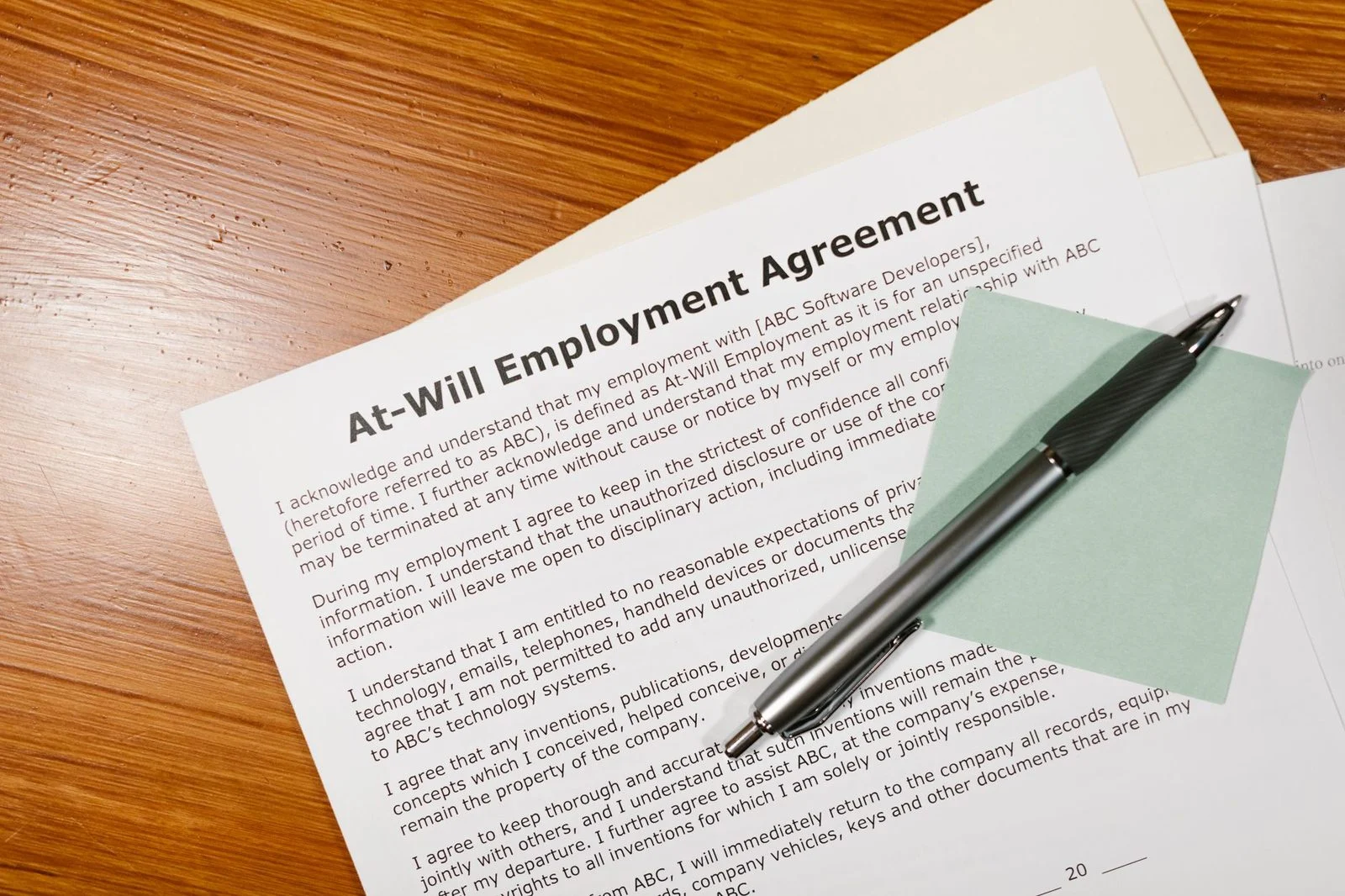
Termination disputes involve firings, layoffs and disagreements over severance. Florida generally follows the at-will rule. Under that rule, an employer can end employment at any time, but not for a reason the law forbids. As the court in Laguerre v. Palm Beach Newspapers put it, an at-will employee may be discharged at any time, as long as the employee is not terminated for a reason prohibited by law, such as retaliation or unlawful discrimination.
Harassment claims involve conduct that makes a workplace hostile. How the business handled complaints often matters as much as the conduct itself.
The Federal and Florida Laws That Most Often Apply
Federal law and Florida law can both apply to a business. Your company’s size and the type of claim decide which rules reach you.
Under Fla. Stat. § 760.10, it is an unlawful employment practice for an employer to discharge or fail or refuse to hire any individual, or otherwise to discriminate against any individual with respect to compensation, terms, conditions, or privileges of employment, because of race, color, religion, sex, pregnancy, national origin, age, handicap, or marital status. The EEOC’s employer guidance explains the federal duties that apply to employers.
The Florida Civil Rights Act is a separate state law. It covers an employer with 15 or more employees for each working day in each of 20 or more calendar weeks in the current or preceding year, as Fla. Stat. § 760.02 defines that term. Claims under that law go through the Florida Commission on Human Relations.
Florida’s minimum wage rules come from Fla. Stat. § 448.110 and Fla. Const. art. X, § 24. Federal wage rules, including overtime under the Fair Labor Standards Act, can apply on their own terms.
Owners of small companies should check which statute reaches them. The answer for the state minimum wage depends on whether the worker is entitled to the federal minimum wage under the federal Fair Labor Standards Act.
Discrimination Claims: Protected Classes and What Counts
Florida law makes it unlawful for an employer to discriminate on certain protected traits. Under Fla. Stat. § 760.10, those traits include race, color, religion, sex, pregnancy, national origin, age, handicap and marital status. The statute uses the word “handicap” for disability.
The law covers more than firing. It also covers hiring decisions and discrimination in pay, terms, conditions or privileges of the job because of race, color, religion, sex, pregnancy, national origin, age, handicap, or marital status.
Two ideas help owners sort these claims. Disparate treatment means a worker was treated worse because of a protected trait.
The statute makes it unlawful to discriminate against someone for opposing an unlawful practice or for taking part in a charge or proceeding.
The remedies can be significant. Under Fla. Stat. § 760.11, a court may order back pay, but no liability for back pay accrues from a date more than 2 years prior to the filing of a complaint with the commission, and a court may award compensatory damages for mental anguish and loss of dignity. Punitive damages are also possible, but the total for one aggrieved person cannot exceed $100,000 under that section.
Before responding to any charge, gather the facts. Compare how similar workers were treated. Check whether policies were applied the same way to everyone. Review the decision-maker’s notes and emails before anyone writes a reply.
Filing Deadlines: How Long an Employee Has to Act
Filing deadlines differ by claim type, and some windows are short. Owners should calendar every date the moment a notice arrives.
For federal charges, 42 U.S.C. § 2000e-5 sets the charge window. After an EEOC right-to-sue notice, a federal lawsuit must generally be filed within 90 days.
For a Florida Civil Rights Act lawsuit, Fla. Stat. § 760.11 says the action must start no later than 1 year after the reasonable-cause determination or the federal right-to-sue notice, whichever is earlier. If neither issues within 180 days after the complaint, the action may start no later than 18 months after the filing. Fla. Stat. § 760.11 reads: “The commencement of such action shall divest the commission of jurisdiction of the complaint, except that the commission may intervene in the civil action as a matter of right.”
Whistle-blower retaliation claims follow Fla. Stat. § 448.103. The employee must sue within 2 years after discovering the action, or within 4 years after it was taken, whichever is earlier.
Florida’s minimum wage statute, § 448.110(8), applies the limitations period found in § 95.11 to minimum wage claims, so the deadline should be checked against that statute. Under Fla. Stat. § 448.07, an action to recover sex-based unpaid wages may be maintained by the aggrieved employee within 6 months after termination of employment, but the section does not apply to an employer subject to the federal Fair Labor Standards Act of 1938, as amended, or to an employee whose employer is subject to that Act.
Which clock applies depends on the facts. The date your business received notice still matters, because it sets your own planning dates. Don’t assume an old-looking claim is harmless.
Not sure what your next step is?
Talk it through with our team — the first consultation is free, confidential, and carries no obligation.
The First 30 Days After a Charge or Demand Letter Arrives
The first days after a charge or demand letter should focus on records, deadlines and a single point of contact. Speed matters, but a careful reply matters more.
Start by logging the date the notice arrived. Save the original envelope, email or file. Note who received it and who else has seen it.
Next, identify the people who made the decision at issue. List their names, roles and the dates of their decisions. This list will matter later.
Calendar every response deadline. Agency notices and demand letters usually set a date for a reply. Missing that date can narrow your options.
Avoid informal replies. Do not answer an agency or the worker’s lawyer before reviewing the notice. A casual email from a manager can become a key exhibit.
A position statement is the business’s written account of the facts and decisions. It explains the reasons behind the action and points to the policies and records that support it. It does not decide the case, and no one can predict how an agency will rule on it.
Preserving Records and Issuing a Litigation Hold
Once a claim is expected, the business should keep every record connected to the worker and the decision. Records that look bad still need to be kept.
Typical records include personnel files, performance reviews, schedules, timecards, pay records, emails, text messages and chat messages. Managers often keep notes on their phones, and those notes count too.
A written preservation instruction helps. It tells managers in plain language to keep relevant material and not delete, edit or discard it. The instruction should be specific about the subject, the people and the time period.
Routine deletion policies may need to pause. Many businesses automatically delete old emails or messages. Once a claim is reasonably expected, that routine may need to stop for records that relate to the claim.
Keep a clear record of how the decision was made. Note who made it, when, what information they had and what policy they followed. A simple, dated record is easier to defend than a memory reconstructed months later.
Communicating With the Employee and Your Team
Managers should avoid any action against the worker that looks like punishment for a complaint. Retaliation can create a second claim on top of the first.
Florida law protects against retaliation in several ways. Under Fla. Stat. § 760.10, an employer cannot discriminate against a person for opposing an unlawful practice or for taking part in a charge or investigation. Under Fla. Stat. § 448.102, an employer may not take retaliatory personnel action against an employee who objects to or refuses to join a practice that violates a law, rule or regulation. For a different kind of claim, one where the employee disclosed or threatened to disclose the practice to an appropriate governmental agency, under oath and in writing, Fla. Stat. § 448.102(1) adds a condition: “However, this subsection does not apply unless the employee has, in writing, brought the activity, policy, or practice to the attention of a supervisor or the employer and has afforded the employer a reasonable opportunity to correct the activity, policy, or practice.”
Internal objections raise a related question. In Gessner v. Southern Co. (Fla. 2026), the Florida Supreme Court held that an employee must show the practice objected to is, by definition, in violation of law. Under Gessner v. Southern Co., to prevail in a retaliation claim under section 448.103 alleging a violation of section 448.102(3), an employee must establish that the employer’s activity, policy, or practice the employee objected to is, by definition, in violation of law. Managers should still treat every objection seriously and review it promptly.
Managers should not comment on the worker’s protected traits or the claim. Keep conversations about work factual and brief. Avoid jokes, threats or hints about the complaint.
Social media posts about a dispute raise hard questions. Whether an employer can act on an employee’s post turns on the facts, including the content and the employer’s written policies. Review the policy before acting.
Limit who hears about the claim. Share details only with people who need them to respond, such as decision-makers, human resources staff and counsel.
Related Exposure: Final Pay, Unemployment and Wage Claims
Unpaid wage claims can carry fee-shifting rules, so a small pay dispute can become costly. Fee-shifting means the losing side may have to pay the other side’s reasonable attorney’s fees.
Under Fla. Stat. § 448.110, a worker who plans to bring an unpaid minimum wage claim must first notify the employer in writing. The employer then has 15 calendar days after receiving the notice to pay the unpaid wages or otherwise resolve the claim.
If the worker wins, the Florida Constitution provides for the back wages plus the same amount as liquidated damages (an added amount for the delay), plus reasonable attorney’s fees and costs. The court has some discretion to reduce liquidated damages when the employer proves good faith and reasonable grounds for its action.
Fla. Stat. § 448.08 also lets a court award the prevailing party in an unpaid wage action costs and a reasonable attorney’s fee.
Final pay should follow your written pay practices and any signed agreement. Consistent records make it easier to show what was owed and when it was paid.
An unemployment (reemployment assistance) claim creates a separate record. Respond to notices on time and keep your answers accurate and consistent with your personnel records.
Prevention: Policies, Agreements and Arbitration
Written policies and clear agreements set expectations before a dispute starts. They also show how the business handles complaints, leave, timekeeping and discipline.
A handbook is useful, but it may not be a contract. Quaker Oats Co. v. Jewell establishes that policy statements contained in employment manuals do not give rise to enforceable contract rights in Florida unless they contain specific language which expresses the parties’ explicit mutual agreement that the manual constitutes a separate employment contract.
Restrictive covenants, such as non-compete or confidentiality terms, need careful drafting. Under Fla. Stat. § 542.335, a court will not enforce a restrictive covenant unless it is set forth in a writing signed by the person against whom enforcement is sought. If a restraint is broader than needed to protect a legitimate business interest, the court must modify it and grant only the relief reasonably necessary.
Arbitration agreements also need care. An arbitration clause is a promise to resolve disputes outside court. In Basulto v. Hialeah Automotive (Fla. 2014), the Florida Supreme Court held that a court must find both procedural unconscionability (how the deal was made) and substantive unconscionability (how unfair the terms are) before refusing to enforce a term on that basis. Whether an agreement holds up depends on how it was drafted and presented.
Review your forms with counsel before you use them. Update policies when your practices change, and train managers on them.
If a worker has filed a charge or sent a demand letter, our team can talk through what it means for your business and your next step. Talk it through with our team — the first consultation is free, confidential, and carries no obligation.
When Outside General Counsel Helps
Outside general counsel gives a business ongoing legal support. It is more than help with one dispute.
Typical work includes reviewing handbooks, offer letters, separation agreements and restrictive covenants. It also includes advising managers on discipline, complaints and leave. When a claim arrives, the same counsel already knows the business’s policies and records.
Situations where counsel is commonly involved include an agency charge, a demand letter, a terminated employee who raises a complaint, or a pattern of similar complaints across the company. Counsel can also help when an owner is planning a sale or a succession, since employment issues often come up in those deals.
A business attorney coordinates with the owner and managers. Where an insurance policy may respond to a claim, counsel can also coordinate with the insurance carrier. Early review generally keeps more response options open.
What is an employment claim against my business in Florida?
It is a complaint, agency charge, demand letter or lawsuit from a worker who says the business broke a workplace law. Claims often start as an internal complaint.
Does the Florida Civil Rights Act apply to small businesses?
It applies to employers with 15 or more employees for each working day in 20 or more calendar weeks in the current or preceding year. Smaller employers may still face other Florida or federal wage rules.
Should a business talk to a lawyer early?
Early review generally keeps more response options open. Acting on a notice before reviewing it can narrow later choices.
Florida Employers in Miami-Dade and Broward
KEW Legal serves businesses across Miami-Dade and Broward counties from offices in Coral Gables and Sunny Isles Beach. Owners and investors in Miami, Coral Gables, Sunny Isles Beach, Aventura, Doral, Brickell and Fort Lauderdale can contact the firm.
The firm acts as outside general counsel for business owners and investors. Its work includes employment law for employers, partnership disputes, contract and vendor disputes, business sales and succession, commercial leases and real estate investment matters.
The firm’s lawyers practice Florida law. Some matters may be referred to another lawyer or firm when that fit is better, and this page says so.
Talk Through Your Situation With KEW Legal
If an employee has filed a charge, sent a demand letter or raised a complaint, you are probably deciding what to do first. Those first choices shape the response that follows, so a clear review helps.
Call 305-990-2300 or send us a message to describe the facts of your situation. Bring the notice, the dates and the names of the people involved.
Our initial consultation is free, confidential, and comes with no obligation to continue.
Common Ways an Employment Claim Begins
Internal Complaint
An employee raises a concern about pay, treatment, scheduling or a supervisor. Early handling can shape how the matter develops.
Agency Charge
A state or federal agency notifies you that a worker has filed a charge. Agency notices often include response requirements that should not be overlooked.
Demand Letter
A former or current worker's attorney sends a written demand. How you respond can affect what happens next.
Lawsuit
A complaint is filed in court. We help employers respond, preserve evidence and manage the case from start to finish.
Do Not Ignore Agency Notices or Demand Letters
Deadlines in agency notices, demand letters and court papers can matter. Avoid responding on your own, deleting emails or altering personnel records. Contact KEW Legal as soon as you receive any written claim.
Talk With KEW Legal About a Claim Against Your Business
Request a Consultation
Fill out the short form and we will take it from there.