

Employment Law for Employers | Coral Gables & Sunny Isles Beach
Facing a Retaliation Claim? Measured Defense for Florida Employers
Our lawyers work with business owners across Miami-Dade and Broward when an employee's complaint puts the company's decisions under review.
By Kristina E. Wilson · Published November 15, 2026
You may have just learned that an employee believes you punished them for speaking up.
What an Employee Retaliation Claim Is and Who It Affects
Retaliation is an employer’s negative action against an employee because the employee engaged in protected activity. Claims often follow an internal complaint, a termination, a written discipline, a reduced schedule or a change in duties. Managers may see these steps as routine, which is why timing draws close attention.
Florida case law lets an at-will employee be fired at any time. The firing still cannot be for a reason the law prohibits, such as retaliation or unlawful discrimination (Laguerre v. Palm Beach Newspapers). At-will status is not a shield against a retaliation claim.
Not sure what your next step is?
Talk it through with our team — the first consultation is free, confidential, and carries no obligation.
Protected Activity: What Counts Under the Law
Protected activity is conduct a statute shields from employer punishment.
- Opposing discrimination or harassment. Federal law protects an employee who opposes an unlawful practice or takes part in a proceeding (42 U.S.C. § 2000e-3). Florida’s civil rights law has a similar rule (Fla. Stat. § 760.10).
- Wage and hour complaints. The Fair Labor Standards Act bars firing or discriminating against an employee who files a complaint or testifies in a proceeding.
- Leave rights. The Family and Medical Leave Act bars interference with leave rights and discrimination against an employee who opposes an unlawful practice.
- Workers’ compensation claims. An employer may not discharge, threaten or coerce an employee over a valid workers’ compensation claim (Fla. Stat. § 440.205).
The Three Elements a Retaliation Claim Must Prove
A retaliation claim fails if the employee cannot prove every element. Test the file against all three before anything else.
- Protected activity. The employee engaged in conduct a statute protects, as described above.
- A materially adverse action. The employer took a serious step, such as termination, demotion, a pay cut, a reassignment or a negative evaluation.
- A causal connection. The protected activity caused the action. Claimants often point to timing, a sudden change in treatment or explanations that shift over time.
When one element is missing, the claim has a gap. Finding that gap early shapes the whole response.
Where Retaliation Claims Are Filed and the Deadlines That Apply
Retaliation claims can start at a state agency, a federal agency or in court, and each route runs on its own clock. Under Florida’s civil rights law, a civil action generally must start no later than one year after a reasonable cause determination by the Florida Commission on Human Relations or a Notice of Right to Sue from the EEOC, whichever comes earlier, and the statute provides exceptions to that general rule. Under subsection (5) of Fla. Stat. § 760.11, if the commission makes no reasonable cause determination, or the Equal Employment Opportunity Commission issues no Notice of Right to Sue, within 180 days after the complaint is filed, an employee’s lawsuit may be filed up to 18 months after the complaint was filed; separately, when the commission sends the notice described in subsection (8)(b), paragraph (8)(c) requires the lawsuit to be filed within 1 year after the date the commission certifies that notice was mailed, so the period that applies to a claim against your business depends on which notices were actually issued.
Those remedies can be significant. Under the same statute, a court may award back pay and compensatory damages, including damages for mental anguish. Total punitive damages are capped at $100,000.
Florida’s whistleblower law sets its own limits. The employee may sue within two years after discovering the action or within four years after it was taken, whichever is earlier (Fla. Stat. § 448.103). Send any agency notice or demand letter to counsel promptly, because these deadlines run from agency actions and other key dates.
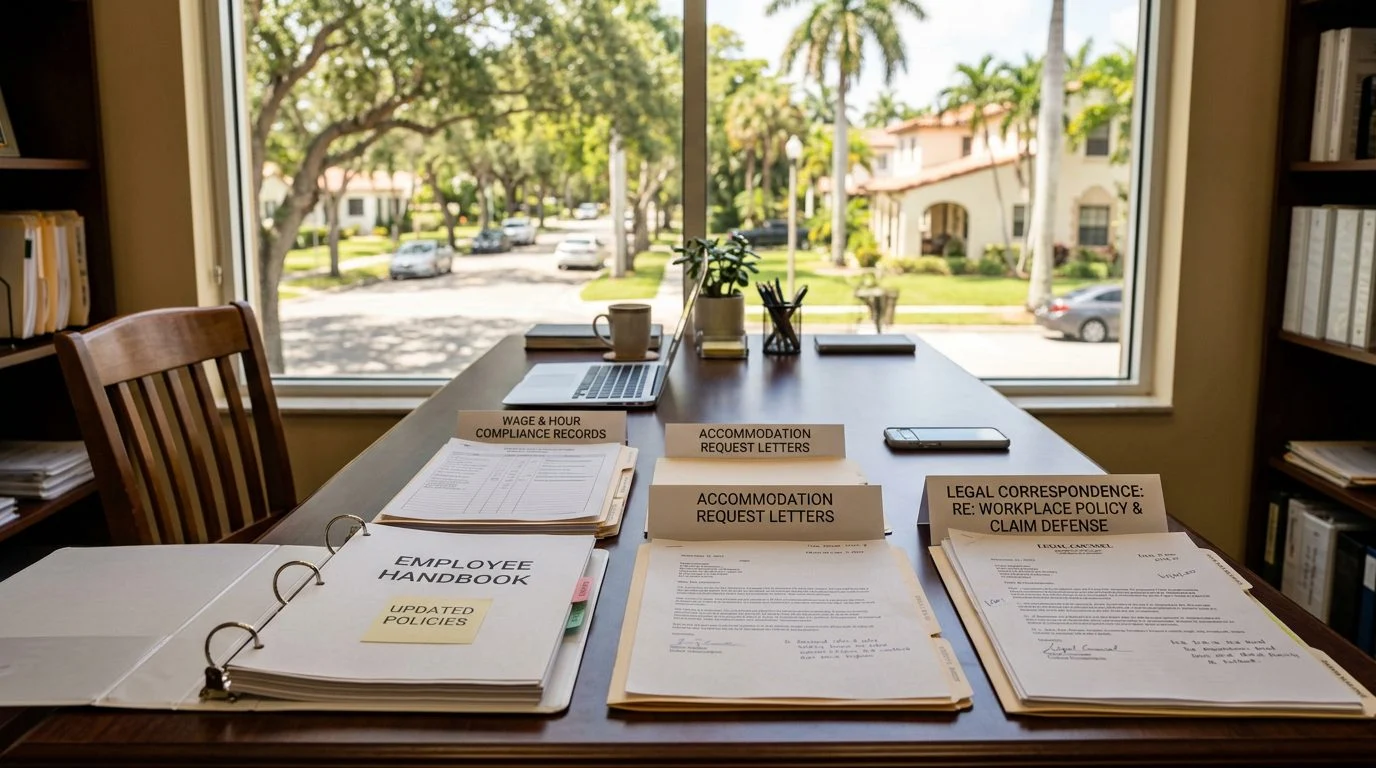
How Employers Defend a Retaliation Claim
Most employer defenses test one of the three elements with records made before the dispute began.
- A documented, legitimate reason. Performance reviews, attendance logs and written conduct notes carry weight, especially when applied the same way to others.
- What the decision-maker knew. The key question is whether the person who made the decision knew about the protected activity.
- Timing and history. An action taken long after a complaint, or after a documented pattern of problems, can weaken the link between the two.
- Consistent discipline. Comparing how similarly situated employees were treated can show whether a rule was applied evenly.
- Responding to a harassment claim. This defense has two necessary elements: (a) the employer exercised reasonable care to prevent and promptly correct any sexually harassing behavior, and (b) the employee unreasonably failed to take advantage of any preventive or corrective opportunities the employer provided or to otherwise avoid harm (Faragher v. City of Boca Raton, 524 U.S. 775, 807 (1998); Burlington Industries, Inc. v. Ellerth, 524 U.S. 742, 765 (1998)). It took reasonable care to prevent and promptly correct harassment, and the employee unreasonably failed to use the options provided (Faragher v. City of Boca Raton).
Which defense fits is a question for the facts of each matter, so the file comes first.
How KEW Legal Handles a Retaliation Matter for an Employer
KEW Legal serves as outside general counsel for business owners and employers, and a retaliation review starts with the documents. The work usually moves through five steps.
- Intake. The firm reviews the complaint, demand letter, agency notice or termination file.
- Preserve evidence. Collect personnel files, emails, schedules and performance records, and issue a litigation hold where appropriate.
- Test the elements. Compare the records against the three elements and identify gaps before any response goes out.
- Prepare the response. Draft the reply to an agency charge, demand letter or complaint, and advise on settlement or mediation options.
- Guide what comes next. Advise managers on communications and future decisions, so a new action does not create a fresh claim.
KEW Legal has offices in Coral Gables and Sunny Isles Beach and serves employers across Miami-Dade, Broward and South Florida. Kristina E. Wilson is the responsible lawyer for this page. Natalie Martinez is also one of the firm’s lawyers, and our lawyers handle employment matters for employers.
Not sure what your next step is?
Talk it through with our team — the first consultation is free, confidential, and carries no obligation.
Frequently Asked Questions
Is it worth fighting a retaliation claim?
Whether a claim is worth defending depends on the documents in the file. An early review of those records is how that decision gets made.
Does Florida have the right to fire employees?
Florida case law allows at-will firings at any time. The firing cannot be for a reason the law prohibits, such as retaliation.
How does HR handle harassment complaints?
A sound process includes a prompt, documented investigation, interim steps to protect the employee, a written outcome and follow-up checks for retaliation.
What is a hostile work environment?
It is harassment serious or frequent enough to change the conditions of someone’s work. It differs from retaliation, though both can appear in the same matter.
Can an employer discipline an employee after a complaint?
Timing and context matter, so review the record before acting.
Talk With KEW Legal About the Matter in Front of You
You may be holding a charge, a demand letter or an employee complaint you did not expect, and you may not have the full picture yet. Sharing the file early gives you a clearer view of your options. La consulta inicial es gratuita, confidencial y sin compromiso de continuar. (Your first consultation is free, confidential and carries no obligation to continue.) Call 305-990-2300 or send us a message through the contact page.
How KEW Legal Approaches a Retaliation Claim
We start with the file
Personnel records, performance reviews, complaints and the timeline of events are reviewed first, so every decision is based on what the documents actually show.
A defense built on the record
Our lawyers focus on the business reasons behind each action and how those reasons are documented, rather than on assumptions about the employee.
Early attention to deadlines
A demand letter, agency charge or lawsuit calls for a prompt response. We help employers review those papers quickly and plan the next steps.
Clear communication
You receive plain-language updates on the matter and the choices in front of you, so you can make informed decisions for your company.
Preserve the Records Now
Once a complaint or demand arrives, keep every related email, text message, schedule, personnel file and policy document. Avoid editing old files or discussing the employee's complaint with co-workers. Call us before taking further action.
Situations Employers Bring to Us
Termination after an internal report
An employee who raised a concern about pay, safety or conduct is later disciplined or let go, and the company needs to understand how the decision will be viewed.
Discipline following a complaint
Write-ups, demotions or schedule changes that follow an employee's complaint require a careful review of timing, documentation and consistency.
Charges and demand letters
A former employee files an agency charge or sends a demand letter alleging retaliation. We review the allegations and prepare the company's response.
Ongoing workplace disputes
Tension between a manager and an employee who has raised concerns can escalate. We advise on steps that protect the company while the matter is resolved.
Speak with Kristina E. Wilson Before You Respond to a Retaliation Claim
Related practice areas
Request a Consultation
Fill out the short form and we will take it from there.