
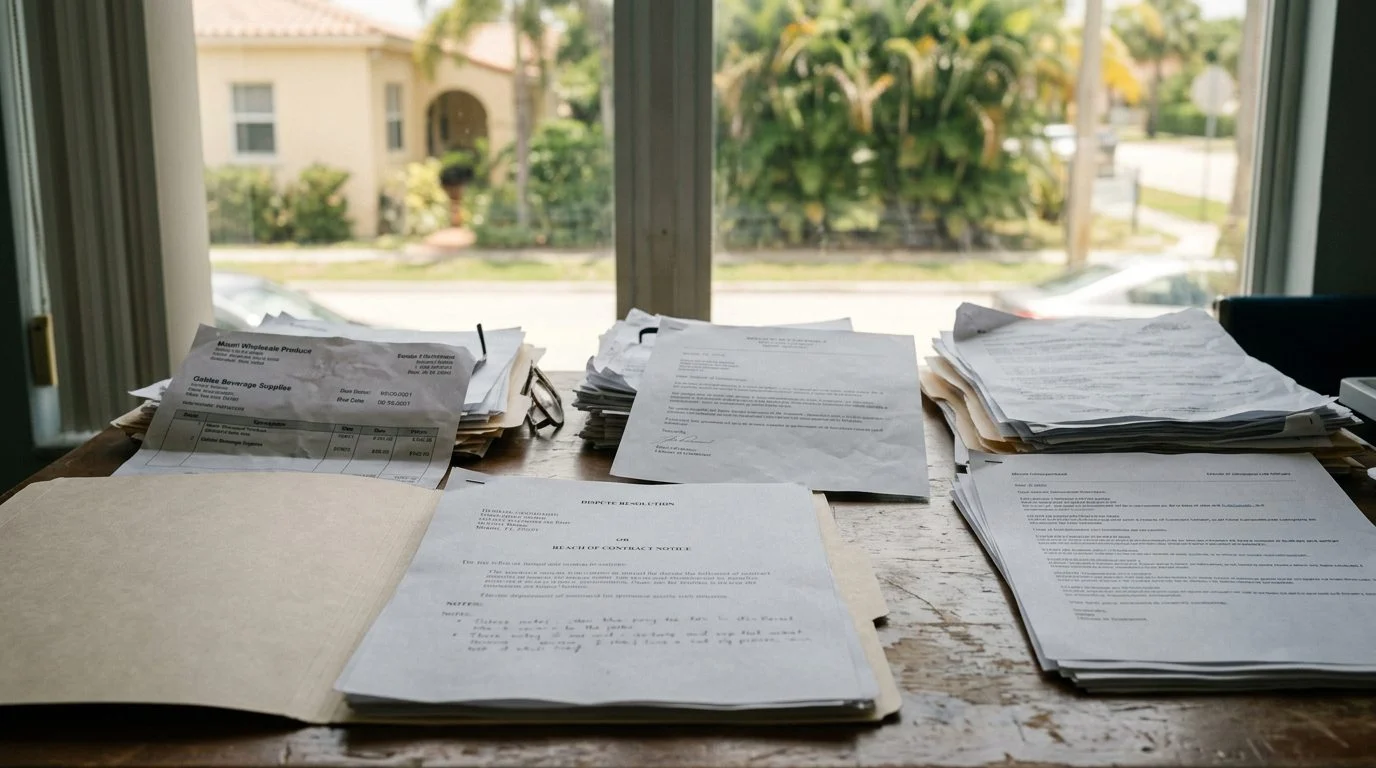
Restaurant Supplier Contract Disputes · Coral Gables and Sunny Isles Beach
Supplier Disputes Can Stall Your Kitchen. Get Clear Legal Guidance.
KEW Legal helps Miami-area restaurant owners understand their supply agreements and respond to disputes over pricing, deliveries and payment.
By Kristina E. Wilson · Published November 16, 2026
What a Restaurant Supplier Contract Dispute Involves
A restaurant supplier contract dispute is a disagreement over what a supply deal requires and whether each side kept its promises. It can involve a food, beverage, produce, seafood, paper goods or equipment vendor.
Restaurant owners, co-owners, operators and managers in Miami, Miami-Dade, Broward County, Coral Gables, Sunny Isles Beach, Aventura, Doral, Brickell and Fort Lauderdale run into these problems. A supplier says you owe a balance. You say the product arrived spoiled, short or late. Both sides may have a point.
KEW Legal is a Florida business law firm with offices in Coral Gables and Sunny Isles Beach. The firm focuses on business contract and vendor disputes. It acts as outside general counsel for business owners and investors across Miami-Dade and South Florida. Kristina E. Wilson is the responsible lawyer for this page, and Natalie Martinez is also one of the firm’s lawyers.
Not sure what your next step is?
Talk it through with our team — the first consultation is free, confidential, and carries no obligation.
Common Restaurant Supplier Disputes We Handle
Most restaurant supplier disputes fall into a few groups. Each one turns on specific contract terms and on proof.
- Unpaid or disputed invoices. The supplier claims a balance, or the restaurant has held back payment over quality or quantity problems.
- Short, late or spoiled deliveries. These disputes often turn on delivery counts, temperature records and photos taken at the door.
- Minimum-purchase and exclusivity clauses. These can become hard to meet when sales fall or when a location closes.
- Price increases and surcharges. Fuel charges and escalation terms can be unclear when the deal is signed.
- Termination and auto-renewal. Notice periods and early-termination fees decide whether you can exit a supply contract.
- Personal promises and related equipment or service contracts. Owners sometimes promise personally to cover a supply account or credit line. Equipment leases can tie into the same vendor relationship.
When a supplier sells goods as a merchant, Florida implies a promise that the goods are merchantable. Unless the contract excludes or modifies it, the goods must at least pass without objection in the trade under the contract description, be of fair average quality if they are fungible goods, be fit for their ordinary purposes, be of even kind and quality within the variations the agreement permits, be adequately packaged and labeled as the agreement may require, and match what the label says (§ 672.314).
Written, Verbal and Invoice-Based Supply Terms in Florida
A supplier relationship can be binding even without one signed contract. Invoices, purchase orders, price sheets and emails can all matter. Sales of goods in Florida are governed by Chapter 672 of the Florida Statutes.
A contract for the sale of goods can be formed in any manner that shows agreement. That includes conduct by both sides that recognizes the deal (§ 672.204). Under § 672.207, conduct by both parties can establish a contract even when their writings do not.
Writing matters more for larger amounts. For goods priced at $500 or more, § 672.201 generally requires a record signed by the party against whom enforcement is sought. That rule has exceptions, including goods that were paid for and accepted.
Between merchants, a written confirmation of the contract received within a reasonable time, which is sufficient against the sender and which the receiver has reason to know the contents of, can satisfy the signed-record requirement against the receiving party. That happens unless the receiver objects in writing within 10 days after receiving it. Read every confirmation a vendor sends you.
Deadlines matter too. Florida’s limitations statute, § 95.11, sets different periods depending on the type of claim. Under Fla. Stat. § 95.11(3)(j), an action on an unwritten contract for the sale and delivery of goods, wares, and merchandise must be commenced within four years.
How the Process Works: Step by Step
A restaurant supplier dispute usually moves from document review to a written demand and then to negotiation. A court filing comes later, if those steps don’t resolve the matter.
- Initial confidential discussion. You describe the contract, invoices, delivery records and the dispute. We review what you have and explain your options.
- Document review. We look at pricing, notice and termination clauses, dispute and venue terms, liability limits and your payment history.
- Demand and negotiation. A written demand or response goes to the supplier. Many disputes settle through a payment plan or a negotiated exit, which can be the fastest route when both sides still do business.
- Mediation or arbitration. If the contract requires arbitration, Florida generally enforces a written arbitration agreement. A court decides whether that agreement exists (§ 682.02).
- Litigation. If needed, larger claims can be filed in Miami-Dade or Broward circuit court. Smaller money disputes can go to small claims court.
No timeline can be promised. Each stage depends on the contract, the amounts involved and how the other side responds.
Protecting Your Restaurant Before a Dispute Starts
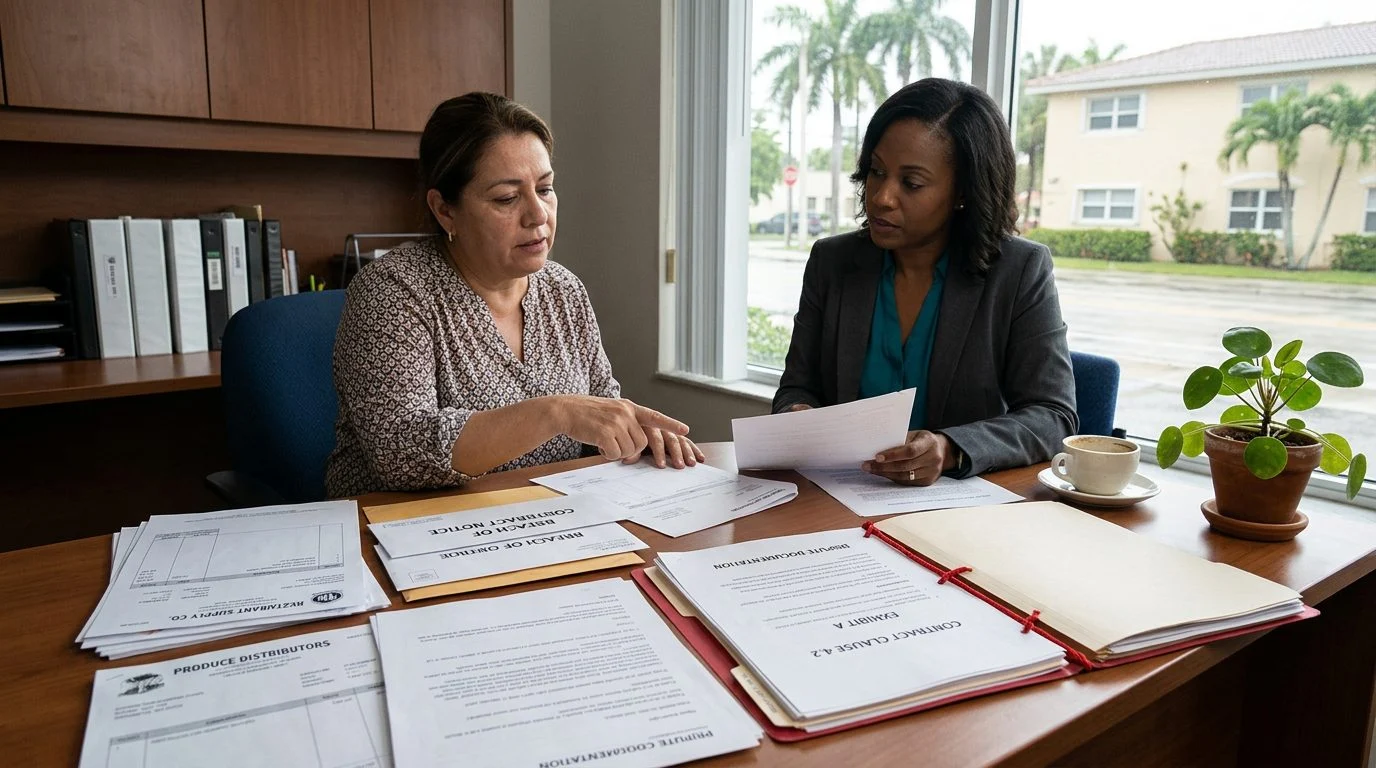
Good records make a supplier dispute easier to review, and they start on the day of delivery. Before you sign or renew, check the basics.
- The supplier’s exact legal name and the terms that govern the deal.
- How and when prices can change, and whether surcharges are allowed.
- Minimum-purchase language, and what happens if you close a location.
- The notice period to end or renew, and any auto-renewal date.
- Any personal promise to cover a company debt, and what it covers.
At delivery, record counts, temperatures and condition. Photograph damaged product. Acceptance matters. Under § 672.606, a buyer accepts goods after a reasonable chance to inspect them when it signals they conform, keeps them despite a defect, or fails to make an effective rejection (s. 672.602(1)). Acting inconsistently with the seller’s ownership is also acceptance, but if that act is wrongful against the seller, it counts only if the seller ratifies it. Fla. Stat. § 672.606 reads: “(c) Does any act inconsistent with the seller’s ownership; but if such act is wrongful as against the seller it is an acceptance only if ratified by her or him.”
After acceptance, notice of a breach is critical. Under § 672.607, you must notify the seller within a reasonable time after you discover, or should have discovered, the breach. Otherwise you may be barred from any remedy. Send written complaints inside the contract’s notice window and keep copies.
Why Restaurant Owners Work With KEW Legal
KEW Legal works with restaurant owners as outside general counsel. The firm reviews supply terms before problems start and handles disputes when they come up.
The firm focuses on partnership disputes, business contract and vendor disputes, employment matters for employers, business acquisitions and sales, succession planning, commercial leases and commercial evictions. A supply dispute often overlaps with a lease, a partner disagreement or a staffing issue. Our team can review those related pieces together.
The firm has offices in Coral Gables and Sunny Isles Beach. Our lawyers serve business clients across Miami-Dade and South Florida, including Broward County. Kristina E. Wilson is the responsible lawyer for this page, and Natalie Martinez is also one of our lawyers.
This page has not been approved by The Florida Bar. A matter may be referred to another lawyer or firm where needed.
Not sure what your next step is?
Talk it through with our team — the first consultation is free, confidential, and carries no obligation.
Frequently Asked Questions
Can my restaurant withhold payment for spoiled or short product?
Withholding payment can create risk for your restaurant. The contract’s notice terms, your timing and what you accepted all matter, and the answer depends on the facts.
Is a verbal agreement with a food supplier enforceable in Florida?
Florida can enforce a deal shown by conduct, but goods priced at $500 or more generally need a signed record. There are exceptions, including goods that were paid for and accepted.
Do I have to pay an invoice if I never signed a contract?
Florida law can find a contract from conduct. A buyer must pay the contract rate for goods it accepts.
Can I sue a vendor in small claims court?
Smaller money disputes can go to small claims court. Our team can review whether that fits your claim.
Does a personal promise make me personally liable for a supply debt?
It can, if you signed it. Florida requires a signed writing before someone can be held to a promise to answer for another person’s debt (§ 725.01).
Do you handle restaurant supplier disputes outside Coral Gables?
KEW Legal serves clients across Miami-Dade and South Florida, including Broward County, from its Coral Gables and Sunny Isles Beach offices. A matter may be referred to another lawyer or firm where needed.
Is the first consultation free?
The first consultation is free, confidential and comes with no obligation to continue.
Talk to KEW Legal About Your Supplier Dispute
If a supplier is demanding a payment you think is wrong, or has renewed a contract you never agreed to extend, KEW Legal can review your documents with you. Call 305-990-2300 or send us a message through our contact page today.
How KEW Legal Works With Restaurant Owners
Confidential First Conversation
The initial consultation is free, confidential and with no obligation to continue. You can describe your dispute openly.
Review of Your Contract Terms
We look at the supply agreement, purchase orders, invoices and delivery records together to understand what was agreed and what happened.
Outside General Counsel Support
Our team works with business owners on an ongoing basis, so supplier questions can be addressed as they arise, not only after a dispute grows.
Clear Options Explained
We explain the practical paths available, from direct negotiation to formal demands, so you can decide how to proceed.
Before You Withhold Payment
Stopping payment to a supplier or refusing a delivery can create exposure for your restaurant. Speak with us before taking action so your response matches your contract and your records.
Common Restaurant Supplier Disputes
Short or Spoiled Deliveries
Disagreements over missing items, product quality and how quickly problems were reported to the vendor.
Pricing and Surcharge Changes
Questions about whether a price increase or fee was permitted under the agreement and whether it was properly communicated.
Minimum Purchase and Exclusivity Terms
Concerns about volume commitments, exclusive supply arrangements and what happens if your kitchen needs change.
Termination and Notice Issues
Disputes over how a supply contract was ended, required notice, and any remaining obligations on either side.
Talk With KEW Legal About Your Supplier Dispute
Related practice areas
- Business Contract And Vendor Dispute Attorney
- Business Loan Promissory Note Default Attorney in Miami-Dade
Request a Consultation
Fill out the short form and we will take it from there.