

Business Contracts | Coral Gables & Sunny Isles Beach
Limitation of Liability Clause Attorney in Florida
Caps on damages and liability carve-outs can decide who pays when a business deal goes wrong. KEW Legal helps Miami-Dade and South Florida business owners draft, review and negotiate these clauses. Kristina E. Wilson and our team are ready to help.
By Kristina E. Wilson · Published October 29, 2026
What a Limitation of Liability Clause Does and Who Needs One
A limitation of liability clause is a contract term that caps how much one party can collect from the other if the deal goes wrong. Some clauses also remove whole types of loss, such as lost profits.
Picture a vendor agreement. The vendor agrees to deliver equipment, software, or services. The work fails, and you lose money. The clause decides how much you can ask the vendor to pay back.
These clauses usually work in two ways. A cap sets a dollar amount or a formula. A damages exclusion waives certain categories of loss. Consequential damages are losses that follow indirectly from a breach, such as lost customers or a stalled project.
Vendors, service providers, software and IT suppliers, contractors, landlords, and tenants all use these terms. So do the businesses that buy from or hire them. Both sides of the deal live with the clause.
The clause often matters as much as the breach itself. You may prove the other side broke the deal and still recover far less than your loss. That is why the wording deserves attention before a dispute starts.
Not sure what your next step is?
Talk it through with our team — the first consultation is free, confidential, and carries no obligation.
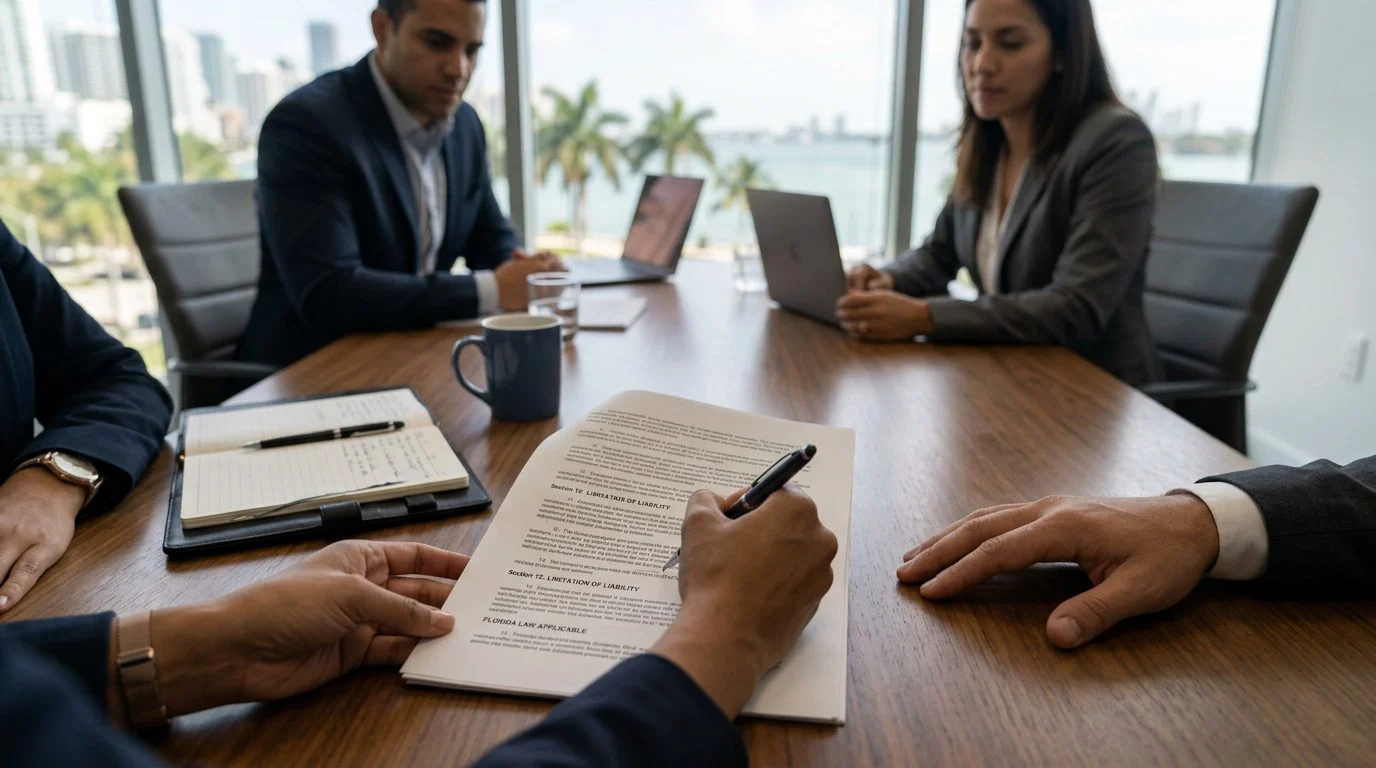
Provisions These Clauses Typically Contain
Most of these clauses include a cap, a damages exclusion, carve-outs, and time limits. Each one changes what you can recover.
- The cap. It may be a fixed amount, the fees paid in a set period, or an insurance limit. A cap tied to fees paid over the last 12 months can be small if the deal is new.
- Direct and indirect damages. Direct damages flow straight from the breach. Indirect and consequential damages do not. Read how the contract defines each term, because the definitions decide what is excluded.
- Carve-outs. These are exceptions to the cap. Common ones cover confidentiality breaches, intellectual property claims, payment obligations, and data security. Check whether willful misconduct is carved out too.
- Time limits. Some clauses require notice within a set period. Florida law voids a contract term that sets a shorter time to bring a suit than the statute of limitations allows, under Fla. Stat. § 95.03.
- Indemnity language. An indemnity or hold harmless promise elsewhere in the contract can override a cap. Read the whole agreement together.
How Florida Courts Review These Clauses
A Florida court can refuse to enforce a contract clause that is unconscionable, meaning so unfair that it should not be enforced. The court has several options. Under Fla. Stat. § 672.302, if a court as a matter of law finds the contract or any clause of the contract to have been unconscionable at the time it was made, the court may refuse to enforce the contract, may enforce the remainder of the contract without the unconscionable clause, or may so limit the application of the clause as to avoid any unconscionable result. When it is claimed or appears to the court that the contract or any clause may be unconscionable, the parties must be given a reasonable opportunity to present evidence on the deal’s setting, purpose, and effect.
Under Basulto v. Hialeah Automotive, both the procedural and substantive aspects of unconscionability must be present. Under Basulto, a court considers both procedural unfairness (how the deal was made) and substantive unfairness (how harsh the terms are). In Basulto v. Hialeah Automotive, the court concluded that both aspects are not necessarily required to the same degree and should be evaluated interdependently rather than as independent elements.
Sales of goods follow their own rules.
Fee clauses matter too. Under Florida’s American Rule, each side generally pays its own attorney’s fees unless a contract or statute provides otherwise, as Price v. Tyler explains. A fee clause in your contract can change who pays.
Drafting and Negotiation Problems That Lead to Disputes
Disputes over these clauses can stem from wording that could have been clarified before signing. Each problem below is easy to miss on a first read.
- Vague cap periods. The contract may not say whether the cap applies per claim, per year, or for the whole deal.
- Conflicting sections. An uncapped indemnity in another section can override the cap you negotiated.
- Missing carve-outs. Confidentiality, data security, or payment terms left out can expose you in ways you did not plan for.
- Caps that don’t match insurance or risk. A cap far below the vendor’s insurance, or far below your real exposure, leaves a gap.
- Late or standard-form terms. A vendor’s confirmation form may add a cap after you have already placed an order. Whether that term binds you can turn on the battle of the forms rules described above.
- Discovery after loss. Owners may read the clause only after a failed delivery, when the vendor is already relying on it.
Reading the cap alone is one way to miss other terms that matter. A clean-looking cap can still be overridden by language somewhere else.
What to Expect When You Work With KEW Legal on This Issue
The process starts with the full paper trail and a review of the whole agreement. Each step below builds on the one before it.
- Intake and documents. You share the complete contract, amendments, purchase orders, statements of work, and related emails or letters.
- Review as a whole. The cap, damages exclusion, carve-outs, indemnity terms, time limits, and governing law are read together.
- Written analysis. The analysis explains how the clause is likely to work against your specific losses or risks.
- Drafting or next steps. For a deal still in negotiation, proposed changes are drafted or redlined. For an active dispute, options and next steps are outlined.
- Negotiation or resolution. Depending on where the matter stands, the firm negotiates with the other side or prepares for resolution.
Timing varies with the complexity of the contract and with whether the deal is still in negotiation or already in dispute.
Why Businesses Bring This Work to KEW Legal
KEW Legal is a Florida business law firm that works as outside general counsel for business owners and investors. It handles contract and vendor matters alongside the rest of a company’s legal needs.
- The firm concentrates in business contract and vendor dispute matters.
- Outside general counsel work connects contract review to other obligations, such as commercial leases, employment, and partnership issues.
- The firm has offices in Coral Gables and Sunny Isles Beach. It serves clients across Miami-Dade and Broward County, including Brickell, Doral, Aventura, and Fort Lauderdale.
- Kristina E. Wilson is the lawyer responsible for this page. The firm’s lawyers include Kristina E. Wilson and Natalie Martinez.
- Every matter turns on its own contract, so no particular outcome can be promised.
Not sure what your next step is?
Talk it through with our team — the first consultation is free, confidential, and carries no obligation.
Frequently Asked Questions
Is a limitation of liability clause enforceable in Florida?
Often, between businesses, yes. Enforceability depends on the clause’s wording, the conduct involved, and the rest of the contract.
Can a cap cover gross negligence or intentional misconduct?
Whether a cap reaches that kind of conduct turns on the clause’s wording and the facts involved. Read any carve-out language closely.
Does a cap stop me from recovering anything at all?
Most caps limit recovery rather than erase it. The cap amount and any damages exclusions decide what remains.
Can a contract shorten the time to file a lawsuit?
No. Under Fla. Stat. § 95.03, a contract term that sets a shorter period than the statute of limitations is void.
What should I gather before a consultation?
Bring the complete contract, any amendments, invoices, and written messages about the problem. Organized papers make the first review faster.
What does the first consultation cost?
KEW Legal offers a free first consultation. It is confidential, and it comes with no obligation to continue.

Talk Through Your Contract Before You Sign or Respond
If a liability cap is in your way, you don’t have to work through it alone. You may be reviewing a vendor agreement before signing, or a vendor may have pointed to a cap after a failed delivery. Call 305-990-2300, send a message through the contact page, or schedule a consultation to walk through your clause and the losses involved.
How KEW Legal Can Help With Your Liability Clause
Contract Review
We read the liability cap, exclusions and indemnity language in context with the rest of your agreement.
Drafting and Negotiation
We prepare clauses that reflect your risk tolerance and push for balanced terms with the other side.
Outside General Counsel
For businesses that want ongoing guidance, we review vendor, client and partner agreements as they come up.
Dispute Support
If a liability question has already arisen, we explain where the clause stands and what options your business has.
Do not assume a cap protects you
A clause that looks protective on the surface can behave very differently once it is tested. Wording, carve-outs and how the clause fits the rest of the contract all matter. Review it before you sign or before you respond to a claim.
Questions to Ask Before You Sign
What is capped, and at what amount?
Confirm whether the cap is a fixed dollar figure, tied to fees paid, or undefined, and whether it applies to both parties.
What is excluded from the cap?
Look at carve-outs for indemnity, confidentiality, intellectual property and willful misconduct.
How does the clause treat gross negligence?
Check whether the language reaches gross negligence or intentional conduct, and how it is worded.
Does it match the rest of the agreement?
Make sure the indemnity, insurance and termination provisions do not conflict with the cap.
Talk With KEW Legal About Your Contract
Related practice areas
- Business Contract And Vendor Dispute Attorney
- Vendor Warranty Breach Attorney in Miami-Dade for Business Buyers
Request a Consultation
Fill out the short form and we will take it from there.