
Business Contracts | Coral Gables and Sunny Isles Beach
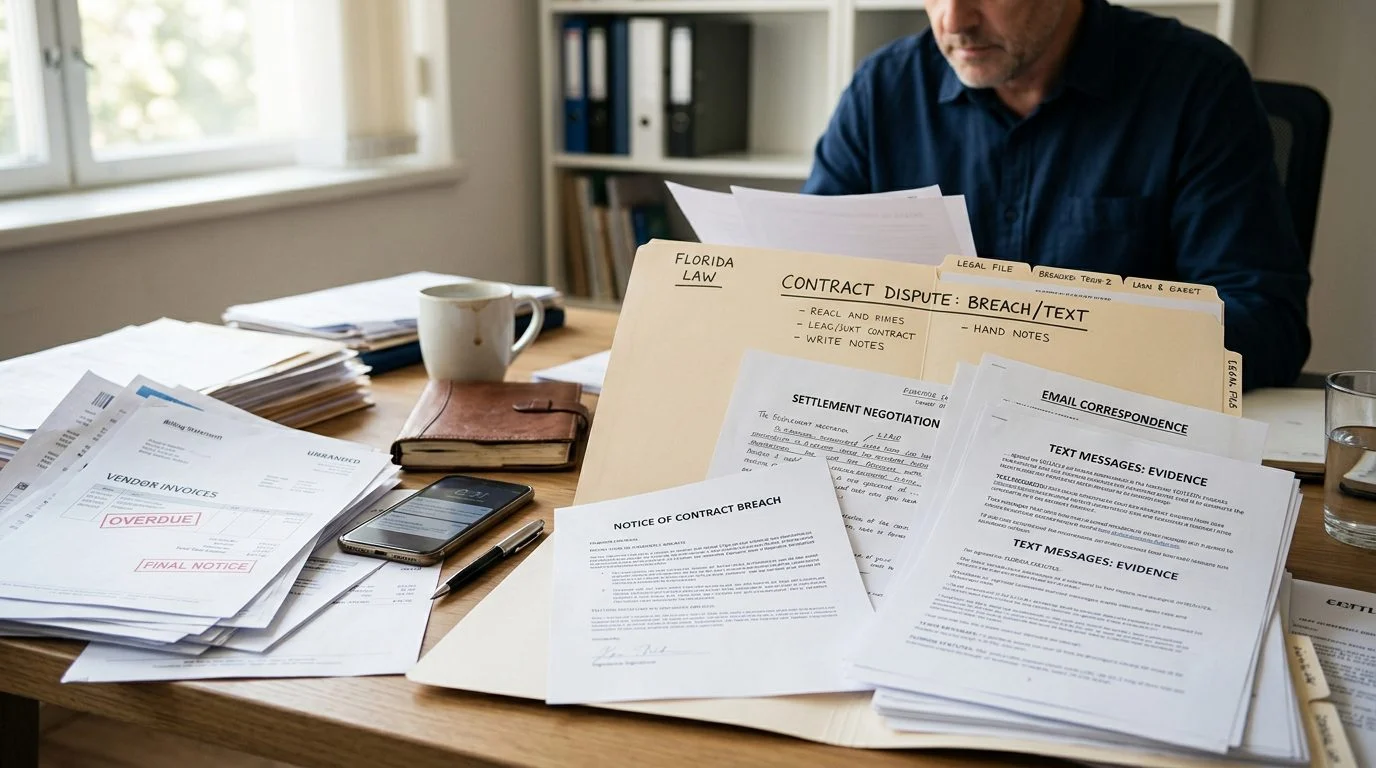
Can a Text Message Bind Your Business in Florida?
KEW Legal helps business owners and investors across Miami-Dade and South Florida sort out whether a text thread created a real deal, and what to do next. Our free first consultation is confidential and comes with no obligation to continue.
By Kristina E. Wilson · Published November 5, 2026
Yes, a text message or email can form a binding business contract in Florida. It happens when the messages show that both sides agreed to the essential terms, and the deal fits the writing rules Florida applies to that kind of agreement. Whether a specific thread does this depends on the facts.
This page is written by Kristina E. Wilson, a lawyer at KEW Legal in Coral Gables, Florida. KEW Legal acts as outside general counsel for business owners and investors in Miami-Dade and Broward County, with offices in Coral Gables and Sunny Isles Beach.
Can a Text or Email Form a Contract in Florida?
Yes, in the right circumstances. A text or email exchange can create a binding agreement when the messages show a real deal, not just a conversation about one. The content of the messages matters, and so does what each person did afterward.
Consider a cleaning company that texts a property manager: “I can do monthly cleaning for $1,800, starting June 1.” The manager replies, “Yes, go ahead.” That exchange names a price, a service, a start date, and a clear yes. It may be enough to show a contract.
Now compare that with “Let’s talk about cleaning sometime.” That is not a deal. The gap between those two sets of messages is the whole question.
Not sure what your next step is?
Talk it through with our team — the first consultation is free, confidential, and carries no obligation.
What Makes Any Florida Contract Binding?
A Florida contract needs an offer, an acceptance, consideration, and essential terms stated clearly enough. Business agreements often focus on what each side will give and what each side will receive in return. The same basics apply to written and electronic deals.
Business agreements often address who the parties are, what work or sale is involved, how payment will be made, and when performance is expected. If one of those is missing or left open, the deal may be incomplete.
Messages can supply these pieces across several texts. One message names the price, another names the scope, and a third says “deal.” The pieces can come from different messages, but they must fit together into one agreement.
How Florida Law Treats Electronic Messages and Signatures
An electronic signature generally carries the same weight as a handwritten one in Florida. Fla. Stat. § 668.004 says that, unless another law provides otherwise, an electronic signature “shall have the same force and effect as a written signature.”
Florida defines an electronic signature as letters, characters, or symbols that a party adopts with an intent to authenticate a writing (Fla. Stat. § 668.003). The key word is intent. A name at the bottom of an email is not automatically a signature in every case. The sender must have meant to sign or adopt it.
The same law says an electronic record is not enforceable against a recipient if the sender blocks the recipient from storing or printing it.
When a Text or Email Exchange Is More Likely to Bind
A text or email exchange is more likely to bind when it names the key terms and the other side clearly accepts them. Clear terms plus a clear yes make the strongest case.
Look for a specific price or payment formula, a defined scope of work, a start date or deadline, the names of the parties, and a plain reply such as “agreed” or “send the invoice.”
Conduct also counts. For sales of goods, Florida allows a contract to be made “in any manner sufficient to show agreement, including conduct by both parties which recognizes the existence of such a contract” (Fla. Stat. § 672.204). If one side orders product and the other ships it and the buyer accepts it, that conduct can help show a deal. Starting a job, paying a deposit, or accepting delivery after the messages can show both sides treated the deal as real.
When Texts and Emails Often Fall Short
Texts and emails often fall short when they discuss a deal without accepting one, or when key terms stay open. “Let’s talk,” “sounds good in principle,” and “I’ll think about it” usually do not close a deal.
Drafts sent for review, and messages that say the terms are subject to a later signed agreement, often show that the parties have not yet agreed.
Some deals also need a signed writing under Florida law. The statute of frauds (Fla. Stat. § 725.01) bars certain actions unless the agreement, or a note or memorandum of it, is in writing and signed by the party to be charged. That covers contracts for the sale of land, leases longer than one year, agreements not to be performed within one year, and several other cases, including any special promise to answer for the debt, default or miscarriage of another person.
Between merchants, a written confirmation can satisfy this rule. The receiver must object in writing within 10 days after receiving it, so that window matters.
How Texts and Emails Are Used as Evidence in a Florida Dispute
Texts and emails are often the main proof in a business dispute. The messages must be shown to be genuine. A court needs to see that they came from the people named and that they were not changed.
Preserve complete threads. Keep phone numbers, email addresses, timestamps, group chats, and attachments. A cropped screenshot can leave out the reply that changes the meaning. Save or export the full conversation from the phone or email account.
Your own sent messages carry weight. What you wrote about a deal can be used to show what you agreed to, so think before you reply.
Deleting messages, switching phones, or closing an email account can make it harder to prove what was said. Keep your devices and accounts until the matter is reviewed.
Not sure what your next step is?
Talk it through with our team — the first consultation is free, confidential, and carries no obligation.
Common Business Situations Where This Question Comes Up
This question usually appears in vendor, payment, partnership, and lease disputes. The facts in each one decide the outcome.
A vendor may send a quote by email, then raise the price by text partway through a job. The question is whether the emailed quote still controls, or whether the later text was a new offer that the other side accepted by continuing the work.
Withholding payment over defective work often rests on messages about quality or completion. Those messages can show what was promised. They can also show whether the work was accepted.
Partnerships are a common surprise. Under Florida law, two or more people who carry on a business for profit as co-owners form a partnership, whether or not they meant to (Fla. Stat. § 620.8202). A person who receives a share of the profits is presumed to be a partner, unless the profits were paid for a listed reason, such as wages, rent, or repayment of a debt. A text saying “you get 20% of profits” can matter a great deal.
Practical Steps to Take While You Sort Out the Facts
Keep every message, including ones that seem unimportant. Do not edit, delete, or rearrange the thread. Write a dated summary of what was agreed, who said it, and when. Keep that summary apart from the messages themselves.
Be careful with new messages. Avoid describing the deal in terms you have not checked, and avoid admitting fault. A short, calm reply is usually safer than a long argument by text.
Timing matters too. If you keep acting as if a deal is in force after learning the key facts, that conduct may matter.
Talk Through Your Messages With KEW Legal
If you’re reviewing a text thread or email chain for a business you run, a partner, a vendor job, or a family member’s company, you may be doing it under pressure. A payment you didn’t expect, a partner who went quiet, or a job that changed midstream can make the messages feel urgent.
KEW Legal can review the actual message thread with you, along with any invoice, quote, lease, or operating agreement. The review looks at the terms, the replies, and what happened afterward. KEW Legal focuses on partnership, vendor, employment, succession, lease, acquisition, and investment matters for business owners and investors.
KEW Legal offers a free first consultation. It is confidential and carries no obligation to continue. Call 305-990-2300 or send a message through the contact page.
Frequently asked questions
Can a text message be a binding contract in Florida?
Yes, it can, when the messages show agreement on essential terms and the deal fits Florida’s writing rules.
Are emails enforceable like texts?
Emails can work the same way, because Florida gives electronic signatures the same effect as written ones in many cases.
Do all business deals need to be in writing?
No. Some deals, such as sales of land and leases longer than one year, need a signed writing under Florida’s statute of frauds.
What to review when a deal was made by text
Save the full thread
Keep every message, including dates, times, attachments and any follow-up. Context often matters as much as the final text.
Identify the essential terms
Look at whether the messages address the parties, price, scope, timing and other key points the business actually needed to agree on.
Check for signs of a final deal
Confirm whether the parties said they were still negotiating, planned to sign a formal document, or made performance contingent on a later step.
Consider the business context
Prior dealings, industry practice, payments, deliveries and other conduct can shape how a text exchange is read in a dispute.
Do not assume a text thread is final
A quick message such as 'sounds good' can be read as agreement, or as a step in ongoing negotiations. Before you perform, pay, deliver, or stop work based on a text exchange, have the exact messages reviewed.
How KEW Legal can help
Contract and vendor disputes
We review the messages, emails and written terms behind a vendor or customer relationship and advise on your position.
Outside general counsel
Ongoing business advice for owners who want a lawyer to review deals, communications and contracts before problems arise.
Partnership and succession matters
Text-based agreements between owners, investors and partners can raise hard questions about ownership, authority and exit terms.
Commercial leases and property
We handle commercial lease and real estate investment questions, including commercial evictions for owners who live abroad.
Talk with Kristina E. Wilson and our team about your messages. Your first consultation is free, confidential and comes with no obligation to continue.
Related practice areas
- Business Contract And Vendor Dispute Attorney
- Can a Vendor Raise Prices Mid-Contract in Florida?
- Verbal Agreement With a Vendor Enforceable in Florida?
Request a Consultation
Fill out the short form and we will take it from there.