
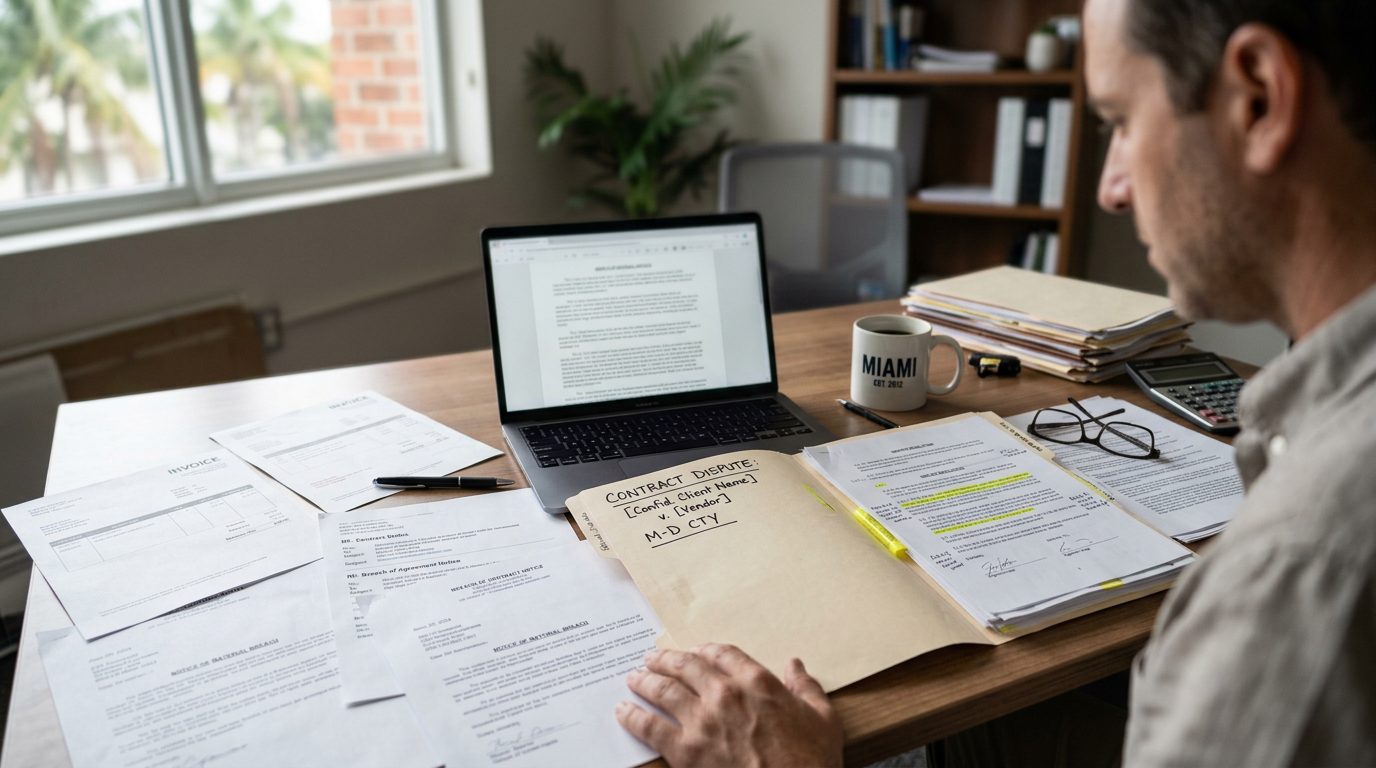
Business Contract Disputes | Miami-Dade County
Contract Interpretation Disputes: Get Clear on What Your Agreement Says
KEW Legal, based in Coral Gables and Sunny Isles Beach, helps business owners across Miami-Dade read their contracts, weigh the other side's position and decide what to do next. Kristina E. Wilson, Coral Gables.
By Kristina E. Wilson · Published October 22, 2026
A contract interpretation dispute happens when both sides signed the same agreement but read a key term differently. This page explains how that reading works and what KEW Legal does before any demand goes out.
What a Contract Interpretation Dispute Is and Who It Affects
A contract interpretation dispute is a disagreement about what a signed agreement means. Both sides can point to the same document and still act on different readings.
Common examples include:
- A vendor says a request fell outside the scope of work and bills for the extra time.
- A client holds back payment because it believes a milestone was never met.
- One party says a termination notice was valid. The other says it was not delivered the right way.
This matters most to Miami-Dade business owners, investors, and managers who hold a service agreement, purchase order, commercial lease, or partnership contract. KEW Legal serves business owners and investors across Miami-Dade and South Florida, and this page covers the contract questions that come up most often in that work.
The cost often starts before anyone files a lawsuit. Payments stall, projects pause, and nobody knows whether work can continue.
If a vendor, client, or partner reads your signed contract differently and payments have stopped, we can review the agreement and the latest notice with you. Talk it through with our team — the first consultation is free, confidential, and carries no obligation.

How a Florida Court Reads a Commercial Contract
Three points shape the reading:
Whether a term is ambiguous is often the first fight. One side says the words are clear. The other says they are not.
Two more rules matter here. Also, an arbitration clause can decide where the fight happens. Under Fla. Stat. § 682.02, a written agreement to arbitrate is valid, enforceable, and irrevocable, except on grounds that exist for revoking any contract. Under Fla. Stat. § 682.03, a court may not refuse to order arbitration just because the claim lacks merit.
Contract Clauses That Cause the Most Interpretation Disputes
The clauses below produce many of these fights. Knowing them helps you spot risk early.
- Scope of work. Words like “completion,” “substantial performance,” or “specifications” invite argument. So does a change order process that was never followed.
- Payment triggers. Payment may depend on invoice approval, acceptance testing, or a required document, such as a lien waiver. Parties often disagree on whether the trigger has happened.
- Termination and notice. “For cause” and “for convenience” mean different things. Cure periods, notice methods, and addresses matter. A defect in notice can decide the outcome.
- Renewal dates. Auto-renewal clauses often set short windows for non-renewal notice. Missing the window can lock in another term.
- A contract provision that sets a shorter period to file a lawsuit arising out of the contract than the applicable statute of limitations is void under Fla. Stat. § 95.03. Venue follows the rules in Fla. Stat. § 47.011: actions are brought only in the county where the defendant resides, where the cause of action accrued, or where the property in litigation is located, and the section does not apply to actions against nonresidents.
- Amendments and waivers. An emailed change or a pattern of doing things differently may or may not change a signed term.
How KEW Legal Reviews the Language and Frames the Dispute
Our lawyers start with the complete paper trail. They frame the disagreement in writing before any position is taken.
- Collect the full contract set. This includes the base agreement, exhibits, purchase orders, amendments, change orders, and notices.
- Read each disputed term against the rest of the agreement. Mark the words that control the outcome.
- Assess whether the term is plain or ambiguous. Note what outside evidence would matter if it is not plain.
- Build a timeline. Record performance, payments, and communications in order.
- Write the issue. Set out each side’s reading, the language behind it, and the practical risk to the client.
- Choose the next step together. Options include a demand, a negotiated fix, a response to the other side’s notice, or preparation for the forum the contract names.
The order matters. A demand sent before the record is clear can lock in a weak position. Florida’s fee-sanctions rule also gives a party 21 days to fix a challenged claim after a sanctions motion is served, as Fla. Stat. § 57.105 explains.
What to Expect: Steps and Timeline
Most matters move through a consultation, a written review, a strategy discussion, and then negotiation or a formal forum. Timing varies with the contract, the number of documents, the other side’s response, and the forum.
- Step 1: Initial consultation. Describe the contract, the disputed term, and what the other side is demanding. Bring the agreement and the latest notice.
- Step 2: Document review. The firm reviews the controlling clauses and open facts, then gives you a written assessment.
- Step 3: Strategy discussion. You decide whether to negotiate, send a demand, keep performing, or pause work. Each option carries different risks.
- Step 4: Negotiation or proceedings. The firm communicates with the other side or its counsel. If the contract requires arbitration, or talks fail, the matter moves into that forum. On request, a court must refer most filed lawsuits for money damages to mediation, provided the requesting party is willing and able to pay the costs of the mediation or the costs can be equitably divided between the parties, unless a listed exception applies, under Fla. Stat. § 44.102.
Why Work With KEW Legal on Contract Interpretation Disputes
KEW Legal is a Florida business law firm based in Coral Gables and Sunny Isles Beach. It acts as outside general counsel for business owners and investors across Miami-Dade and South Florida.
- Related business issues. The firm’s practice areas include business contract and vendor disputes, partnership disputes, commercial leases, and business succession. A contract question is reviewed alongside related exposure. Florida’s partnership law sits in Florida Statutes Chapter 620.
- Responsible lawyer. Kristina E. Wilson is the responsible lawyer for this page. Natalie Martinez is also one of the firm’s lawyers. Our lawyers handle commercial matters with support staff.
- Plain-language assessments. Written reviews show you the clause and the risk in plain words, so you can choose your next step.
Not sure what your next step is?
Talk it through with our team — the first consultation is free, confidential, and carries no obligation.

Questions Business Owners Ask About Contract Interpretation Disputes
Do I have to keep paying or performing while the dispute is open?
The payment, suspension, and notice clauses in your contract answer this first. Review them before you stop or continue work.
Does a demand letter start a lawsuit?
A demand states your reading and sets a deadline. Whether a lawsuit follows depends on the other side’s response and the contract’s dispute clause.
Can an emailed change alter a signed contract?
A written change can matter, but the signed terms and the contract’s amendment clause usually come first.
Will a court read our conversations?
Outside evidence usually matters only when a term is found ambiguous. The written contract still comes first.
What does the first meeting cost?
The initial consultation is free, confidential, and carries no obligation to continue.
If a vendor, client, or partner reads your signed contract differently and payments have stopped, call 305-990-2300 or send the agreement and latest notice through our contact page to schedule your initial consultation.
How we approach a contract interpretation dispute
Read the whole agreement
We review definitions, payment, termination, notice and dispute clauses together, because they often affect how each other should be read.
Pinpoint the disagreement
We identify whether the dispute is about what a term means, whether a condition was met, or whether a party performed as required.
Compare both readings
We look at emails, drafts, invoices and the parties' conduct to see how the agreement has been understood in practice.
Protect your position
We advise on whether to keep paying, keep performing or pause while the question is open, based on what the contract says.
Choose the next step
We discuss options such as a demand letter, negotiation, mediation or litigation, matched to your contract and your goals.
Check the contract before you stop paying or working
Stopping payments or work before reviewing the payment, suspension and notice clauses can create problems of its own. A short review first can help you decide how to proceed.
Common contract interpretation disputes
Payment and fee terms
Disagreements over what amounts are owed, when they are due, late charges, or credits.
Scope of work
Questions about whether a vendor, contractor or service provider delivered what the agreement describes.
Termination and notice
Disputes over whether a notice was properly given and what the contract requires before the relationship ends.
Ambiguous language
Key words such as "completion," "material breach" or "exclusive" that can reasonably be read more than one way.
Amendments and side agreements
Questions about whether later emails, change orders or verbal changes modify the written contract.
Talk with KEW Legal about your contract dispute. Your first consultation is free, confidential and comes with no obligation to continue.
Related practice areas
Request a Consultation
Fill out the short form and we will take it from there.