
Business Contract & Vendor Dispute Attorney | Coral Gables & Sunny Isles Beach
Facing a Breach of Contract Lawsuit?
KEW Legal represents business owners and investors across Miami-Dade and South Florida when a vendor, partner, client or other party claims your business failed to meet its contract. Our team focuses on clear answers, careful review and a strategy built around your business.
Where to Find Us
2
Offices in Coral Gables and Sunny Isles Beach
Free
Confidential first consultation, with no obligation to continue
By Kristina E. Wilson · Published October 22, 2026
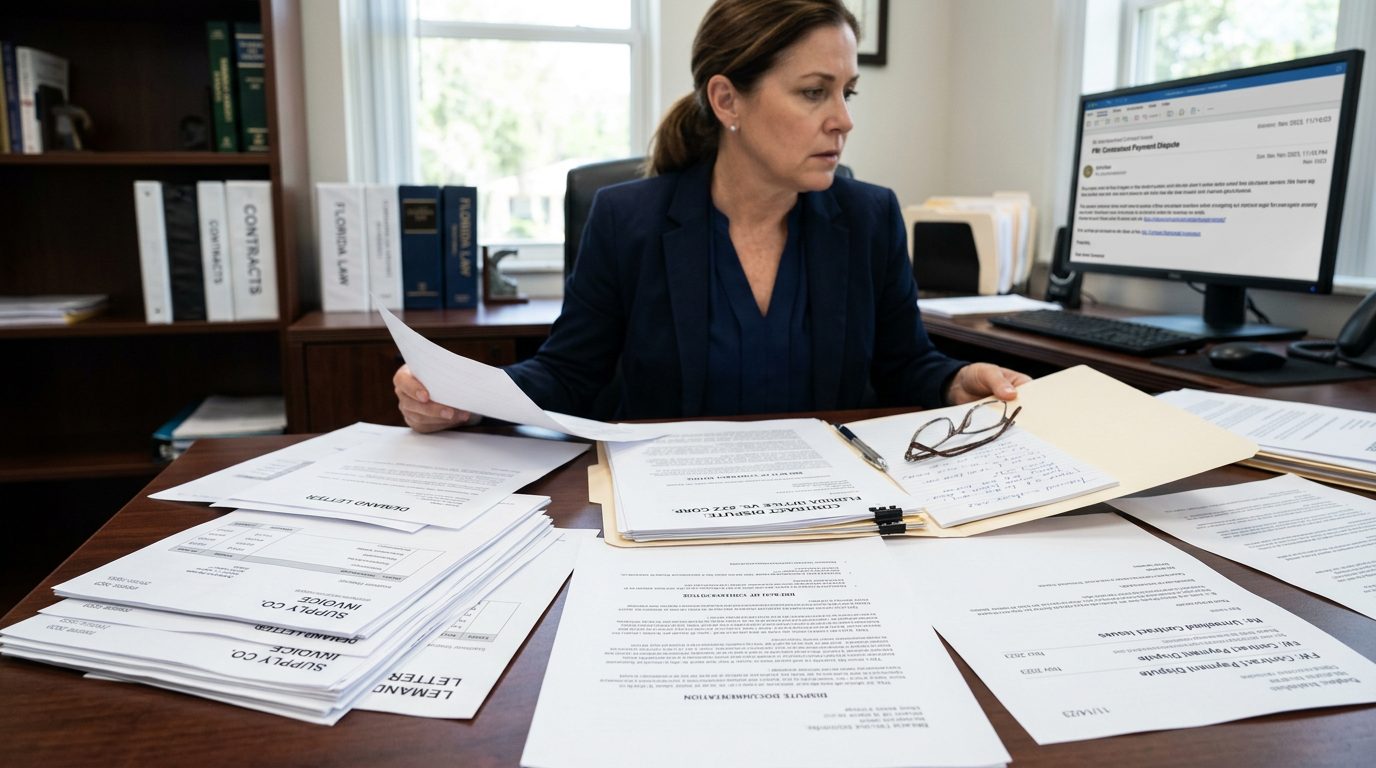
If your business has been sued for breach of contract in Florida, or received a demand letter saying it broke a deal, start with the deadlines. Read every paper the day it arrives and mark the response date. Then gather your records. Defending a business sued for breach of contract in Florida means testing the claim against the contract, the timeline and Florida law. Outcomes depend on the facts.
What this defense covers and who it is for
Defending a business sued for breach of contract in Florida means representing the company when another party says it failed to meet a contract term. It also covers a pre-suit demand letter that makes the same claim.
The defense fits owners, managers and officers facing claims from customers, vendors, landlords, co-owners or other business partners. A vendor may say an order was never paid. A landlord may say a lease term was broken. A partner may say a shared obligation was missed.
KEW Legal serves as outside general counsel for businesses in Miami-Dade, Broward and South Florida. The firm has offices in Coral Gables and Sunny Isles Beach. If the claim involves a co-owner, a partnership dispute may also be part of the picture.
If your business was just served with a breach of contract lawsuit or a demand letter, we can review your deadlines with you and walk through the next steps. Talk it through with our team — the first consultation is free, confidential, and carries no obligation.

Read the papers first: complaint, demand letter and deadlines
A lawsuit starts a court response clock. A demand letter may set its own date. Know which one you have before you do anything else.
A summons and complaint are court papers. A demand letter is a notice from the other side. It can set its own deadline and shape how the dispute moves later.
Missing a court deadline can lead to a default judgment against your business. A default is much harder to undo than a timely response.
Gather these items now: the signed contract and every amendment, purchase orders, emails and texts, invoices, delivery and payment records, and any notices exchanged. Keep originals. Don’t edit or delete anything.
What a Florida breach of contract claim must show
Each point can be tested against your records.
Timing is one of the first tests. The Florida limitations statute sets different time limits for different types of actions. Under Fla. Stat. § 95.11(1), the twenty-year period applies to an action on a judgment or decree of a court of record in this state. It does not set the deadline for a breach-of-contract claim.
Under Florida’s accrual rule, that is the date the claim’s last element happens. Some payments and pending arbitration can pause the clock under Florida’s tolling rules.
A contract clause that sets a shorter time to sue than the statute allows is void, under § 95.03. Check the notice, cure and dispute steps in the contract, too.
Email can form part of a deal. Under Florida electronic signature law, an electronic signature generally has the same force as a written one.
Which defenses may apply to a breach of contract claim?
Defenses depend on the facts, so each one is a question to test against your records. Start with timing. If the suit came after the limitations period ran, a time-bar defense may apply.
Next, check the contract’s own steps. If it required written notice, an inspection or a cure period, and the other side skipped it, that may matter.
For goods priced at $500 or more, a signed record is generally required. Florida’s statute of frauds for goods also says that, between merchants, a record confirming the contract that is sufficient against the sender, received within a reasonable time, whose contents you have reason to know, can satisfy the signed-record requirement against you unless you give notice of objection in a record within 10 days after receiving it.
After accepting goods, a buyer must notify the seller of a breach within a reasonable time after discovering or should have discovered it, or be barred from any remedy under Florida’s UCC notice rule.
Unconscionability is another test. The Florida Supreme Court in Basulto requires both how the deal was made and how unfair the term is. Waiver, accord and satisfaction, and a signed release may also apply to the facts.
How the defense works, step by step
The defense usually moves through six stages, from first review to resolution. Timing depends on the court and the case.
- Intake and deadlines. We review the papers, confirm the response date and check for conflicts.
- Document review. We build a timeline of the contract, performance, payments and messages.
- Response strategy. We decide how to answer the complaint or reply to the demand letter.
- Filings. Answers, defenses and any counterclaim are filed within court deadlines.
- Discovery. Both sides exchange documents and may take depositions, which are sworn questions asked outside court.
- Resolution. The case may end through negotiation, mediation or trial, depending on the facts and your business goals.
Fees, settlement offers and counterclaims
Fee exposure in a contract case can run both ways. Review the fee clause and any settlement offer early.
If a contract lets one party recover fees for enforcing it, the court may allow fees to the other side when that side wins. Florida’s attorney’s fee statute provides for this under § 57.105(7). Under § 57.105(7), for contracts entered into on or after October 1, 1988, a one-way fee clause may not stay one-way: the court may allow reasonable attorney’s fees to the other party when that party prevails.
Under § 57.105(1), on the court’s initiative or a party’s motion, the court shall award a reasonable attorney’s fee, to be paid to the prevailing party in equal amounts by the losing party and the losing party’s attorney, when the losing party or its attorney knew or should have known that a claim or defense was not supported by the material facts or would not be supported by then-existing law. Under § 57.105, a sanctions motion must be served and then wait 21 days, giving the other side time to withdraw or correct the paper.
See Florida’s offer of judgment statute, § 768.79.
Settlement talks are generally protected. Under § 90.408, an offer to compromise a disputed claim cannot be used to prove liability or its value.
If the other side owes your business money, such as unpaid invoices, a counterclaim may be filed where the contract and records support it.
Not sure what your next step is?
Talk it through with our team — the first consultation is free, confidential, and carries no obligation.
Why KEW Legal for a breach of contract defense
KEW Legal focuses on business law. The firm handles partnership disputes, vendor and contract disputes, employment matters for employers, and commercial leases.
Kristina E. Wilson is the responsible lawyer for this page. Natalie Martinez is also a lawyer at the firm. Our lawyers work with business owners as outside general counsel.
Our approach to defending a business sued for breach of contract in Florida starts with the contract and the record. Defenses follow from the facts and from what matters most to your business.
The firm has offices in Coral Gables and Sunny Isles Beach. It serves businesses across Miami-Dade and Broward County. The first consultation is free, confidential and carries no obligation to continue.
Frequently asked questions
Calendar that date the day the papers arrive.
Is a demand letter the same as a lawsuit?
No. A demand letter is a notice from the other side, while a lawsuit is a court filing. A demand letter can still set a deadline, so respond promptly.
Can a breach claim be based on an email agreement?
Yes, if the facts show a contract was formed. Florida law generally gives an electronic signature the same effect as a written one.
How long does someone have to sue for breach of contract in Florida?
The Florida limitations statute sets different time limits depending on the type of action. For example, an action on a judgment or decree of a court of record in this state must be commenced within twenty years. Accrual and tolling rules can change the count.
Can I ignore a vendor’s claim and hope it goes away?
No. Ignoring a filed lawsuit can lead to a default, so review it right away.
What should I do with messages about the dispute?
Keep them, including emails and texts. Don’t delete or change them.
If your business was just served with a breach of contract lawsuit or a demand letter, call 305-990-2300 or send us a message so we can review your deadlines with you.
How KEW Legal Defends Your Business
Careful Contract Review
We review the agreement, its amendments, purchase orders, emails and performance history to determine what was actually promised and what was delivered.
Defense Strategy Built for Your Goals
Whether you want to resolve the matter quickly, protect your reputation or keep a valuable vendor or client relationship, we tailor our approach to your priorities.
Clear, Direct Communication
We explain the claim, the options available and the likely costs in plain language so you can make informed decisions at every stage.
Outside General Counsel Support
For business owners who want ongoing guidance, our team can serve as outside general counsel, helping you address disputes before they escalate.
Don't Ignore Legal Papers
A demand letter, a notice of dispute or court papers can carry important consequences. Do not ignore them or send a response without advice. Contact our office promptly so we can review the matter before you respond.
What Happens After You Contact Us
1. Free, Confidential Consultation
We listen to the facts, review the documents you have and identify the issues. Your first consultation is free, confidential and comes with no obligation to continue.
2. Evaluate the Claim
We examine the contract terms, the other party's allegations, the defenses that may apply and any counterclaims available to your business.
3. Respond and Protect Your Position
We handle communications with the other side, prepare a response and take steps to preserve evidence that supports your business.
4. Resolve or Litigate
We pursue negotiation, mediation or litigation as the situation requires, keeping you informed throughout the process.
Get Clear Answers About Your Breach of Contract Claim
Related practice areas
- Business Contract And Vendor Dispute Attorney
- Vendor Agreement Drafting Attorney in Miami-Dade | KEW Legal
Request a Consultation
Fill out the short form and we will take it from there.