
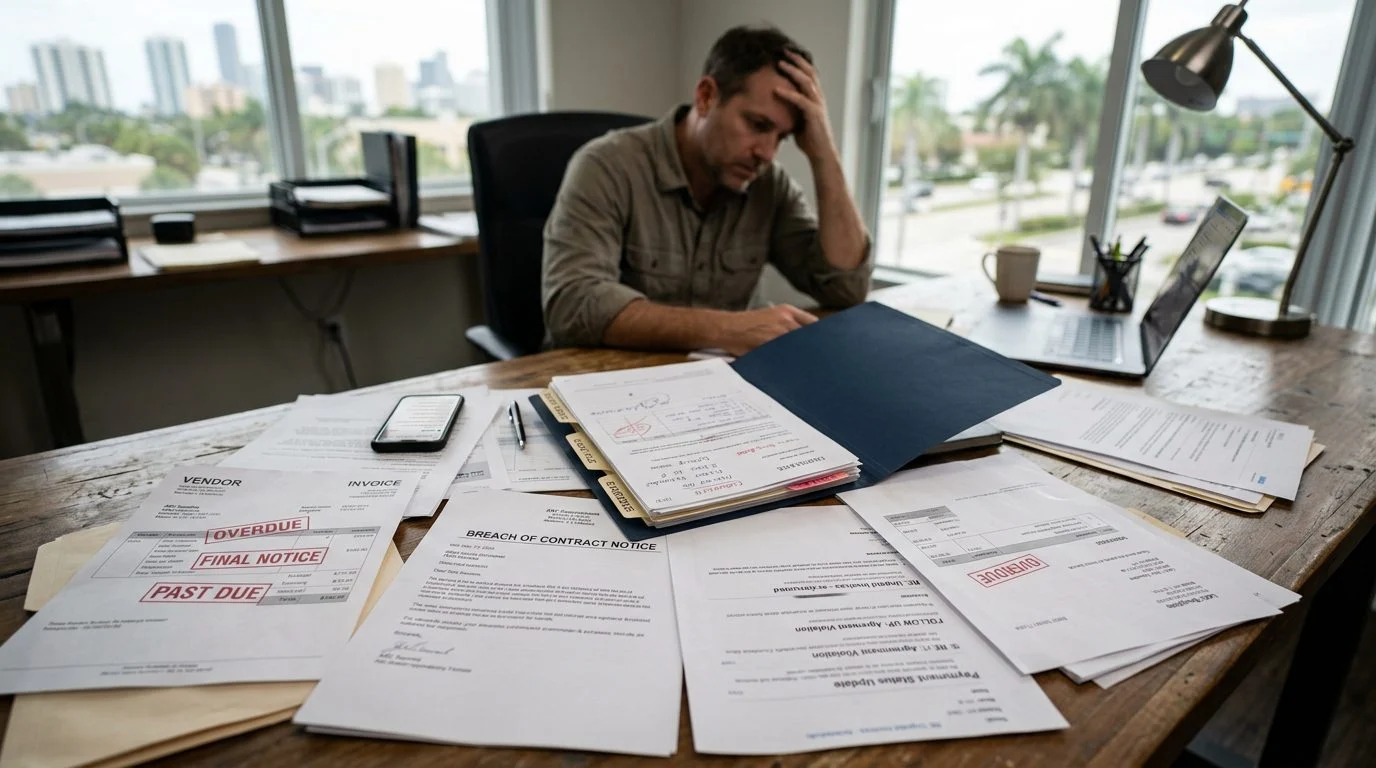
Business Contracts & Commercial Leases | Miami-Dade
Stay in Control When Customers, Vendors, or Tenants Fall Behind
Unpaid invoices, vendor balances, and back rent can strain cash flow. KEW Legal works with business owners and investors across Miami-Dade and Broward to address them through the contracts and leases that govern the relationship.
Where We Work
2
Offices: Coral Gables and Sunny Isles Beach
Miami-Dade
Counties served include Broward and South Florida
By Kristina E. Wilson · Published November 17, 2026
A business debt collection attorney helps a company recover money that a customer, vendor, client, or tenant owes under a business deal. KEW Legal handles this work for owners and investors in Miami-Dade and South Florida. The process usually starts with a documented demand, then moves to negotiation or a lawsuit if the debt stays unpaid. Here is how it works, what to gather, and when court makes sense.
What Business Debt Collection Covers and Who It Is For
Business debt collection is the work of recovering money owed to a company under a business relationship. It covers unpaid invoices, service fees, vendor balances, loans between businesses, and unpaid commercial rent.
KEW Legal focuses on business-to-business collection for company owners, investors, and controllers in Miami-Dade and South Florida. The firm has offices in Coral Gables and Sunny Isles Beach.
Common situations include:
- A customer has not paid after delivery.
- A client disputes an invoice for work already finished.
- A commercial tenant fell behind on rent.
- A vendor keeps a deposit you believe you are owed.
Some debtors live or do business outside Florida. That affects where you can sue and how you serve them, as covered below.
Because KEW Legal can also serve as outside general counsel, collection can run alongside ongoing contract and lease work in one file.
Not sure what your next step is?
Talk it through with our team — the first consultation is free, confidential, and carries no obligation.
Gather the Documents Before Any Demand Is Sent
Gather your records before you send anything. A demand is only as strong as the paper behind it.
- The contract or purchase agreement. Look for payment terms, late-fee language, interest terms, and any clause that awards attorney fees.
- Invoices and proof of delivery. Add purchase orders and any signed acceptance or work-completion form.
- A payment history. Show every payment, credit, and the running balance.
- All written communication. Keep emails, texts, and any notice of default or dispute.
- The debtor’s exact legal name. Sunbiz records hold official registration and status information for Florida business entities. Use them to confirm the name.
Gaps cause the most trouble. A missing signed acceptance or an unexplained credit gives the debtor an opening to dispute the amount.
Sometimes no contract was signed, but the parties traded for months and agreed on a balance. An account-stated claim requires proof of an agreement fixing the amount due from earlier transactions, and a promise to pay it. See the Bushnell account-stated ruling.
How the Pre-Suit Demand Letter Works
A pre-suit demand letter states the amount owed, the basis for it, a payment deadline, and the next step if the debt stays unpaid. It also builds a written record before any court filing.
A typical demand follows four steps:
- Check the amount against the contract and the payment history.
- Send a formal demand with a clear response deadline.
- Log every reply and track each dispute in writing.
- Decide whether to negotiate, offer terms, or prepare a filing.
Expect a response that challenges the bill. A debtor may say the work was defective or the terms are unfair. Florida courts refuse to enforce a contract term as unconscionable only when both unfair deal-making and unfair terms are present. See Basulto v. Hialeah Automotive.
So the demand should answer the likely defense early. The firm reviews the response and separates a real contract issue from a stalling tactic before recommending the next move.
Collection Steps After the Demand: Negotiation, Payment Plans and Settlement
After the demand, many cases end in a written resolution: full payment, a payment plan, or a reduced settlement. Put every outcome in a signed agreement.
A settlement agreement should cover:
- The payment schedule and due dates.
- What happens if a payment is missed.
- Release language that ends the claim once payment is made.
- Whether the debtor admits the debt.
Florida law sets out a written settlement-offer procedure. Under § 45.061, a written offer is served but not filed, and it may be served at any time more than 60 days after service of the summons and complaint and not less than 60 days (or 45 days if it is a counteroffer) before trial, but the section does not apply to causes of action that accrue after its effective date. Subsection (6) provides that this section does not apply to causes of action that accrue after the effective date of the act. Fla. Stat. § 45.061 reads: “The offer shall remain open for 45 days unless withdrawn sooner by a writing served on the offeree prior to acceptance by the offeree.” It stays open 45 days unless withdrawn. It is deemed rejected if not accepted in that time.
If the case later reaches judgment, the court may impose a sanction on the offeree under § 45.061(2) if, on a motion by the offeror filed within 30 days after entry of judgment, the court determines that the offer was rejected unreasonably, resulting in unnecessary delay and needless increase in the cost of litigation. Under subsection (6), the section does not apply to causes of action that accrue after the effective date of the act. The offeror must make that motion within 30 days after judgment is entered.
Interest and fees start with the contract. A written contract can set its own interest rate. Otherwise, judgment interest is set at the rate the Chief Financial Officer establishes when the judgment is obtained, and that rate is adjusted annually on January 1.
Florida’s usury statute caps interest on certain loans and forbearance at 18 percent per year, with exceptions. Check any rate before you add it to a demand. See § 687.03.
If a contract lets a party recover fees for enforcing it, a court may also award fees to the other side when that side wins. See § 57.105.
Costs may include court filing fees, service fees, and recording fees for a judgment. The amount depends on the case and the court.
When to Go to Court in Miami-Dade
File suit when a demand fails, a settlement breaks down, or a deadline is close. The right court and county matter as much as the claim itself.
Smaller balances often go to small claims court. Larger balances and more complex commercial disputes usually go to county or circuit court. The amount in dispute decides which court fits.
Where you file is set by statute. Under § 47.011, an action is brought in the county where the defendant resides, where the cause of action accrued, or where the property in litigation is located. That section does not apply to actions against nonresidents.
Timing matters too. If your deal with a vendor or customer was oral or never put in writing, including a sale and delivery of goods, Florida law generally gives you four years to file suit under paragraph (3)(j) of § 95.11. Other claim types have other deadlines.
Florida courts can also reach some out-of-state businesses. A person who breaches a contract in Florida by failing to perform acts the contract requires here submits to Florida courts for any cause of action arising from that breach. See § 48.193.
A domestic limited liability company or registered foreign limited liability company may be served through its registered agent under § 48.062.
After judgment, certain property can be levied and sold under execution. That includes goods and stock in corporations, under § 56.061.
Signs a lawsuit may be next include no response to a demand, a broken settlement, or a debtor who refuses to produce records.
Why Clients Work With KEW Legal on Business Debt Collection
KEW Legal focuses on business law for owners and investors in Miami-Dade and South Florida. Collection is one part of that work. The firm reviews the contract and the record before recommending a demand, a negotiation, or a filing.
Kristina E. Wilson is the responsible lawyer for this page. The firm’s lawyers include Kristina E. Wilson and Natalie Martinez.
Collection connects to the firm’s wider practice. That includes contract and vendor disputes, commercial leases, commercial evictions, partnership disputes, and outside general counsel work. If a late-paying customer is also a tenant or partner, one file can cover both.
A common mistake is waiting. Each claim type has its own filing deadline, and a late start can cost you the claim.
Not sure what your next step is?
Talk it through with our team — the first consultation is free, confidential, and carries no obligation.
Frequently Asked Questions About Business Debt Collection
Do I need a business debt collection attorney to send a demand letter?
You can send a letter yourself. A lawyer can tie the amount, the contract basis, and the deadline to the record, and prepare the file if a lawsuit becomes necessary.
Can I collect unpaid commercial rent?
Unpaid rent can be pursued alongside a commercial eviction when the lease allows it. The lease terms and the facts decide the remedy.
What if the debtor says the work was defective?
That is a contract dispute. The documents and the dispute decide how it is handled before any demand or filing.
How long do I have to sue?
Deadlines depend on the type of claim under § 95.11, so the kind of contract matters. Waiting can cost you the claim.
Can I sue a debtor located outside Florida?
Florida courts can reach some out-of-state businesses, depending on the contract and where it was to be performed. Venue rules for nonresidents work differently under § 47.011.
If a customer, vendor, or tenant owes your business money and has not paid, contact KEW Legal today at 305-990-2300 or send us a message. Your first consultation is free, confidential, and carries no obligation to continue.
Matters We Handle
Unpaid Invoices and Vendor Balances
When a customer or supplier does not pay for goods or services, we review the contract, purchase terms, and payment records and help you decide on next steps.
Breach of Commercial Contract
We address payment obligations that go unmet under business agreements, including demand letters and, when needed, preparation for further proceedings.
Unpaid Commercial Rent
Back rent is often addressed alongside a commercial eviction when the lease allows it. We review the lease terms and the payment history together.
Partnership and Buyout Payments
Amounts owed between partners or under a buyout or sale agreement can become disputes. We work to document the obligation and the terms that govern it.
How We Work With Business Owners
Records First
We build the file around the contract, invoices, lease, and correspondence that show what is owed and why.
Clear Communication
We explain your options in plain terms so you can decide how to proceed.
Outside General Counsel
Our team can serve as your ongoing legal resource, so payment issues are handled as part of how your business is run.
Prompt Attention
Early review of a missed payment helps keep your options open and your records organized.
Keep Your Records Organized
Signed contracts, invoices, purchase orders, lease agreements, and written notices are the core evidence in any payment dispute. Gather them before you make demands or speak with the other side.
The First Consultation Is Free, Confidential, and Carries No Obligation to Continue
Related practice areas
Request a Consultation
Fill out the short form and we will take it from there.