
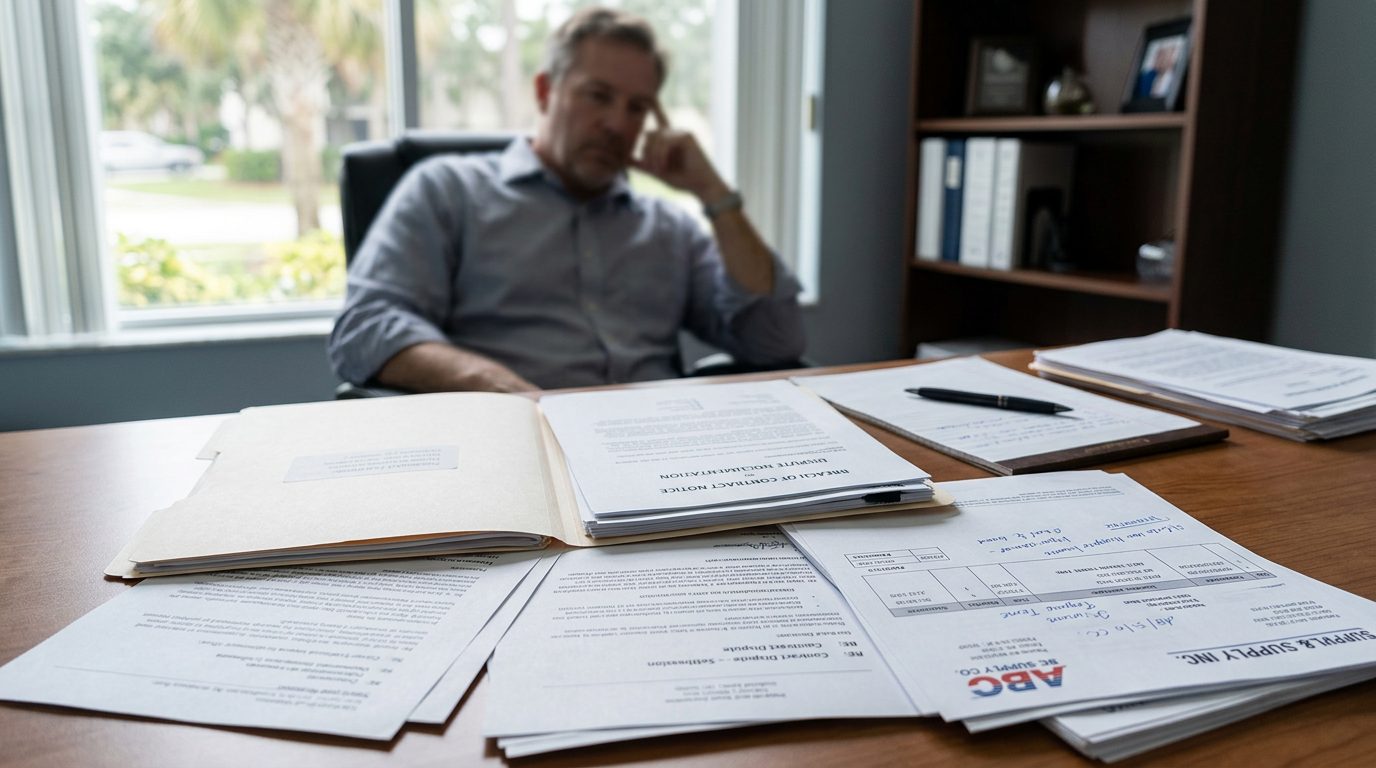
Business Dispute Mediation | Coral Gables & Sunny Isles Beach
Work Through Business Disputes at the Table
KEW Legal represents business owners and investors across Miami-Dade and South Florida in mediation over partnership, vendor and contract disputes. Your first consultation is free, confidential and without obligation.
By Kristina E. Wilson · Published October 27, 2026
If you need a business dispute mediation attorney in Florida, start with one question: can the sides reach a deal with a neutral helper? Business dispute mediation is a confidential negotiation where a neutral mediator helps the parties settle.
KEW Legal is a Florida business law firm. We represent business owners and investors in these negotiations across Miami-Dade and South Florida.
Business Dispute Mediation Is a Negotiation, Not a Trial
Business dispute mediation is a process where a neutral mediator helps the parties work through a disagreement. The mediator does not decide who is right.
Florida law describes a mediator as a neutral, impartial person who helps the parties reach their own agreement, without prescribing the result (Florida’s mediation definitions).
Mediation usually starts in one of three ways:
- Your contract has a mediation clause that requires it first.
- The parties agree to mediate after a dispute arises.
- A court orders it once a lawsuit is pending.
Mediation suits owners who want to keep a working relationship, keep the matter private, and control timing. It is one route within our business contract and vendor dispute work.
Not sure what your next step is?
Talk it through with our team — the first consultation is free, confidential, and carries no obligation.

Business Disputes That Often Go to Mediation
Mediation often fits disputes over money, contract terms, or an ongoing business tie. Common examples include:
- Partnership and co-owner disputes. These include deadlock, buyout terms, capital contributions, and control fights.
- Vendor and contract disputes. These include nonpayment and disagreements over scope. Some turn on whether an oral agreement with a vendor can be enforced.
- Commercial lease and eviction matters. These include evictions for owners who live abroad.
- Employment and succession disputes. We handle employment matters for employers and buy-sell disagreements among owners.
Many contract fights turn on notice. Review the right-to-cure notice rules early. If the signing method is in question, see electronic signatures in business contracts.
Court referral has limits. Under Florida’s court-ordered mediation statute, a court must send a filed civil action for money damages to mediation when one party asks. Fla. Stat. § 44.102 provides that a court, acting under rules adopted by the Supreme Court, must, upon request of one party, refer any filed civil action for monetary damages to mediation, as long as the requesting party is willing and able to pay the mediation costs or those costs can be equitably divided between the parties, except in the situations the statute lists. Fla. Stat. § 44.102 reads: “(2) A court, under rules adopted by the Supreme Court: (a) Must, upon request of one party, refer to mediation any filed civil action for monetary damages, provided the requesting party is willing and able to pay the costs of the mediation or the costs can be equitably divided between the parties, unless: 1.” Exceptions include a landlord and tenant dispute with no personal injury claim and an action to collect a debt. Whether mediation fits depends on the contract and the stage of the dispute.
How a Lawyer-Led Mediation Works, Step by Step
A lawyer-led mediation usually moves through six steps, from first meeting to signed agreement.
- Intake. You share the facts, the parties involved, and any deadlines.
- Document review. We review contracts, notices, leases, emails, and payment records. We look for leverage and deadlines.
- Position and terms. We set out your side’s position and the terms you’re willing to accept, in writing when useful.
- Mediator selection. The parties agree on a mediator, or one is chosen under the contract or a court order.
- The session. The mediator may meet each side alone and then together to explore options. Your lawyer speaks for you. The mediator does not.
- Agreement or next step. If terms are reached, they are written and signed. If not, the parties can pursue arbitration or litigation.
Florida’s mediation duration rules say a non-court-ordered mediation ends when a settlement is signed, the mediator declares an impasse, the mediation is terminated by court order, court rule, or applicable law, or the parties agree to end it; in a multiparty mediation, one party may also terminate its own participation by giving notice to all other parties.
Timing varies. It depends on how many parties are involved, how many documents exist, and whether a court deadline applies. Raise your deadlines at intake so we can plan around them.
Mediation, Arbitration, and Litigation Compared
Mediation leaves the decision with the parties. Arbitration leaves it with an arbitrator. Litigation leaves it with a judge or jury.
| Mediation | Arbitration | Litigation | |
|---|---|---|---|
| Who decides | You and the other side, with a neutral helper | An arbitrator | A judge or jury |
| Binding? | Only after a signed agreement | Generally, under a valid clause | Decided by the court’s ruling |
| Privacy | Mediation communications are confidential | Set by your contract | Court filings are part of the court record |
| Your control | Highest | Shared with the arbitrator | Limited by court rules |
If your contract has a valid arbitration clause, Florida law generally enforces it.
Read your contract before you choose a route. Some agreements require mediation first, then arbitration or court. The right route is a question to answer with a lawyer, not a rule that fits every case.
Is What You Say in Mediation Confidential?
Generally, yes. A signed settlement agreement is treated differently.
- If someone knowingly and willfully discloses a protected communication, § 44.406 allows remedies such as equitable relief, compensatory damages, and attorney’s fees. In Florida, a claim on a written contract must be brought within 5 years, and a claim on an oral or unwritten contract, including a sale of goods, within 4 years (Fla. Stat. § 95.11).
Parties often record a settlement in a written agreement. Key terms to address include:
- Payment amounts and schedule
- The scope of any release
- Confidentiality of the deal itself
- Default and cure provisions
- How future disputes will be handled
- Dismissal of any pending case
Challenges to a settlement are limited. Rescission for mutual mistake is available only if the mistake is mutual and concerns a fact at the essence of the contract (Waterside at Boynton Homeowners’ Ass’n). A voidable contract can be ratified when a party fails to rescind after learning the key facts (Flaherty v. Flaherty). That is a general rule, not an automatic result. Have a lawyer review the agreement before you sign it.
Why Business Owners Work With KEW Legal
KEW Legal is a Florida business law firm that acts as outside general counsel for business owners and investors in Miami-Dade and South Florida.
- The firm has offices in Coral Gables and Sunny Isles Beach.
- Kristina E. Wilson is the lawyer responsible for this page. Natalie Martinez is also a lawyer at the firm.
- The firm concentrates its work on business-side matters: partnership, vendor and contract, commercial lease, employment for employers, and succession.
- We represent our client in mediation and negotiation. We do not act as the neutral mediator, so our work is for your side.
- We serve clients in Miami, Doral, Brickell, Aventura, Coral Gables, Sunny Isles Beach, Fort Lauderdale, and throughout Broward and Miami-Dade counties.
Our team reviews your documents, explains your options, and handles the negotiation on your behalf.
Not sure what your next step is?
Talk it through with our team — the first consultation is free, confidential, and carries no obligation.
Frequently Asked Questions
Is business dispute mediation binding?
Mediation itself does not force a deal.
Can my contract require mediation before a lawsuit?
Review that clause with a lawyer before you respond or file.
Do I need a lawyer at mediation?
You can attend with your lawyer. A lawyer represents your side, reviews offers, and checks the terms before you sign.
Is what I say at mediation protected?
Generally, yes, under Florida’s mediation statute. Signed settlement agreements are treated differently, so review them before signing.
What if the other side won’t mediate?
Your options depend on the contract, the stage of the dispute, and any court deadlines. Talk through those with a lawyer early.
What does the first meeting cost?
The first consultation is free, confidential, and carries no obligation to continue.
If your partner is refusing a buyout term, a vendor is holding payment, or a lease dispute has a deadline coming up, call 305-990-2300 or send us a message. We’ll review your documents and talk through whether mediation fits your situation.
How our firm approaches mediation
Preparation before the session
We review your agreements, correspondence and the other side's position so you know your options before you sit down at the table.
Protection of your interests
We review any mediation clause, settlement term sheet or proposed agreement before you sign, so your business is not committed to terms you have not evaluated.
Support for partners and owners
Our team helps business owners, partners and investors keep the discussion focused on the business issues that need to be solved.
Outside general counsel perspective
Because we advise businesses on an ongoing basis, we connect each dispute to contracts, leases, employment matters and succession plans already in place.
Before you respond to a demand
Do not sign a mediation agreement, settlement proposal or release until a lawyer has reviewed it. Review any contract clause requiring mediation before you respond to a demand letter or file anything.
What to expect when you work with us
1. Free first consultation
Tell us about your business, the dispute and the people involved. The consultation is confidential and carries no obligation to continue.
2. Review of your documents
We look at your operating agreement, vendor contracts, leases or other documents that govern the relationship at issue.
3. Mediation strategy
We discuss your goals, the issues you need to address and the terms you are willing to consider, so you can take part with a clear plan.
4. Representation through the process
Whether you attend with your lawyer or need help preparing written terms, our team works with you at each stage.
Talk with Kristina E. Wilson and our team about your business dispute
Related practice areas
- Joint Venture Dispute Attorney Miami: Breach & Buyout Claims
Request a Consultation
Fill out the short form and we will take it from there.