
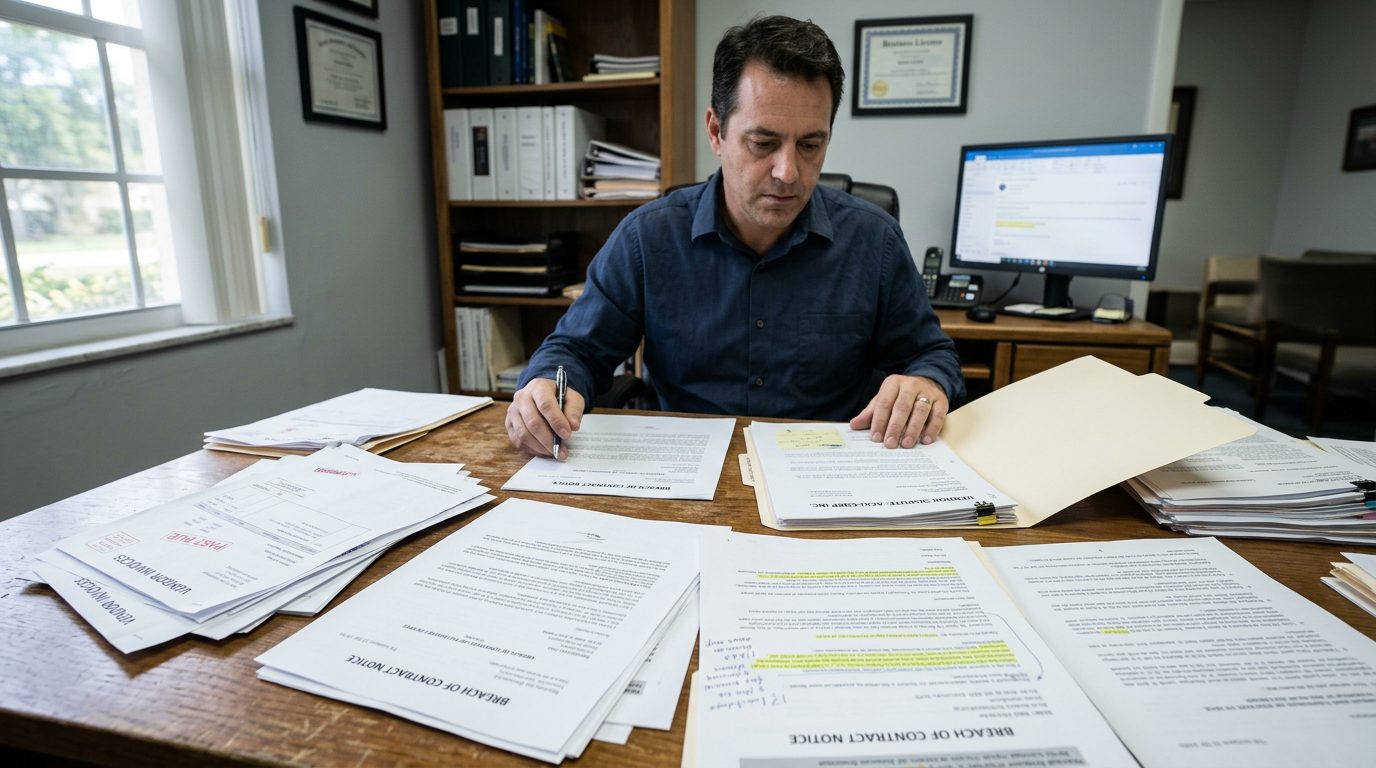
Business Contract & Vendor Disputes | Broward County
Business Contract and Vendor Dispute Attorney for Broward County Businesses
KEW Legal, based in Coral Gables and Sunny Isles Beach, advises Broward County business owners on vendor disputes, breached agreements and commercial contract problems. Call 305-990-2300 to discuss your situation.
By Kristina E. Wilson · Published October 20, 2026
This page is for Broward County business owners who need a business contract and vendor dispute attorney. When a vendor misses a delivery, a customer holds back payment, or a contractor walks off a job, the owner must decide what comes next. In most cases, the first step is to gather the paperwork and check the contract’s notice rules. A business contract and vendor dispute attorney reviews those documents, writes demand letters, negotiates, and handles mediation or a lawsuit if talks fail.
This page explains how Florida business contract and vendor disputes usually unfold. It is general information, not a prediction about your agreement. KEW Legal is a Florida business law firm with offices in Coral Gables and Sunny Isles Beach. It serves business owners and investors across Miami-Dade and South Florida, including Broward County. Kristina E. Wilson is the responsible lawyer for this page.
When a Vendor or Business Contract Dispute Lands on a Broward Business Owner
Most vendor disputes start with one missed obligation that the other side won’t fix. Broward County has many kinds of businesses. Restaurants order supplies on tight schedules. Medical and professional offices rely on outside vendors for equipment and services. Construction companies use subcontractors. Retailers and distributors move goods through long supply chains.
Each of these settings uses agreements with different terms. The same late delivery can carry very different consequences in two businesses. When something goes wrong, you usually have a few choices. You can ask for the problem to be fixed, negotiate a payment plan, end the relationship, or take formal legal action. The right path depends on what the written contract says and what the records show.
If a vendor has missed a delivery or a customer is holding back payment, you may have a claim worth reviewing, and our team can look at your agreement with you. Talk it through with our team — the first consultation is free, confidential, and carries no obligation.

What Type of Attorney Handles Contract Disputes?
A business or commercial contract attorney usually handles vendor and contract disputes. This lawyer reads the agreement first. Then the lawyer reviews emails, invoices, purchase orders, and delivery records to see how the deal actually ran.
That review matters. Florida’s sales-of-goods rules recognize that conduct by both parties can show a contract exists, even when the writings are incomplete. Personal injury and family law cases follow different rules and focus on different facts. A business dispute usually calls for a commercial practice.
The attorney’s work often moves through several stages. These include reviewing the contract, drafting a demand letter, negotiating, taking part in mediation, and filing suit if needed. Not every dispute reaches the last stage. KEW Legal focuses on business contract and vendor disputes, along with outside general counsel work for business owners and investors.
Common Commercial Disputes Facing Broward Businesses
The most common disputes involve money, delivery, and changes to the work. They often include:
- Nonpayment or late payment
- Defective or late delivery of goods
- Scope changes on services
- Disputed invoices
- Early termination
- Price increases tied to escalator clauses
Vague terms cause many of these fights. A contract that never explains how to request a change, or how a price can rise, leaves both sides guessing. Unsigned amendments create the same problem. A price talk can turn into a fight over what was actually agreed.
Notice and cure clauses matter too. A notice clause sets how formal notice must be sent. A cure period gives the other side time to fix a problem. Without these terms, one missed phone call can damage a working relationship.
Florida’s sales-of-goods rules also include a signature requirement. Between merchants, if a written confirmation is received within a reasonable time, is sufficient against the sender, and the receiver has reason to know its contents, it can count against the receiver unless that person gives written objection within 10 days.
A restaurant that orders supplies by text, a medical office that buys equipment on a quote, and a distributor that takes shipments all face these issues.
How a Contract or Vendor Dispute Is Typically Handled
Most disputes move from paperwork to a written demand, then to talks, and only then to mediation or court. Start by collecting the signed agreement, purchase orders, invoices, emails, and delivery records. Then check the notice and cure terms. They set the steps you must follow next.
Next comes a written demand or notice letter. The letter should follow the contract’s notice steps. If it doesn’t, the other side may argue it was never properly sent. Negotiation usually comes next, and many disputes end there.
If talks fail, a Florida court may send the case to mediation.
Some contracts send disputes to arbitration instead of court. A written agreement to arbitrate is generally valid and enforceable (Fla. Stat. § 682.02). A court may order the parties to arbitrate, and it may not refuse only because the claim lacks merit (Fla. Stat. § 682.03).
Where a case is filed also follows set rules. Actions shall be brought only in the county where the defendant resides, where the cause of action accrued, or where the property in litigation is located, but this rule does not apply to actions against nonresidents (Fla. Stat. § 47.011).
Is It Worth Suing for Breach of Contract?
Suing can make sense when the amount owed, the written terms, and the evidence all support your position. Weigh these factors together:
- How much is owed, compared with the cost of a lawsuit
- How clear the written terms are
- What records you can prove
- Whether the other side can pay a judgment
- How much time and money the case will take
Some contracts include an attorney fee clause. If a contract allows fees for enforcing it, the court may allow reasonable fees to the party that prevails (Fla. Stat. § 57.105). That can change the math, but it depends on the terms and the court’s decision.
Florida’s offer-of-settlement statute, Fla. Stat. § 45.061, sets timing rules: an offer may be served at any time more than 60 days after service of a summons and complaint on a party but not less than 60 days (or 45 days if it is a counteroffer) before trial. Section 45.061 provides that this section does not apply to causes of action that accrue after the effective date of this act, so a reader should not assume this procedure applies to a current vendor dispute (Fla. Stat. § 45.061). The quoted language in § 45.061 governs how long a written offer stays open, but the section does not apply to causes of action that accrue after the act’s effective date, so this language should not be read as governing a current dispute. The statute provides: “The offer shall remain open for 45 days unless withdrawn sooner by a writing served on the offeree prior to acceptance by the offeree.” An offer neither withdrawn nor accepted within 45 days is deemed rejected.
A lawsuit is one option among several. You might agree to a payment plan, end the contract with a release, or reach a short settlement. Relationships and daily operations count, too. Whether suing makes sense depends on the facts of your agreement and records.
Can You Sue a Vendor in Florida?
Yes, a business can usually bring a breach of contract claim against a vendor that fails to perform as the agreement requires. Florida sets deadlines for these claims. Under Florida law, a lawsuit on an oral or other unwritten contract, including a claim over a sale of goods, has to be filed within 4 years (s. 95.11(3)(j), Florida Statutes).
A contract provision that sets a shorter time to sue than the statute allows is void (Fla. Stat. § 95.03).
Contracts can also add steps. Pre-suit notice, cure periods, arbitration clauses, and forum terms can change where and how a claim is filed. Buyers who accept goods face one more trap. Where a tender has been accepted, a buyer must, within a reasonable time after he or she discovers or should have discovered any breach, notify the seller of the breach or be barred from any remedy (Fla. Stat. § 672.607).
Vendors often answer with counterclaims. Review your own performance and records before you file. Confirm the vendor’s exact legal name and entity status with the Florida Department of State, Sunbiz.
Not sure what your next step is?
Talk it through with our team — the first consultation is free, confidential, and carries no obligation.
How Much Does a Contract Attorney Cost?
The initial consultation with KEW Legal is free, confidential, and without obligation to continue. That first meeting lets you walk through your agreement before you decide on next steps.
Fees for ongoing work depend on the complexity of the agreement, the stage of the dispute, and whether a lawsuit is needed. Ask about fees before you decide how to proceed.
Timing matters as well. Staff change, and messages get lost. Gathering your documents early keeps your options open and helps you track the deadlines described above.

Talk to KEW Legal About Your Broward County Vendor or Contract Dispute
KEW Legal has offices in Coral Gables and Sunny Isles Beach. Kristina E. Wilson is the responsible lawyer. The firm serves business owners and investors across Miami-Dade and South Florida.
Some owners want help before a fight begins. Outside general counsel work means ongoing review of vendor agreements, so terms are clearer and notice steps are set. Florida’s partnership law in Chapter 620 covers partner rights, dissolution, and partner disputes. KEW Legal also handles partnership disputes between owners. For more on this practice in Miami-Dade, see the Miami-Dade contract dispute page.
Bring these items to your consultation:
- The signed contract and any amendments
- Purchase orders and invoices
- Emails and other correspondence
- A timeline of performance problems
Common Questions
What type of attorney handles vendor disputes?
A business or commercial contract attorney usually handles them. They review the agreement and the records first.
Can a contract shorten the time to sue?
No. Florida voids a contract term that sets a shorter time to sue than the statute allows.
Does Florida require mediation before trial?
Often, yes.
If a vendor has missed a delivery or a customer is holding back money, you may have a claim worth reviewing. Call 305-990-2300 or send your contract details through the contact form to schedule a consultation.
How We Approach a Vendor or Contract Dispute
Review the Agreement
We start by reading the full contract, including definitions, payment terms, notice requirements, and any dispute resolution or limitation clauses.
Organize the Record
Invoices, purchase orders, emails, delivery records, and change requests are gathered and put in order so the timeline is clear.
Map Your Options
We explain the practical paths available, such as a demand letter, negotiation, mediation, or litigation, and what each would involve.
Protect Ongoing Operations
Where a vendor relationship must continue, we look for ways to manage the dispute without disrupting your daily business.
Act Before You Sign Anything New
Vendors and counterparties sometimes send revised terms, payment demands, or termination notices during a dispute. Do not sign an amendment, release, or settlement until a lawyer has reviewed it.
Why Broward County Businesses Work With KEW Legal
Business Contract Focus
KEW Legal focuses on business law, including contracts, vendor agreements, and commercial relationships.
Outside General Counsel
We act as ongoing outside counsel for business owners and investors, so you have one legal resource for many issues.
Offices in Coral Gables and Sunny Isles Beach
We serve Broward County clients from our Miami-Dade offices, with the same attention to your matter.
Clear Communication
We explain your options in plain language so you can make informed decisions about your business.
Get a Free, Confidential First Consultation With No Obligation to Continue
Request a Consultation
Fill out the short form and we will take it from there.