
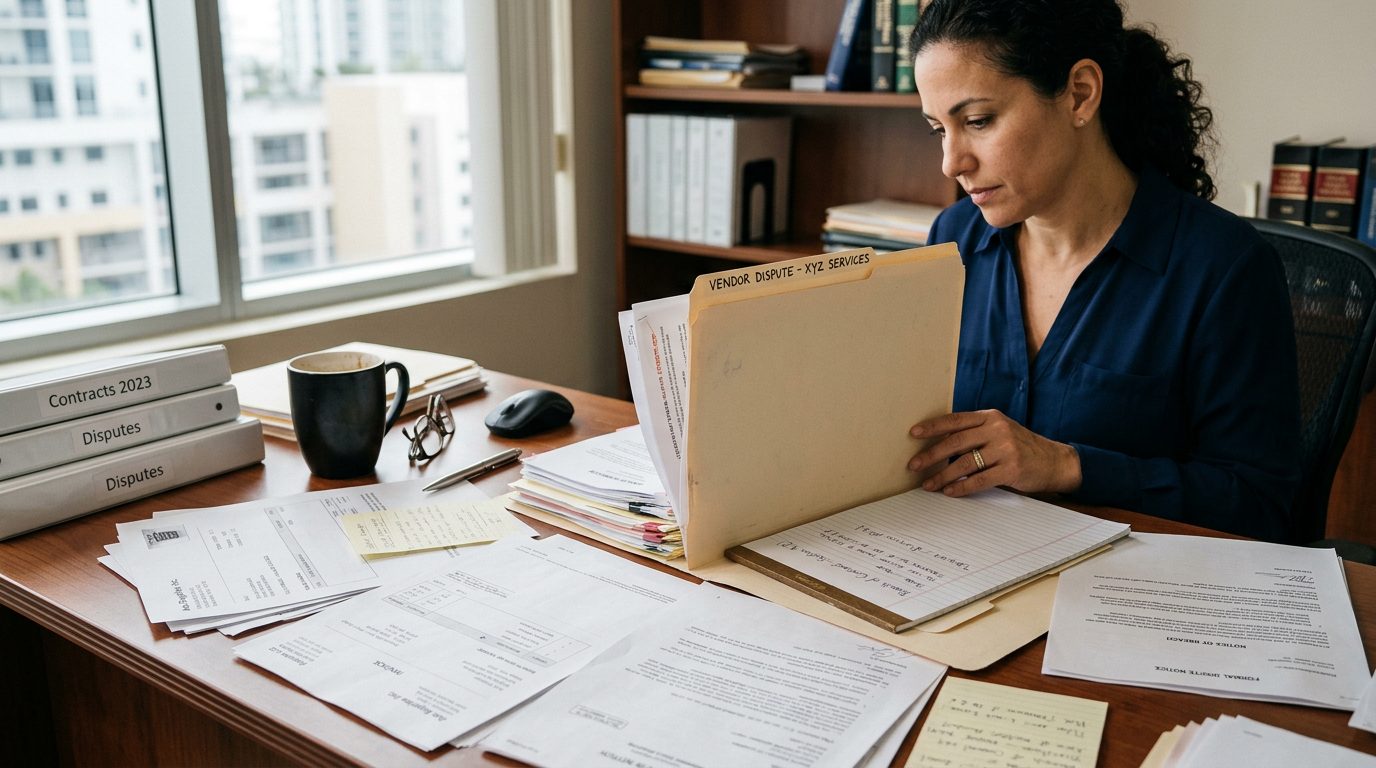
Business Contract and Vendor Disputes | Coral Gables and Sunny Isles Beach
Resolving Business Contract and Vendor Disputes in Miami-Dade
KEW Legal focuses on business contract and vendor disputes for owners and investors across Miami-Dade County, with offices in Coral Gables and Sunny Isles Beach.
By Kristina E. Wilson · Published October 10, 2026
Business Contract and Vendor Dispute Attorney in Miami-Dade
If you need a business contract and vendor dispute attorney in Miami-Dade, the paper trail matters most. KEW Legal reviews the agreement and the records behind it. Then the firm helps you weigh a demand letter, negotiation, mediation, or a lawsuit. KEW Legal has offices in Coral Gables and Sunny Isles Beach. This page explains what the work covers, how a matter moves, and what to gather before you call.
Not sure what your next step is?
Talk it through with our team — the first consultation is free, confidential, and carries no obligation.
What Is a Business Contract and Vendor Dispute?
A business contract dispute is a disagreement over what an agreement requires. It also covers whether one side broke it. Most vendor fights come down to one question: did the other party do what the contract says?
Common triggers in Miami-Dade include:
- Unpaid invoices or disputed payment amounts
- Late, short, or defective deliveries
- Missed milestones or work not finished as written
- Disputed change orders and extra charges
- Termination fights over who had the right to end the deal
This work fits owners, managing members, operators, and investors in Miami, Coral Gables, Doral, Brickell, Aventura, and Sunny Isles Beach. It also fits anyone dealing with vendors, suppliers, subcontractors, or customers.
The exact wording often decides the matter. Read the whole document chain. That includes purchase orders, emails, amendments, and invoices. A casual email that changes a price can matter as much as the signed contract.
What KEW Legal Covers in Vendor and Contract Matters
As a business contract and vendor dispute attorney, KEW Legal covers the contract work before a lawsuit. It also covers the dispute work after one. Services include:
- Review and interpretation of vendor, supplier, service, and customer agreements
- Demand letters and formal notices of breach, cure, or termination, sent under the contract’s own procedures
- Negotiation of payment plans, settlements, releases, and amended terms
- Drafting and redlining of vendor agreements, master services agreements, and purchase terms
- Review of limitation-of-liability clauses (caps on what one side can recover) and indemnity clauses (who pays for certain claims)
- Review of notice periods, cure periods, and dispute-resolution clauses such as mediation or arbitration
Arbitration clauses carry real weight. Florida’s arbitration statute says a written agreement to arbitrate is valid, enforceable, and irrevocable. The exception is a ground that exists at law or in equity for revoking a contract.
Matters that need a court trial may be referred to another lawyer or firm. The firm will say so at the start.
How a Contract or Vendor Dispute Is Handled
A typical matter moves through five steps. The timeline depends on the contract and on how the other side responds.
- Consultation. You describe the agreement, the payment or delivery problem, and any deadlines in the contract.
- Document review. You provide the signed contract, amendments, invoices, delivery records, and emails. The firm checks notice requirements and cure periods. It also confirms the other party’s exact legal name with the Florida Division of Corporations.
- Assessment. The firm explains which contract terms apply and what options you have, in plain language. It does not predict how the dispute will end.
- Demand and negotiation. A formal written demand or response goes out. Negotiation or mediation follows where the contract and the parties’ interests allow.
- Escalation or referral. If the dispute cannot settle without litigation, the firm discusses next steps. Some matters move into business litigation services. Where a matter falls outside the firm’s practice, the firm refers you to another lawyer or firm.
The firm cannot promise a set timeline. Florida’s mediation statute says a court must, on one party’s request, refer many civil actions for money damages to mediation. Listed exceptions apply.
Have questions about what happened?
Ask our team directly. The first conversation is free, confidential, and there is no obligation to continue.
Review and Drafting Before a Dispute Starts
Reviewing a contract before you sign is the cheapest point to prevent a dispute. Most fights trace back to gaps that were easy to fix at signing.
Common gaps in vendor and customer agreements include:
- Undefined acceptance criteria, so no one knows when work counts as done
- Unclear termination rights and notice steps
- No late-fee or interest terms for overdue payments
- Missing limitation-of-liability language
- No dispute-resolution clause, or one that does not match how you want disputes handled
Electronic signatures count. Under Florida’s electronic signature statute, an electronic signature has the same force and effect as a written signature.
Owners who want ongoing review can use an outside general counsel arrangement. The scope and fees are set out in writing before work begins. Any stated fee or cost is disclosed in full, including filing and third-party fees.
How KEW Legal Serves Business Owners
KEW Legal is a Florida business law firm with offices in Coral Gables and Sunny Isles Beach. The firm focuses on business matters for owners and investors across Miami-Dade County and South Florida.
Its business work includes:
- Partnership disputes and member conflicts
- Vendor and contract disputes
- Employment issues for employers
- Business sales and succession
- Commercial lease matters and commercial eviction matters
- Investment property matters
The outside general counsel services model lets one firm review the contract history, the deal, and the dispute together. That view matters when a vendor fight ties into a lease or a partner conflict. KEW Legal is responsible for the content of this page.
Questions Business Owners Ask Before Calling
Owners often ask whether a small dispute is worth a lawyer. They also ask whether they can stop paying. The answers depend on the contract and the amount at stake.
- Is a small amount worth a lawyer? Weigh the cost of resolving the dispute against the amount at stake and what the contract lets you recover.
- Should I stop paying or stop working? That decision can affect your rights. Review the contract first.
- What should I gather? The signed agreement, amendments, purchase orders, invoices, delivery records, and all written messages with the other side.
- Will this go to court? Many disputes settle through negotiation or mediation. A lawsuit is possible. Matters outside the firm’s scope may be referred.
- What does a consultation cost? The firm states its consultation terms before you commit. Contact KEW Legal for a consultation to ask about them.
Want to know where you stand?
Tell us what happened and our team will walk you through the options available to you, at no cost.
Frequently Asked Questions About Business Contract and Vendor Disputes
Can an oral agreement be enforced in Florida?
Sometimes. Whether an oral deal is enforceable depends on the facts and on Florida law.
How long do I have to sue over a contract?
Deadlines differ for written contracts, so review yours promptly.
Do I need a signed writing for goods over $500?
The answer depends on the specific facts and documents involved. Under Florida’s sale-of-goods rules, a contract for goods priced at $500 or more is not enforceable unless there is a record signed by the party against whom enforcement is sought. That rule covers goods, not service agreements.
Can an email chain create a binding deal?
It can, depending on the facts. Between merchants, a written confirmation can satisfy the signed-writing rule against the party that received it, unless that party gives notice of objection within 10 days after receipt.
Can we add mediation or arbitration to future contracts?
Yes. A written arbitration clause is generally enforceable under Florida law, so the drafting matters. The review step covers how the clause should read.
Does KEW Legal handle matters in Broward County?
KEW Legal serves Miami-Dade County and South Florida. Matters outside the firm’s scope may be referred to another lawyer or firm.

Talk to KEW Legal About Your Vendor Dispute
If a vendor has stopped delivering, a customer won’t pay, or a contract term is unclear and a deadline is close, the next step matters. Speak with a business contract and vendor dispute attorney at KEW Legal. Bring the agreement and the key dates. Schedule a consultation through the KEW Legal contact page, call 305-990-2300, or send a message on that same page.
How KEW Legal Approaches Contract and Vendor Matters
Review the Written Record
We start with the signed agreement, purchase orders, invoices, emails and payment history, so the dispute is measured against what the parties actually documented.
Protect Your Position
We identify notice requirements, termination terms and payment obligations that may affect your options before you respond to a vendor or counterparty.
Outside General Counsel Model
KEW Legal acts as outside general counsel for business owners and investors, handling contract questions as part of ongoing business matters.
Options Beyond Litigation
Depending on the facts, we discuss negotiation, demand letters, mediation and formal proceedings, and recommend the path that fits your business goals.
Key Step: Keep Your Records Together
Before speaking with the other side, gather every signed contract, amendment, email, text, invoice, delivery record and payment receipt related to the dispute. Avoid making written admissions or threats until the documents have been reviewed.
Common Business Contract and Vendor Disputes
Payment and Invoice Disputes
Disagreements over amounts owed, unpaid invoices, change orders and whether services or goods met the agreed terms.
Late or Incomplete Performance
Vendors who miss delivery dates, deliver non-conforming products or stop performing before the contract ends.
Termination and Notice Clauses
Questions about whether a contract was validly terminated, what notice was required and what obligations continue afterward.
Oral and Partially Written Agreements
Deals made by email, handshake or a mix of informal and written terms, where the parties now disagree about what was agreed.
Discuss Your Contract or Vendor Dispute with KEW Legal
Request a Consultation
Fill out the short form and we will take it from there.