
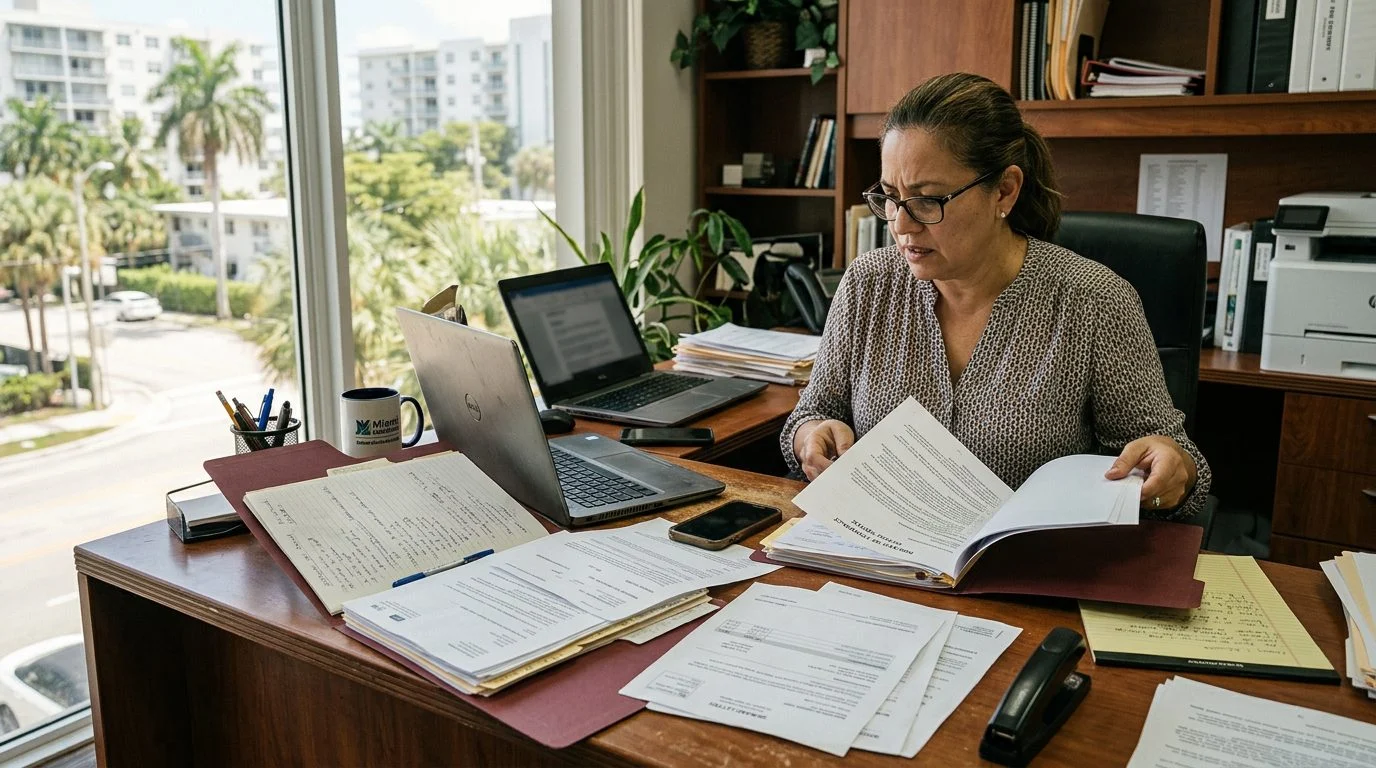
Business Contract Disputes · Miami-Dade and Broward
Breach of Contract? Put Your Demand in Writing the Right Way
A clear, carefully drafted letter can identify the problem, state what you need, and set the terms for what comes next.
By Kristina E. Wilson · Published November 26, 2026
Your partner has stopped paying distributions, or your vendor missed the delivery it promised. Now you have to decide what to do next. Often, a written demand letter is the first formal step. It names the contract, describes what went wrong, and says what you need and by when.
Whether a demand letter for breach of a business contract fits your situation depends on your contract and the facts. This guide explains when a letter makes sense in Miami-Dade, what your contract may require first, what the letter should say, and the mistakes that can weaken your position.
What a Demand Letter Is and When a Business Owner Uses One
A demand letter is a formal written notice. It identifies the contract, describes the breach, and states what you want done and by what date. It is a pre-suit step. You send it before any lawsuit, so the other side has clear written notice of the problem.
This step fits business owners, partners, and employers in Miami-Dade who have a commercial agreement with a vendor, partner, customer, or landlord. The agreement may be written or oral.
The letter also creates a written record of your position. If the dispute reaches a courtroom, that record shows what you asked for, when you asked, and how the other side responded.
If a partner, vendor, or landlord has broken your business contract, you may have a claim worth reviewing now, and our team can walk through it with you. Talk it through with our team — the first consultation is free, confidential, and carries no obligation.
Signs It May Be Time to Send One
A demand letter usually makes sense once a clear breach has happened and a call or email has not fixed it.
- A vendor stops delivering, delivers late, or delivers work that does not match the contract.
- A partner withholds profit distributions, ignores capital obligations, or stops doing the duties the agreement assigns.
- A customer refuses to pay invoices that are due under the contract.
- A buyer or seller misses a closing date or a post-closing obligation in a purchase agreement.
- A commercial tenant stops paying rent, or a landlord fails to perform its lease duties.
A vendor may also say, before a delivery is due, that it will not perform. For contracts covering goods, if either party repudiates before delivery is due and the loss will substantially impair the value of the contract to the other party, the aggrieved party may wait a commercially reasonable time or pursue a remedy for breach, under Fla. Stat. § 672.610. Do not let silence drag on.
Check the Contract Before You Write Anything
Read the notice, cure, and dispute clauses first. They set the rules your letter has to follow.
- Notice clause. It sets the delivery method, the address, and whether notice must be in writing.
- Cure period. It gives the other side a set window to fix the problem.
- Dispute clause. It may require mediation or arbitration first. A written agreement to arbitrate is valid, enforceable, and irrevocable under Fla. Stat. § 682.02, except upon a ground that exists at law or in equity for the revocation of a contract.
- Signing party. Confirm an LLC’s exact name on Sunbiz. Under Fla. Stat. § 605.0117, a notice or demand under that chapter to a Florida LLC can go to its registered agent, to a member of a member-managed LLC or a manager of a manager-managed LLC, or to its principal office in Florida.
- Fee clause. If a contract lets one side recover attorney’s fees for enforcing it, Fla. Stat. § 57.105 lets the court also award fees to the other side when it prevails.
Florida courts do not favor reading a notice or cure step as a condition precedent.
Check the deadline now. Florida law sets deadlines for filing a lawsuit over a contract, and the deadline depends on the type of claim. A contract clause that shortens the statutory period is void under Fla. Stat. § 95.03.
What a Miami-Dade Breach of Contract Demand Letter Should Include
A strong letter states the facts, the contract terms, the demand, and a deadline. It claims nothing you cannot support.
- The parties, the agreement date, and the specific clauses you say were broken.
- The breach facts, with dates, amounts, and copies of invoices, emails, or delivery records.
- The payment or performance you demand, with a clear calculation where money is involved.
- A response or cure deadline that fits the contract’s cure period.
- An accurate statement of next steps. A suit must be brought in a county the venue statute allows, such as where the defendant resides or where the cause of action accrued, under Fla. Stat. § 47.011. The statute does not apply to actions against nonresidents.
- A reservation of rights, so the letter does not give up other remedies.
- Delivery by the method the contract requires, with proof of delivery.
What Typically Happens After the Letter Is Sent
The other side may cure, dispute the claim, propose terms, or stay silent.
- Cure. If the problem gets fixed, confirm the fix in writing.
- Goods. If you rejected a nonconforming delivery and the contract time has not run out, the seller may seasonably notify you it intends to cure and then send a conforming delivery within the contract time, under Fla. Stat. § 672.508.
- Dispute. A denial turns the matter into negotiation, mediation, or arbitration if the contract requires it.
- Mediation. On one party’s request, a court must refer a filed money-damages case to mediation, if the requesting party can pay or the costs can be divided. Fla. Stat. § 44.102 reads: “(2) A court, under rules adopted by the Supreme Court: (a) Must, upon request of one party, refer to mediation any filed civil action for monetary damages, provided the requesting party is willing and able to pay the costs of the mediation or the costs can be equitably divided between the parties, unless: 1.” Some cases are excluded, including a landlord-tenant dispute without a personal injury claim.
- Commercial rent. A landlord may recover possession of non-residential premises only through a court action, a surrender, or an abandonment. See Fla. Stat. § 83.05.
Keep every response, payment record, and delivery record in one file.
Mistakes That Can Weaken a Demand Letter
The biggest mistakes are waiting too long, skipping a notice step, and making claims your documents do not support.
- Sending an angry or threatening letter with statements you cannot back up.
- Missing a notice step, or sending the letter to the wrong party or address.
- Accepting late or partial performance without a written reservation of rights. The other side may argue you agreed to the change.
- Accepting goods and staying silent about defects.
- Waiting after you learn the facts.
- Assuming the letter pauses the deadline. A lawsuit must still be commenced within the period set by § 95.11.
Not sure what your next step is?
Talk it through with our team — the first consultation is free, confidential, and carries no obligation.
Frequently Asked Questions
Do I have to send a demand letter before suing?
Not always. Your contract may require notice or a cure period first. A letter is often the practical first written step.
Does a demand letter stop the statute of limitations?
No. A lawsuit still must be filed within the time Florida law allows.
Can I send the letter myself?
You can. The notice clause, the signing party, and the cure period all affect whether the letter counts.
What if the other side lives out of state or abroad?
The contract’s notice terms still apply. Florida’s venue statute does not apply to actions against nonresidents, so the contract’s venue and governing-law clauses matter.
How long should I wait for a response?
Set a deadline that matches the contract’s cure period, and state it clearly in the letter.
Is a demand letter confidential?
Not necessarily. The letter may later be used as evidence, so plan its wording carefully.
Does the first consultation cost anything?
The initial consultation is free, confidential, and comes with no obligation to continue.
Why Business Owners Work with KEW Legal on Contract Disputes
KEW Legal focuses its practice on business matters for owners and investors across Miami-Dade and South Florida, including business contract and vendor disputes. The firm acts as outside general counsel, so it handles contract questions alongside employment, leases, and ownership issues.
The firm has offices in Coral Gables and Sunny Isles Beach. Kristina E. Wilson is the lawyer responsible for this page. Natalie Martinez is also one of the firm’s lawyers.
No lawyer can promise how a dispute will end. Every contract and set of facts is different, so our team starts by reviewing your documents.
Talk With KEW Legal About Your Contract Dispute
If a partner, vendor, customer, or landlord has broken your contract, you do not have to work out the next step alone. A breach often arrives at a hard moment, with money or operations at stake and a short window to decide. The timing and wording of a letter can shape what comes next.
Call 305-990-2300 or use our contact form to set up a consultation about your agreement and the breach.
What a Well-Built Demand Letter Covers
The Contract Language
We identify the clauses that apply, including any notice, cure, or dispute provisions the agreement requires.
The Facts, Stated Precisely
Dates, amounts, and communications are set out so the other side has a specific record to respond to.
Your Position, Protected
Wording is chosen with the possibility of later litigation in mind, so the letter does not concede points you have not decided to concede.
A Clear Ask
The letter states what you want done, such as payment, performance, or a meeting, and how you expect to hear back.
Review Before You Send
Sending one without reviewing the contract and the facts can weaken your position or create deadlines you did not intend.
Talk With KEW Legal Before Your Letter Goes Out. Kristina E. Wilson and our team focus on business contract and vendor disputes for owners across Coral Gables, Sunny Isles Beach, and South Florida. The first consultation is free, confidential, and carries no obligation to continue. Call 305-990-2300 or send us a message.
Related practice areas
Request a Consultation
Fill out the short form and we will take it from there.