
Business Law | Coral Gables & Sunny Isles Beach
Vendor Dispute in Florida? Take the Right Steps First
A vendor has failed to deliver, billed you incorrectly, or stopped performing. KEW Legal helps Miami-Dade and Broward business owners understand their options and protect their position from the start.
By Kristina E. Wilson · Published October 19, 2026
A vendor dispute happens when a supplier or service provider doesn’t do what your contract or order required. The first steps are to gather your records, put the problem in writing, and give the vendor a fair chance to fix it. Florida law attaches notice rules and deadlines to these steps, so the order you act in matters.
Every vendor dispute Florida small business owners face is different. The early steps, though, follow a common path. This guide walks through that path: documentation, written notice, cure periods, negotiation, mediation or arbitration, and finally a lawsuit. It is general information, not advice about your specific deal.
KEW Legal is a Florida business law firm with offices in Coral Gables and Sunny Isles Beach. Kristina E. Wilson is the attorney responsible for this page. Our team supports business owners across Miami-Dade and South Florida, including Broward County. We also work with owners as outside general counsel.
What Counts as a Vendor Dispute?
A vendor dispute is a disagreement about whether a supplier performed as promised. Common examples include late delivery, goods that don’t match the order, defective products, poor service work, and unpaid or overcharged invoices.
Under Fla. Stat. § 672.607, the buyer must pay at the contract rate for any goods accepted. Service contracts and mixed deals can follow different rules. The type of deal shapes which rules fit, so identify it early.
If a supplier missed a delivery or shipped goods that don't match your order, you may have options worth reviewing. Our team is ready to talk through your contract and your next steps. Talk it through with our team — the first consultation is free, confidential, and carries no obligation.

Start With Documentation
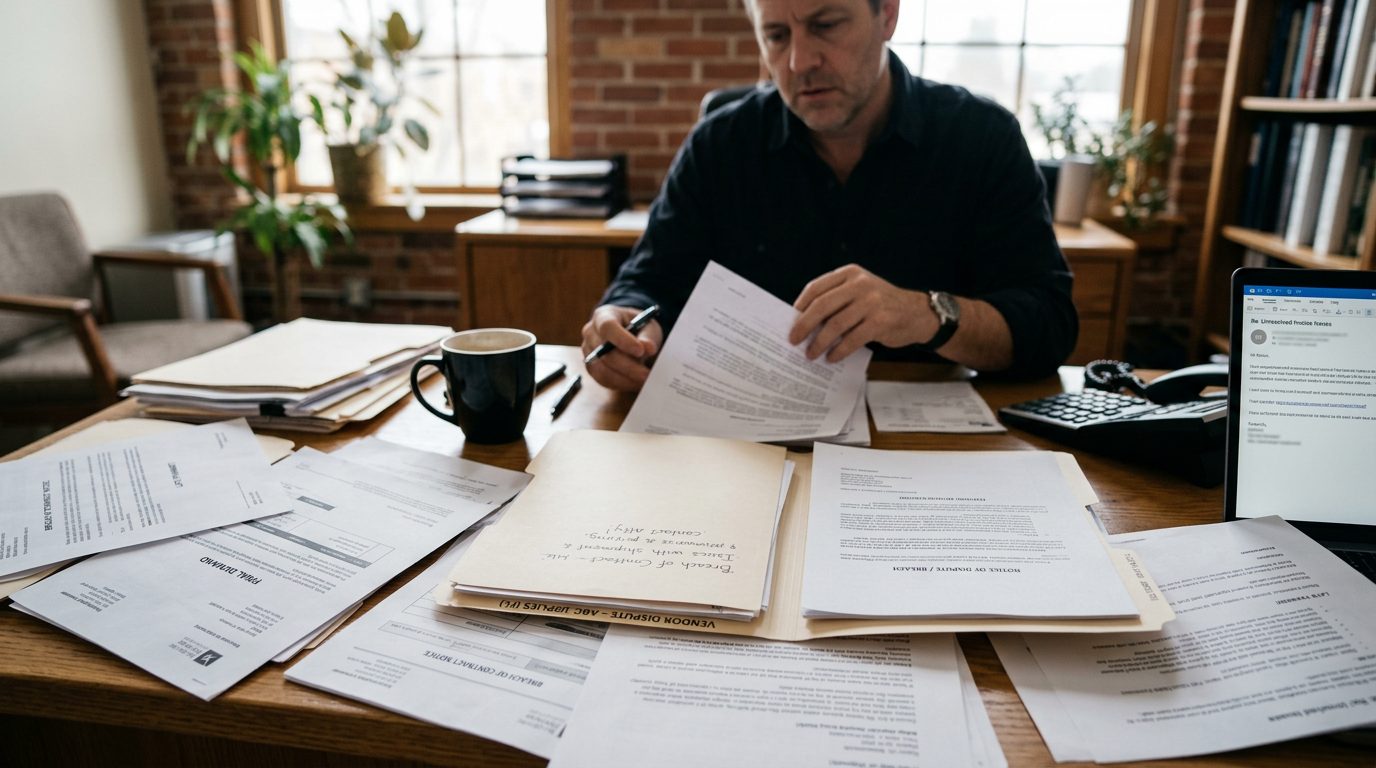
Your first job is to build a clear record. Collect the contract, purchase orders, invoices, delivery receipts, photos, emails, texts, and payment records. Then write a short timeline showing when goods arrived, when problems appeared, and what the vendor said about them.
Documentation matters for a reason tied to Florida law. Under Fla. Stat. § 672.606, acceptance of goods can occur after a reasonable chance to inspect. Acceptance happens when, after a reasonable opportunity to inspect the goods, the buyer signals the goods are conforming or that it will keep them despite a problem, or fails to make an effective rejection; it also happens when the buyer does any act inconsistent with the seller’s ownership, but if that act is wrongful as against the seller, it counts as acceptance only if the seller ratifies it.
Many owners keep using delivered goods while they argue about them. That conduct can be treated as acceptance. Inspect goods promptly, and record what you found.
Check Whether the Deal Is in Writing
Florida’s statute of frauds sets a signed-record rule for larger deals. Under Fla. Stat. § 672.201, except as the section otherwise provides, a contract for goods priced at $500 or more is not enforceable by way of action or defense unless there is a record that shows a contract was made. The record must be signed by the party against whom enforcement is sought, or by that party’s authorized agent or broker.
Between merchants, the rule works differently. A written confirmation can satisfy the signed-record requirement against the person who receives it, if it is received within a reasonable time, is sufficient against the sender, and the receiver has reason to know its contents. That happens unless the recipient objects in a record within 10 days after receiving it. If you receive a vendor’s confirmation that you disagree with, object in writing within that window.
Watch the Extra Terms
Vendors often send invoices or confirmations with added terms. Under Fla. Stat. § 672.207, between merchants, added terms do not become part of the contract in certain cases. Those cases include when the offer limits acceptance to its own terms, when the terms materially alter the deal, or when you already objected or object within a reasonable time.
Read every confirmation and invoice. Mark any new terms, such as shorter warranty periods, new fees, or limits on remedies.
Send Written Notice of the Problem
Under Fla. Stat. § 672.607, when a tender of goods has been accepted, the buyer must notify the seller of any breach within a reasonable time after discovering or should have discovered it. If the buyer doesn’t, the buyer is barred from any remedy.
The same statute says the buyer must pay the contract rate for goods accepted. It also places the burden on the buyer to prove any breach in goods it has accepted. Your written notice should protect your position on both points.
A good notice is short and specific. It should:
- Identify the contract or order by number and date.
- Describe the problem with the goods or service.
- Attach photos or records that support it.
- State what you want, such as a repair, replacement, credit, or refund.
- Set a reasonable response date.
Keep a copy of everything you send. Use a method that gives you proof of delivery.
Give the Vendor a Chance to Cure
Many contracts give the vendor a set period to fix the problem. This is often called a cure period. Read your contract for any cure language, notice requirements, or deadlines for fixing defects.
Contract deadlines can be short and strict. A Pinellas County services agreement shows the pattern. Your own contract may set different terms, so check the exact wording and calendar every date.
Offering a cure period is also useful for your case. It shows you gave the vendor a fair chance to correct the problem. It also gives you a clear record of what happened next.
Negotiate Before You Escalate
Most vendors respond better to a clear, written proposal than to an angry phone call. A settlement proposal can include a partial refund, a credit on future orders, a replacement shipment, or a payment schedule.
Put every offer in writing. Describe what you will accept and what you will not. Keep your tone factual. Avoid threats you can’t back up.
Negotiations also reveal how the parties behaved. Under Fla. Stat. § 672.207, conduct by both parties that recognizes a contract can establish a contract for sale. This can matter when the written documents don’t fully match what the parties did.
Mediation and Arbitration
Mediation brings in a neutral person to help both sides talk through a settlement. Whether mediation is required depends on your contract. A neutral helper can help narrow the issues even when the vendor won’t agree to everything.
Your contract may also contain an arbitration clause. Under Fla. Stat. § 682.02, an agreement in a record to submit existing or future controversies to arbitration is valid, enforceable, and irrevocable. The exception is a ground that exists at law or in equity for revoking a contract.
Arbitration can change your plan. Read the clause before you file anything in court.
Not sure what your next step is?
Talk it through with our team — the first consultation is free, confidential, and carries no obligation.
Know the Deadlines Before You File Suit
Florida sets time limits for filing a lawsuit. Florida law sets different filing deadlines for contract claims depending on whether the contract is founded on a written instrument. Other kinds of claims can have shorter periods, so check the timing early.
Notice rules can also set earlier deadlines than the lawsuit time limit. A late notice can bar remedies under the UCC rule discussed above. Build a deadline list that includes the notice date, any cure period, the objection window, and the filing limit.
Think About Fees and Settlement Offers
Attorney’s fees are a major cost in any lawsuit. Under Fla. Stat. § 57.105, a court must award reasonable attorney’s fees, paid in equal amounts by a losing party and its attorney, on a claim or defense they knew or should have known was not supported by the material facts or by then-existing law, subject to the section’s exceptions. Under Fla. Stat. § 57.105, if a contract provides for fees to a party that must enforce it, the court may allow reasonable fees to the other party when that party prevails, for contracts entered into on or after October 1, 1988. If a contract lets a party recover fees for enforcing it, the court may allow fees to the other side when it prevails, but only for contracts entered into on or after October 1, 1988.
Settlement offers can also shift costs. Under Fla. Stat. § 768.79, in a civil action for damages, a written offer of judgment not accepted within 30 days can shift reasonable costs and attorney’s fees. That happens for a defendant’s offer of judgment if the judgment is one of no liability or the judgment obtained by the plaintiff is at least 25 percent less than the offer, and the defendant is then entitled to recover reasonable costs and attorney’s fees from the date the offer was filed. The offer must be in writing, state that it is made under this section, name both parties, state its total amount, and, if it covers punitive damages, state with particularity the amount offered to settle that claim.
Because these rules affect strategy, a written offer is a serious step. Plan it before you send it.
Frequently Asked Questions
When must a buyer notify a seller about defective goods in Florida?
Under § 672.607(3)(a), Florida Statutes, where a tender of goods has been accepted, the buyer must notify the seller of a breach within a reasonable time after the buyer discovers or should have discovered it, or the buyer is barred from any remedy.
Is there a deadline to sue a vendor on a written contract in Florida?
The time limit for a legal or equitable action on a contract founded on a written instrument is set out in Fla. Stat. § 95.11. Other claims can have shorter periods, so check the deadline early.
Does a Florida contract for goods need to be in writing?
For goods priced at $500 or more, Florida requires a signed record to enforce the contract by action or defense. Some exceptions apply under § 672.201.
Can a Florida court send a vendor dispute to arbitration?
Yes, if the contract has a valid arbitration agreement and the other side refuses to arbitrate. Florida courts can order arbitration under § 682.03.
Who pays attorney’s fees in a Florida contract dispute?
If the contract allows fees to the party that must enforce it, the court may award fees to the other side when it prevails. That rule comes from § 57.105.
What is an offer of judgment?
It is a written settlement offer in a civil damages case. It can shift costs and fees if the final judgment is far enough from the offer under § 768.79.

Talk With KEW Legal
Every vendor dispute carries its own facts, contract language, and deadlines. This page can’t tell you how your situation will turn out. A conversation can help you sort out your records, notice steps, and timing.
KEW Legal offers a free first consultation. It is confidential, with no obligation to continue. You can call 305-990-2300 or send us a message through our contact page. Kristina E. Wilson and our team serve business owners in Coral Gables, Sunny Isles Beach, and across Miami-Dade and Broward counties.
Why Involve Counsel Early
Your Contract Comes First
The written agreement, purchase orders, and invoices often define what each side owes and how a dispute must be handled.
Protect Your Position
Early, careful communication with the vendor can prevent statements or admissions that complicate a later claim.
Understand Your Options
Negotiation, a formal demand, mediation, or litigation each carry different costs and risks. Choosing well starts with the facts.
Business-Focused Counsel
KEW Legal focuses on business law for owners and investors, including contract and vendor disputes, as outside general counsel.
Warning: Do Not Ignore a Breach Notice
Do not ignore a vendor's demand letter or a notice claiming you are in breach, and do not sign any release, settlement, or new agreement until you have reviewed it. Written responses can shape the outcome of a dispute.
Steps to Take First
1. Gather the Paperwork
Collect the signed contract, amendments, purchase orders, invoices, delivery records, and all emails or texts with the vendor.
2. Preserve Evidence
Keep original files and do not delete messages, even ones that seem unimportant. Save photos, samples, and records of defective or late work.
3. Document the Problem
Write a clear timeline of what was promised, what was delivered, when problems arose, and what losses your business has suffered.
4. Pause Before Responding
Avoid admitting fault, making threats, or agreeing to new terms in writing until your position has been reviewed by counsel.
Talk Through Your Vendor Dispute With KEW Legal
Request a Consultation
Fill out the short form and we will take it from there.