
Business Law | Coral Gables and Sunny Isles Beach
Common Problems Business Owners Face in Florida
Partner disputes, vendor conflicts, employee issues, commercial lease trouble and unplanned ownership changes. Learn how each one usually starts and which records matter. Kristina E. Wilson focuses on business law for owners across Miami-Dade and South Florida.
By Kristina E. Wilson · Published October 16, 2026
Most business owners in Miami-Dade and South Florida face a few recurring legal problems. The common problems business owners face include disputes between partners, vendor and contract conflicts, employee issues, commercial lease trouble, and unplanned ownership changes. This page explains how each one usually starts, what the early warning signs look like, and which records matter. It is general information, not legal advice about your situation.
Disagreements Between Business Partners and Co-Owners
Partner disputes usually start with something nobody wrote down. That might be roles, capital contributions, profit splits, or one owner making a decision the other never approved.
Early warning signs include votes that stall, financial records that go unanswered, and arguments about who can sign or manage. Vague or missing governing documents make each of these worse.
In a Florida LLC, the operating agreement comes first. An operating agreement is a central document for setting out how members and the company deal with one another. Records matter too. Under Fla. Stat. § 605.0410, a member of a member-managed LLC may inspect and copy company records that are material to the member’s rights and duties, on reasonable notice and during regular business hours. For partnerships, the partnership agreement is the first place to look for the terms that govern a partner’s access to books and records.
The outcome of any dispute depends on the specific documents and facts. This page does not predict how a dispute will end.
If a co-owner or tenant has you wondering what to do next, you do not have to sort it out alone: ask us for a free, confidential initial consultation with no obligation to continue. Talk it through with our team — the first consultation is free, confidential, and carries no obligation.

Vendor, Customer, and Contract Disputes
Vendor and customer disputes usually turn on what the written contract says about delivery, price, scope, and ending the deal.
Common triggers include missed deliveries, disputed invoices, unclear scope of work, auto-renewal terms, and termination disagreements. Many of these arguments trace back to a change agreed out loud but never put in writing.
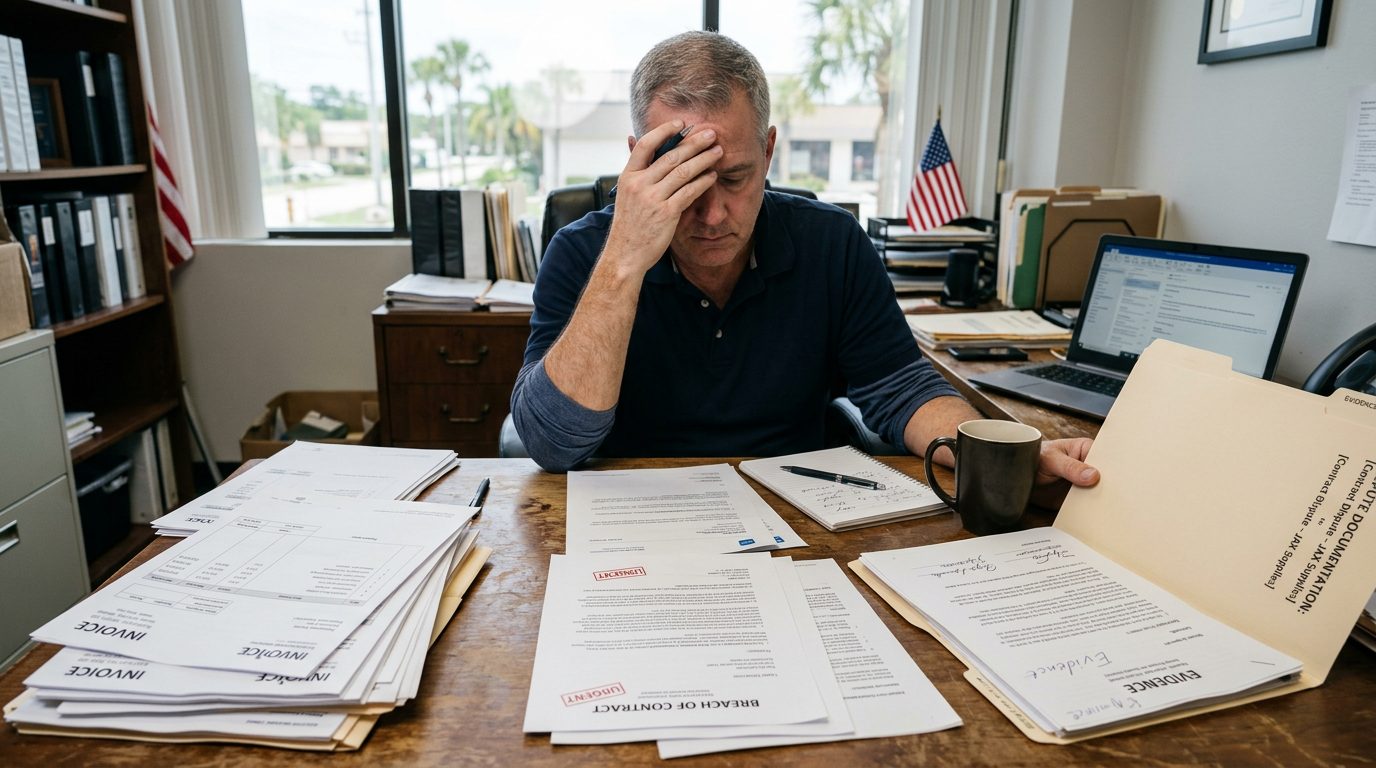
Written terms, change orders, invoices, and payment records are your core evidence. Keep them together, date every change, and confirm changes by email or letter.
For goods, Florida adds a writing rule. Under Fla. Stat. § 672.201, a contract to sell goods priced at $500 or more is generally not enforceable unless a writing signed by the party against whom enforcement is sought shows that the deal was made. If you accept goods, Fla. Stat. § 672.607 requires a buyer to notify the seller of a breach within a reasonable time after the buyer discovers, or should have discovered, the breach, or the buyer may be barred from any remedy.
Some disputes settle through a direct conversation or a written demand. Others move toward litigation. Which path fits depends on the contract and the amounts involved. KEW Legal focuses on business contract and vendor disputes.
Employee Issues and Employer Compliance Questions
Employer problems usually come from pay, worker classification, performance, or firing decisions that lack written support.
Frequent concerns include performance management, wage and hour questions, handbook gaps, and terminations that may raise discrimination or retaliation questions.
Calling a worker an “independent contractor” does not settle the question. Under the federal Fair Labor Standards Act, minimum wage, overtime pay, and recordkeeping obligations apply to workers who are employees, and the label a business gives a worker does not by itself decide that status (federal independent contractor regulation). The test looks at economic reality, including whether the worker is economically dependent on the employer or in business for themself.
Florida’s Civil Rights Act, Fla. Stat. § 760.10, prohibits certain employment discrimination by “employers” as defined in § 760.02, which generally covers employers with 15 or more employees. Fla. Stat. § 760.10 covers discharge, refusal to hire, and other discrimination in pay or terms of employment because of race, color, religion, sex, pregnancy, national origin, age, handicap, or marital status.
Keep consistent written policies, signed handbook acknowledgments, and a dated note of the reason for each personnel decision. KEW Legal also handles employment matters for employers.
Commercial Leases and Nonpayment Problems
Commercial lease problems usually involve unclear repair duties, operating expense charges, default notices, or what happens when the term ends.
Small issues escalate when a balance goes unpaid, notices are late or unclear, or no one kept dated copies. Those gaps make the next step harder to document.
Under Fla. Stat. § 83.001, Part I of Chapter 83 governs nonresidential tenancies and tenancies not governed by Part II of that chapter. Fla. Stat. § 83.001 says Part I applies to nonresidential tenancies. Under Fla. Stat. § 83.05, a landlord recovers possession only through a court action that decides the right of possession, after the tenant surrenders the premises, or after the tenant abandons them. A landlord generally cannot retake the space on its own.
A tenant who stays after a written lease ends creates another issue. Under Fla. Stat. § 83.04, a tenant who holds over without the landlord’s written consent is a tenant at sufferance.
Owners who live outside Florida face an added challenge. Rent checks, insurance certificates, and tenant emails can go to a manager or an old inbox. Distance makes a late payment or lapsed policy easy to miss. Regular, dated review of the lease file helps.
Buying, Selling, and Passing On a Business
Sale and succession problems usually come from missing records, unclear purchase terms, or no written plan for who takes over.
In a sale, watch for due diligence gaps, representations and warranties that don’t match the facts, purchase price adjustments, and transition terms no one defined. Each one can change what the buyer actually receives.
Succession problems often surface after an owner dies or becomes disabled. Without a written plan, such as a buy-sell agreement, family members or remaining owners may disagree about control and ownership. Owners who skip this step often face that disagreement at a difficult time.
Gather entity records, key contracts, leases, and tax filings early. Entities registered with the Florida Department of State, such as corporations, LLCs and limited partnerships, generally must file annual reports, so check the state record too.

Why Waiting Can Make These Problems Harder
Waiting can narrow your options, because records get harder to reconstruct and early steps are easy to miss.
Owners often treat early warning signs as ordinary business friction. A stalled vote or an unanswered records request can seem routine until it becomes part of a larger problem.
KEW Legal acts as outside general counsel for business owners and investors across Miami-Dade and South Florida. Kristina E. Wilson is the lawyer responsible for this page. The firm’s support staff handle administrative work. KEW Legal has offices in Coral Gables and Sunny Isles Beach.
What are some common problems business owners face?
Partner disputes, vendor disagreements, employee issues, lease nonpayment, and unplanned ownership changes are frequent problems. Many begin with a gap in writing.
Can a landlord change the locks on a commercial tenant?
Florida law limits how a landlord recovers possession. Under Fla. Stat. § 83.05, a landlord recovers possession only through a court action, after surrender, or after abandonment.
Does calling a worker a contractor settle the question?
Whether a worker counts as an employee or an independent contractor turns on the economic realities of the working relationship, including whether the worker depends economically on the business for work or is in business for themself (federal worker classification regulation).
This page does not promise any result. Some matters may be referred to another lawyer or firm when that fits better.
If a co-owner or tenant has you wondering what to do next, you do not have to sort it out alone. Send us a message or call 305-990-2300 for a free, confidential initial consultation, with no obligation to continue.
Five Issues We See Most Often
Partner and Co-Owner Disagreements
Disagreements over decision-making, profit distributions or the direction of the company often start small and grow as the owners' positions harden.
Vendor and Contract Conflicts
Late deliveries, disputed invoices and unclear terms in a written agreement can stall operations and strain relationships with suppliers and customers.
Employee Issues
Hiring, discipline, pay questions and separations raise recordkeeping and compliance questions that employers benefit from reviewing early.
Commercial Lease Trouble
Missed rent, disputed charges and unclear lease terms can put a business location at risk and are easier to address when the lease is reviewed promptly.
Unplanned Ownership Changes
The death, departure or disability of an owner, or an unexpected offer to buy or sell, can leave a business without a clear plan for what comes next.
Keep Your Records in One Place
Signed agreements, amendments, written notices, invoices and payment records are the first things reviewed in most business disputes. Keeping them organized and dated makes any later review faster and clearer.
How KEW Legal Works With Business Owners
Outside General Counsel
KEW Legal acts as outside general counsel for business owners and investors, covering contracts, disputes, employment questions and property matters as they arise.
Contracts and Leases
The firm reviews and negotiates business contracts and commercial leases, and handles commercial evictions for owners who live abroad.
Ownership Transitions
Partner disputes, buying and selling a business, and succession planning are handled with attention to the agreements and records each owner already has.
Miami-Dade and Broward
KEW Legal has offices in Coral Gables and Sunny Isles Beach and serves business owners across Miami-Dade and South Florida.
Talk With Kristina E. Wilson About Your Business. Your First Consultation Is Free, Confidential and Carries No Obligation to Continue.
Related practice areas
Request a Consultation
Fill out the short form and we will take it from there.