
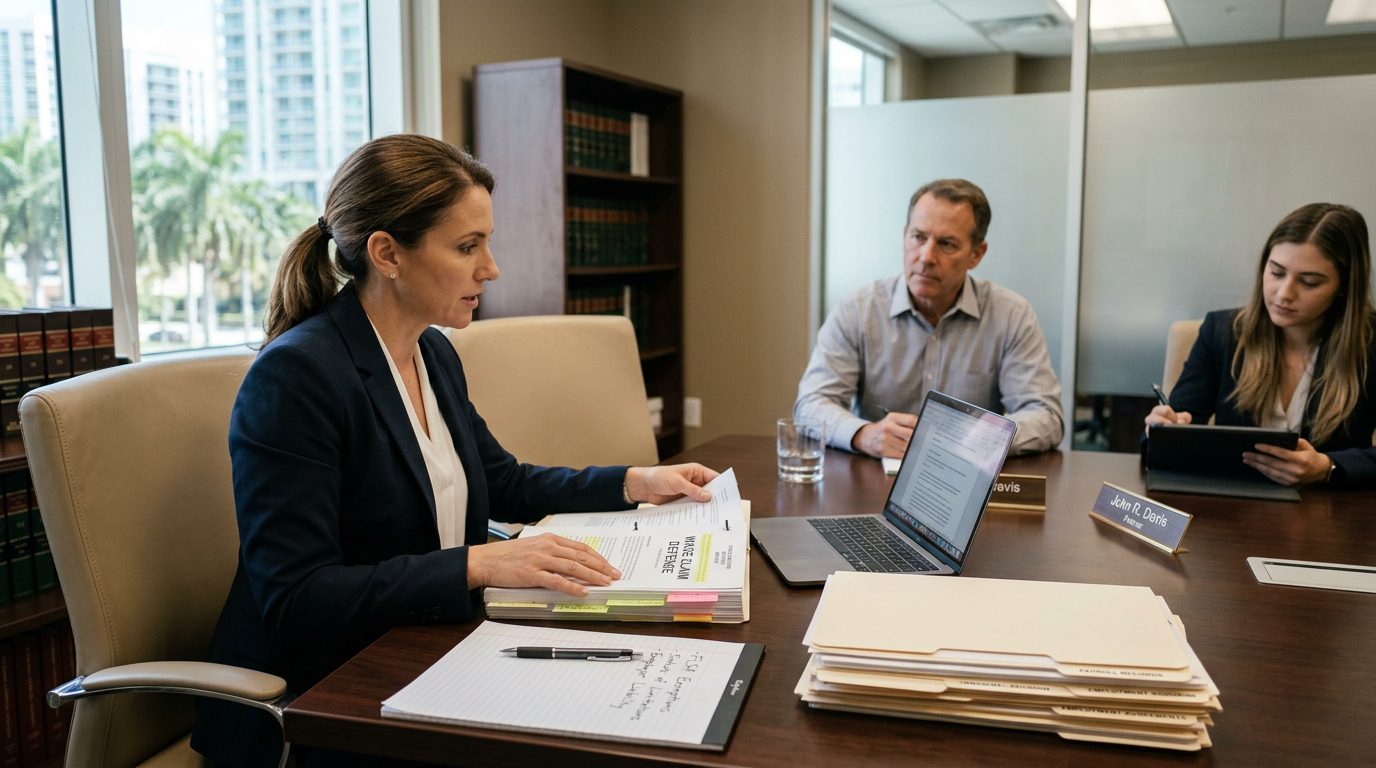
Employment Defense for Employers · Coral Gables & Sunny Isles Beach
Defending Florida Employers Against Unpaid Wage Claims
KEW Legal represents business owners across Miami-Dade and Broward counties when an employee demand, complaint or lawsuit over pay raises questions about the company's obligations and exposure. Our attorneys help you respond with a clear strategy.
By Kristina E. Wilson · Published October 24, 2026
If an employee says you owe unpaid wages, the clock may already be running. An unpaid wages lawsuit defense attorney for a Florida employer reviews the claim, tests the numbers against your records, and answers within the deadlines that apply. This page explains how that defense works for owners, managers, and HR leads in Miami-Dade, Broward, and South Florida. It is general information, not advice on your specific facts.
What an Unpaid Wage Claim Against a Florida Employer Is
An unpaid wage claim is an employee’s allegation that the business did not pay wages it owed. The claim may involve regular pay, overtime, a final paycheck, tips, or a minimum wage shortfall.
Claims usually arrive in one of four forms:
- An internal complaint from a current or former worker
- A demand letter from the employee or the employee’s lawyer
- An inquiry from a government agency
- A civil lawsuit filed in court
This page is written for owners, managers, and HR decision-makers who have received one of these. Many readers handle a claim for a company they run or work for, not for themselves.
Early response matters. Once you know about a claim, you should preserve records and watch the deadlines. Informal replies can also create new problems. Our guide on managing problem employees and our page on whether an employee can sue an employer cover related ground.
If an employee's pay complaint has landed on your desk, you don't have to work out the deadlines alone. Our team is ready to talk it through with you. Talk it through with our team — the first consultation is free, confidential, and carries no obligation.
Florida and Federal Wage Laws Employers Face
Florida and federal wage laws can both apply to the same pay dispute. The state rules come from the Florida Minimum Wage Act and the minimum wage amendment in the Florida Constitution, Article X, Section 24. Federal overtime and minimum wage rules come from the Fair Labor Standards Act (FLSA).
Several rules shape your response:
- Written notice first. Before suing for unpaid minimum wages, the employee must give written notice. The notice must name the minimum wage claimed, the work dates and hours, and the total unpaid amount. You then have 15 calendar days after receipt to pay or otherwise resolve the claim.
- Liquidated damages. Upon prevailing in an action under § 448.110, aggrieved persons recover the full amount of unpaid back wages plus the same amount as liquidated damages and are awarded reasonable attorney’s fees and costs, although the court may, in its sound discretion, award no liquidated damages or an amount not exceeding the unpaid minimum wages if the employer proves by a preponderance of the evidence that its act or omission was in good faith and that it had reasonable grounds for believing it was not a violation.
- Under the Florida Minimum Wage Act, the time limit to sue is the period set in s. 95.11 of the Florida Statutes, starting on the date of the alleged violation. Section 95.11 sets four years for an action alleging a violation, other than a willful violation, of s. 448.110.
- Fee shifting. Under Fla. Stat. § 448.08, the court may award the prevailing party in an action for unpaid wages costs of the action and a reasonable attorney’s fee. That party can be the employer, so fee risk runs both ways.
What Outside Counsel Covers in an Unpaid Wage Defense
Outside counsel reviews the claim, tests the numbers, and shapes the response before any deadline passes. The work covers both the paperwork and the records behind it.
Typical work includes:
- Reading the demand letter or complaint and listing each wage category claimed
- Checking payroll, timekeeping, schedules, and tip records against the employee’s figures
- Reviewing how the worker was classified as an employee or contractor, and as exempt or non-exempt from overtime. Whether a classification holds up turns on the facts.
- Handling agency inquiries and drafting position statements
- Negotiating settlement terms, release language, and payment schedules
- Defending a lawsuit, including pleadings, discovery, and motions
- Raising counterclaims or offsets when there is a good-faith basis for them
One point matters early. A defense the facts do not support can carry its own cost. Under Fla. Stat. § 57.105, a court must award a reasonable fee, paid in equal amounts by the losing party and the losing party’s attorney, when the party or attorney knew or should have known that a claim or defense lacked the material facts or was not supported by then-existing law. Exceptions apply: there is no sanction for a good-faith argument to change the law made with a reasonable expectation of success, no sanction against a represented party for a law-based defect, no sanction against an attorney who relied in good faith on the client’s facts, and no sanction on the court’s own initiative unless it is awarded before a voluntary dismissal or settlement of the claims. A sanctions motion also cannot be filed unless the challenged claim or defense is not withdrawn or corrected within 21 days after the motion is served. A records-first defense is the safer path.
How the Process Works, Step by Step
The process starts with a consultation and moves through records, a written assessment, and a timely response. Each step can move faster or slower, depending on the court and the claims.
- Free first consultation. We review the claim and the deadlines that may apply.
- Preservation instructions. You receive written instructions covering payroll, email, texts, and schedules.
- Records review. We test the employee’s numbers against your payroll and timekeeping data.
- Written assessment. We outline your exposure, defenses, and options, with a recommendation.
- Response. We reply to the demand, negotiate, or submit to the agency within the deadline that applies. If the employee sent a statutory notice, the 15-day window may already be running.
- Litigation or mediation, if needed. Under Fla. Stat. § 44.102, a court must refer a filed damages case to mediation when a party asks, provided the requesting party is willing and able to pay the costs of the mediation or the costs can be equitably divided between the parties, unless an exception applies. Exceptions include actions governed by the Florida Small Claims Rules.
Timelines vary by court and facts, and no particular outcome can be promised.
What to Gather and Preserve Now
Start with the records that show what was paid, when, and how. Gather them before you reply to anyone outside the company.
- Payroll registers, pay stubs, and direct deposit records for the period claimed
- Timekeeping logs, badge or scheduling data, and manager approvals
- Offer letters, job descriptions, and handbook sections on pay, overtime, and final pay
- Messages with the employee about hours, rates, commissions, or tips
- Independent contractor agreements and invoices if classification is disputed
Then follow three habits. Don’t alter or delete records once you know a claim exists. Keep informal back-and-forth with the employee to a minimum, and route contact through counsel. Also, don’t take action against an employee for raising a pay complaint. The Florida Minimum Wage Act makes retaliation for exercising those rights unlawful.
Common Questions Employers Ask About Unpaid Wage Claims
Yes, an employee can sue a Florida employer for unpaid wages, subject to notice, time limits, and proof. The short answers below cover common questions.
Can an employee sue a Florida employer for unpaid wages?
Yes. Under Fla. Stat. § 448.110(6), a person aggrieved by a minimum wage violation must first notify the employer alleged to have violated the section, in writing, of an intent to initiate an action, and the employer then has 15 calendar days after receiving the notice to pay the total amount of unpaid wages or otherwise resolve the claim to the satisfaction of the person aggrieved.
Does a demand letter mean a lawsuit is coming?
Not always. Treat any deadline in the letter as binding until counsel confirms the next steps.
Does paying the disputed amount end the claim?
Not automatically. Release terms, liquidated damages, and possible attorney’s fees all need review before you treat a claim as closed.
Can a settlement offer be used as evidence?
Generally no. Under Fla. Stat. § 90.408, evidence of an offer to compromise a disputed claim is inadmissible to prove liability or its value.
Can a Florida employer fire an employee who complains about pay?
Not for a reason the law prohibits.
Not sure what your next step is?
Talk it through with our team — the first consultation is free, confidential, and carries no obligation.
Why Businesses Work With KEW Legal on Wage Claims
KEW Legal is a Florida business law firm that acts as outside general counsel for business owners and investors. Wage defense sits alongside the firm’s work on contracts, commercial leases, ownership changes, and employment matters for employers.
- The firm has offices in Coral Gables and Sunny Isles Beach and serves Miami-Dade, Broward, and South Florida.
- Kristina E. Wilson is the lawyer responsible for this page. Natalie Martinez is also a lawyer at the firm.
- The firm focuses on business and employment matters for employers.
- The first consultation is free, confidential, and carries no obligation to continue.
- Some matters may be referred to another lawyer or firm. If that happens in your case, the firm will tell you.
- Because the firm also handles ongoing business counsel, a related vendor payment dispute or lease issue can be reviewed alongside the pay claim.
Talk Through Your Wage Claim With KEW Legal
If an employee’s pay complaint has reached you, you don’t have to sort out the deadlines alone. Call 305-990-2300 or send a message through the KEW Legal contact page to set up your free first consultation.
How We Help Employers Respond
Review of the Claim
We examine the demand letter, complaint or agency notice and the pay records behind it, so you understand what is being alleged and what the documents show.
Defense Strategy
We evaluate defenses, settlement options and how a response may affect your business, then recommend a course of action you can weigh before deciding.
Guidance for Owners and HR
We advise owners, managers and human resources staff on communications with the employee, preservation of records and steps to avoid further disputes.
Practical Pay Practices
After a matter resolves, we can help you review timekeeping, overtime, final pay and classification practices to reduce future risk.
Act Early on a Wage Demand
A letter or lawsuit about unpaid wages is not something to set aside. Early review of the claim, the pay records and any notices you have received gives your business more options and helps you avoid statements that could complicate the matter.
Matters We Handle for Employers
Demand Letters
Responding to a written demand for back pay before it becomes a court filing or agency proceeding.
Lawsuits and Agency Complaints
Defending wage claims filed in court or brought before a government agency, from initial response through resolution.
Pay Practice Reviews
Examining overtime, timekeeping, final paycheck and classification practices that may be at the center of a dispute.
Settlement Negotiation
Working to resolve claims in a way that fits your business goals, with a clear view of the costs and risks involved.
Get a Clear Picture of Your Wage Claim Exposure. Our Free First Consultation Is Confidential and Carries No Obligation to Continue.
Related practice areas
Request a Consultation
Fill out the short form and we will take it from there.