
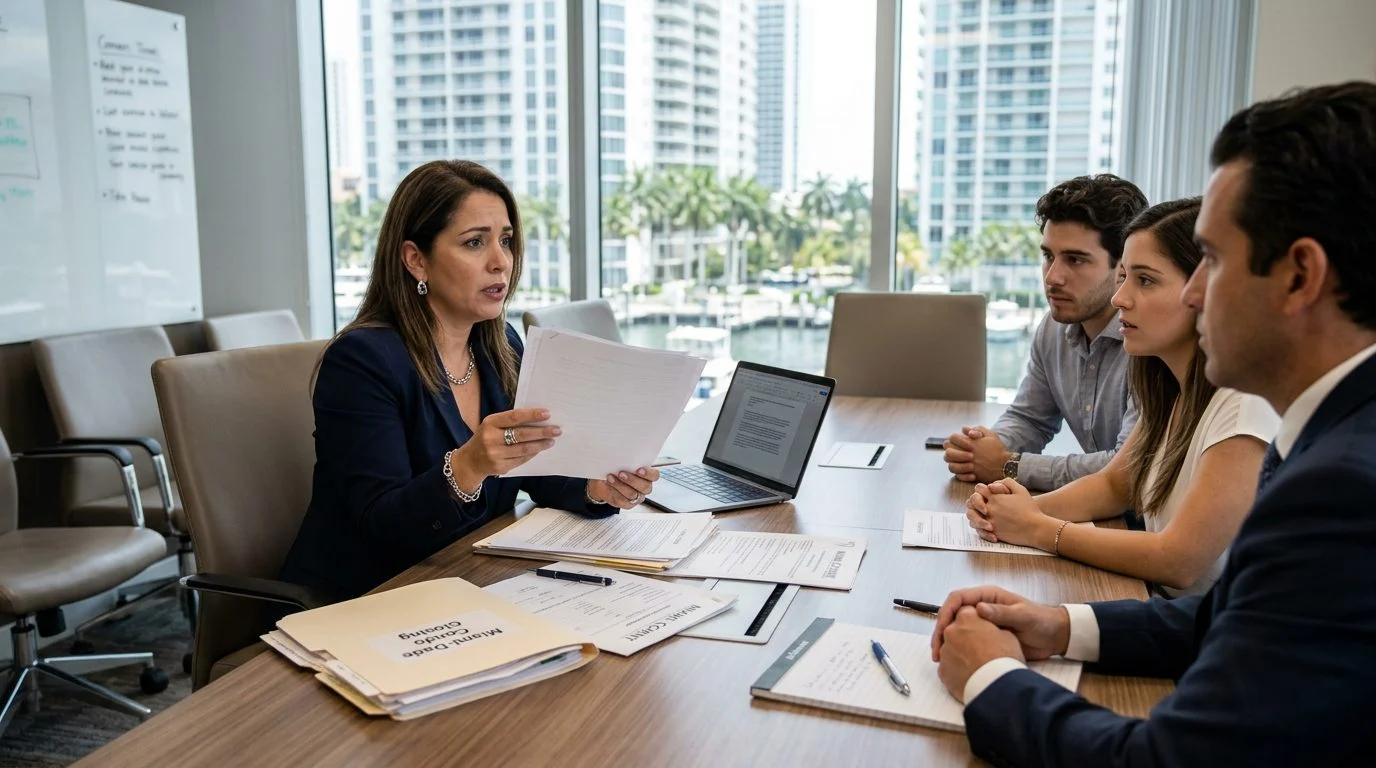
Business Law | Coral Gables and Sunny Isles Beach
Stalled by Your Joint Venture Partner? Get the Condo Closing Moving Again
When a co-investor stops cooperating, the answer usually starts with the agreement you already signed.
By Kristina E. Wilson · Published November 17, 2026
Your buyers are waiting, the turnover date is on the calendar, and your joint venture partner has stopped signing. A partner can hold up a condo closing when the deal needs that partner’s signature, vote, or money. The company’s own agreement usually decides how much say that partner has.
The first step is reading the joint venture or operating agreement next to the closing papers. KEW Legal reviews those documents for Miami-Dade developers and then sets out a path to closing.
When Your Joint Venture Partner Is Holding Up a Condo Closing
A stalled closing is usually a paperwork problem before it is a calendar problem. Lenders, title companies, and buyers all need the company’s signatures and approvals on time.
If your partner stops signing, the company may not be able to deliver the deed, closing statement, or affidavits on the scheduled date. One missing signature can push back a turnover, even when everyone else is ready.
Whether your partner can block the closing depends on the facts in your joint venture agreement and your closing documents. Reading those documents together comes first, before you answer any email from your partner.
In practice, the costly problems often start with informal messages. Texts, verbal promises, and unsigned drafts leave everyone unsure who agreed to what. That uncertainty slows a closing more than almost anything else.
If your partner has stopped signing as your closing date nears, you don't have to work through the documents alone. Talk with our team about your situation. Talk it through with our team — the first consultation is free, confidential, and carries no obligation.
What a Partnership Dispute Attorney Handles for a Condo Developer
KEW Legal handles partnership disputes for joint ventures and LLCs. It also acts as outside general counsel for the same business owners on closings and everyday contracts.
If your project company is member-managed, Fla. Stat. § 605.0407 places management in the members, except as the chapter provides. Approvals generally need a majority-in-interest of members, and the operating agreement can be amended only with every member’s consent (§ 605.04073).
If your agreement is silent on voting, the default rules in § 605.04073 apply: in a member-managed LLC, each member has the right to vote on the management and conduct of the company’s activities and affairs, with each member’s vote proportionate to that member’s percentage or other interest in the profits of the company, and in a manager-managed LLC, each manager has equal rights in that management. A promise to contribute to an LLC, whether money or other property, is enforceable only if it is set out in a writing signed by the person making it (§ 605.0403).
A member may bring a direct action against another member, a manager, or the limited liability company to enforce the member’s rights and protect the member’s interests, including rights under the operating agreement. To maintain that action, the member must establish, by pleading and proof, either an actual or threatened injury that is not solely the result of harm to the company, or an actual or threatened injury resulting from a violation of a separate statutory or contractual duty owed by the wrongdoer to the member, even where that injury is in whole or in part the same as the harm to the company (§ 605.0801).
Our lawyers also handle closings, company upkeep, operating agreement compliance, and day-to-day vendor and buyer contracts. That work takes routine items off your in-house counsel’s desk. Related disputes, such as co-developer cost overruns or a manager’s duties under Florida LLC law, can sit alongside a closing fight.
Common Ways a Partner Delays a Condo Closing
Most closing delays come from a partner who holds back a signature, a vote, or money the deal needs.
- A lease of real property does not require subscribing witnesses under § 689.01.
- Refusing to fund a capital call that the closing or final punch list requires.
- Send notices to one of those places and keep proof.
- Raising new objections late. A change to buyer assignments or contract terms can reopen essential terms. Florida’s Third District has held that while essential terms are still being negotiated, there is no meeting of the minds (Third District meeting-of-minds ruling).
- Using the closing as leverage in a wider fight over profits, fees, or control.
Waiting carries its own risk. Under Florida law, a party that could cancel a deal but keeps going after learning the key facts may be found to have ratified it (Flaherty ratification ruling).
How We Work Through a Stalled Closing
We start with your documents, then state the company’s position in writing and work toward a signed path to closing.
- Gather the record. Collect the joint venture or operating agreement, the closing timeline, and every notice and signature exchanged.
- Identify what’s required. Find which approvals or signatures the deal needs and which notice or cure steps apply. Florida courts don’t favor treating a contract step as a condition first, unless the words plainly make it one (Covelli conditions precedent case).
- Send a clear written demand. State the company’s position and the steps needed to close.
- Negotiate a path to closing. Options include a signing protocol, an escrow arrangement, or a limited written agreement on the open point.
- Review the dispute path. If the partner still refuses, check whether your agreement requires arbitration. Florida enforces a written arbitration agreement unless a ground to revoke a contract applies (§ 682.02). In many court cases for money damages, a judge must refer the case to mediation on one party’s request, if that party can pay the costs or they can be split (§ 44.102).
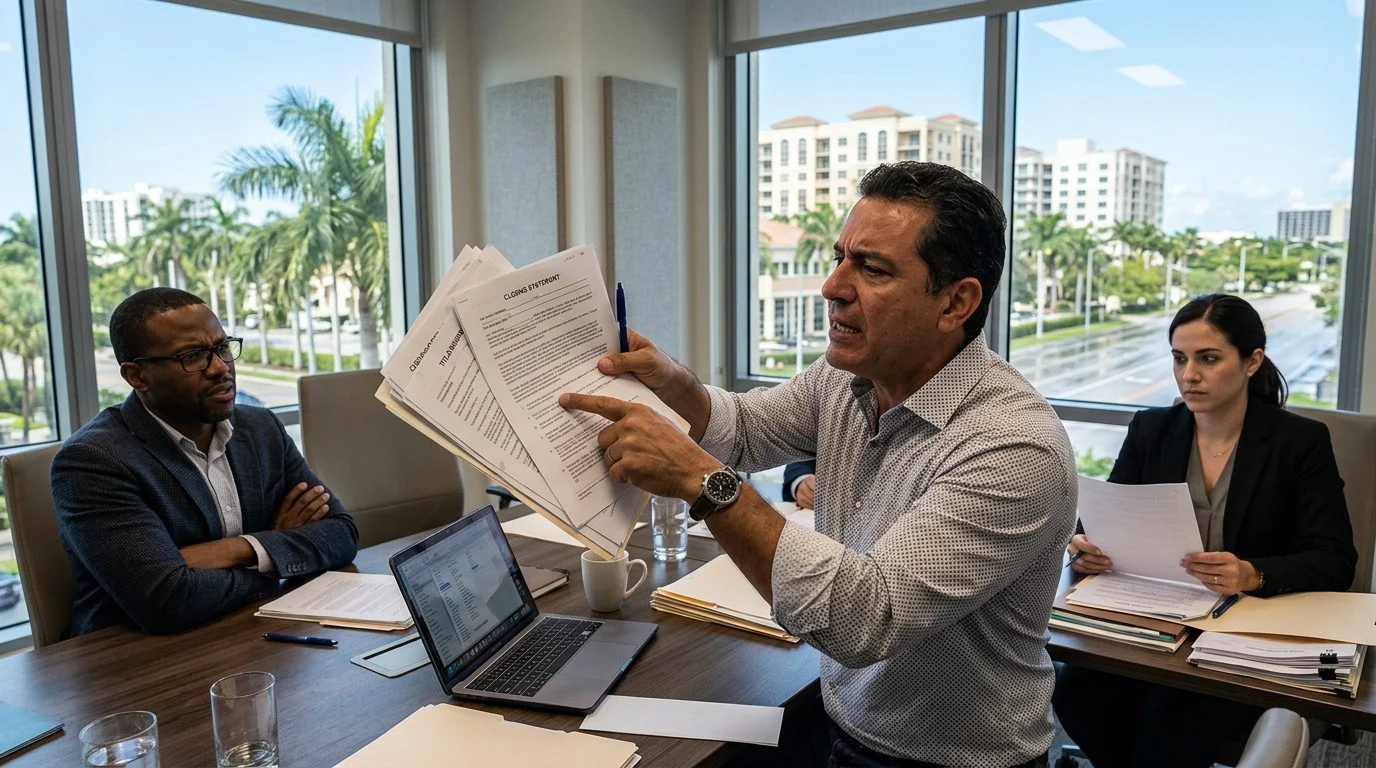
Discretion, Speed, and Coverage for Your Family Business
KEW Legal keeps family, buyer, and lender details on a need-to-know basis. It can also work alongside your in-house counsel.
- Confidentiality. Details about your family, buyers, and lenders go only to the people who need them.
- Closing-day questions. Questions about signature logistics and contract wording are handled as they come up, so the deal isn’t stuck waiting on routine answers.
- Ongoing support. Entity upkeep and contract review for new rental and tower projects can run alongside your in-house work.
- Where we are. Our offices are in Coral Gables and Sunny Isles Beach. We serve clients across Miami-Dade and South Florida, including Broward County.
Why Developers Work with KEW Legal
KEW Legal is a Florida business law firm that acts as outside general counsel for business owners and investors in Miami-Dade and South Florida.
- Responsible lawyer. Kristina E. Wilson is the responsible lawyer for this page. Natalie Martinez is also a lawyer at the firm.
- Focus. Our lawyers concentrate in business and real estate matters. These include partnership disputes, business contracts and vendor disputes, commercial leases, real estate investment, and business succession.
- Starting point. We begin with your own documents, not generic advice about partner disputes.
- One ongoing team. Closings, company upkeep, and routine contracts can stay with one outside legal team instead of a new firm for each project.
- No promised result. No outcome or timeline is promised here. The first step is reviewing your documents.
Not sure what your next step is?
Talk it through with our team — the first consultation is free, confidential, and carries no obligation.
Frequently Asked Questions
Here are short answers to questions a developer may ask when a partner stalls a closing.
Can the closing go forward without the partner’s signature?
The answer turns on what your agreement and closing papers require. Review comes first.
How quickly can a stalled closing be addressed?
The first steps are a document review and a written demand. Timing varies with the documents and how the partner responds.
Will my information stay confidential?
Family, buyer, and lender details are shared only with the people who need them.
What does the first meeting cost?
La consulta inicial es gratuita, confidencial y sin compromiso de continuar. The initial consultation is free, confidential, and carries no obligation to continue.
Who handles my matter?
Kristina E. Wilson is the responsible lawyer. Other lawyers at the firm, including Natalie Martinez, may also work on it.
If your partner has stopped signing while your turnover date gets closer, you don’t have to work through this alone. Contact KEW Legal to schedule a consultation, or call 305-990-2300.
How KEW Legal Approaches a Stalled Closing
Document review first
We read the joint venture or operating agreement, the purchase contract and the closing instructions to see what each partner must do before the deal can close.
Written demand when needed
If your partner is blocking the transaction, we can put the obligations in writing and request a specific response.
Protecting your position
We help you avoid signing, funding or sending anything that could weaken your rights while the dispute is being addressed.
Outside general counsel
Our lawyers work with business owners and investors on an ongoing basis, so the closing is handled with the rest of your business matters in mind.
Before You Sign Anything Else
Do not sign, fund or send new instructions to the title company or your partner until the joint venture agreement and closing documents have been reviewed. A rushed signature can change the outcome of the dispute.
Common Ways a Partner Stalls a Condo Closing
Refusing to sign
A partner withholds signatures on the deed, closing statement or lender documents, leaving the transaction stuck at the last step.
Withholding funds
A co-investor delays or refuses to contribute its share of the purchase price, closing costs or reserves.
Demanding new terms
A partner tries to renegotiate price, ownership percentages or management control just before closing.
Going silent
Calls, emails and closing-day messages go unanswered, and the title company and lender are left waiting.
Kristina E. Wilson and our team in Coral Gables are ready to review your closing. The first consultation is free, confidential, and carries no obligation to continue.
Related practice areas
- Partnership Dispute Attorney
- My Co-Developer Partner Ran Up Project Costs and Blocked Our Lender
- What Duties Does an LLC Member or Manager Owe the Company in Florida?
- Outside General Counsel For Businesses
Request a Consultation
Fill out the short form and we will take it from there.