
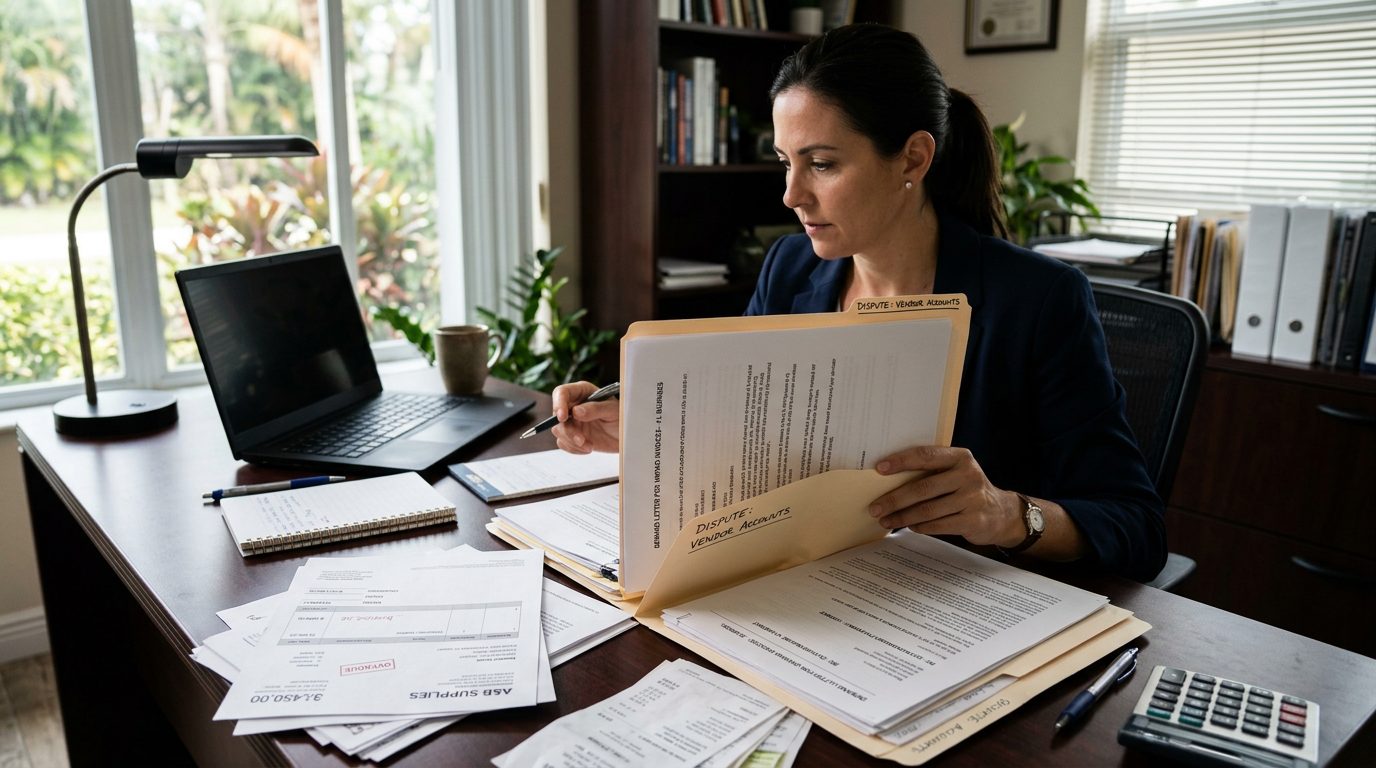
Business Contract & Vendor Disputes · Miami-Dade & Broward
Demand Letters for Unpaid Invoices, Written to Get Your Business Paid
KEW Legal helps Florida business owners and investors prepare clear, professional demand letters for unpaid invoices, with offices in Coral Gables and Sunny Isles Beach.
By Kristina E. Wilson · Published October 25, 2026
A demand letter for unpaid invoice is a formal written request for payment. You send it before filing a lawsuit. It states what is owed, why it is owed, and the date by which the other side must pay. This page explains what a Florida business demand letter should contain, when to send one, and what can happen next.
What a Pre-Suit Demand Letter Is and Who It Is For
A pre-suit demand letter is a written request for payment sent before any lawsuit is filed. It puts the debt, the basis for it, and a deadline to pay in one document.
Business owners, managers, and bookkeepers often send these letters. They are owed money for unpaid invoices, completed services, or goods delivered under a contract or purchase order.
A casual reminder and a demand letter do different jobs. A reminder asks for payment. A demand letter also states the consequences of nonpayment and creates a dated record. That record matters if the dispute later reaches a Florida court.
The contract and Florida law set the terms of a business debt. Your letter should follow them.
If an unpaid invoice has your business stuck between waiting and suing, our team can review the contract and the amounts with you at a first consultation. Talk it through with our team — the first consultation is free, confidential, and carries no obligation.

When to Send a Demand Letter and What to Gather First
A demand letter makes sense when reminders have failed and the debt is clearly tied to a contract or purchase. Common signals include:
- Due dates that passed after one or more reminders
- A customer that has gone quiet after receiving an invoice
- A vendor that refuses to pay for work it accepted
- An invoice the customer admits receiving but has not paid
Before you write anything, read the contract. Look for payment terms, notice addresses, late-fee or interest rules, and any mediation step that must come first. Look for attorney-fee clauses too. Under Fla. Stat. § 57.105(7), if a contract lets a party recover attorney’s fees for enforcing it, a court may also allow fees to the other party when that party prevails.
Gather these records:
- Signed agreements, purchase orders, and change orders
- Invoices with numbers and dates
- Delivery, completion, or acceptance records
- Emails or texts where the customer acknowledges the work
- A running account statement
Timing matters. Fla. Stat. § 95.11 sets different time limits for different claims. It sets five years for an action on a contract founded on a written instrument. A claim on an oral or other unwritten contract, such as one for the sale and delivery of goods, is an action on a contract, obligation, or liability not founded on a written instrument, including an action for the sale and delivery of goods, wares, and merchandise, and on store accounts, under Fla. Stat. § 95.11(3)(j), which falls under the four-year period in § 95.11(3). Review the age of the debt early. Do not wait months for informal follow-up to run out.
What a Florida Demand Letter for Unpaid Invoices Should Include
A strong letter names the parties, the contract, each unpaid invoice, the amount owed, and a firm deadline. It should be neutral and easy to check.
Include these parts:
- The full legal names of both parties and the contract or purchase order that connects them
- Each invoice with its number, date, and amount
- An itemized total, with the principal balance shown separately from any interest or fees
- Only the interest or fees the contract allows. If the contract sets no interest rate, Fla. Stat. § 687.01 points to the rate provided in § 55.03, which sets the rate of interest that shall be payable on judgments or decrees.
- The facts: what was delivered or performed, when, and what remains unpaid
- A payment deadline, accepted payment methods, and a response address or email
- A plain statement of what happens if the deadline passes, without threats you do not plan to carry out
Delivery matters too. If the customer is an LLC, Fla. Stat. § 605.0117(2) allows a notice or demand under Florida’s LLC chapter to go to a member of a member-managed company, a manager of a manager-managed company, the registered agent at the company’s registered office in Florida, or another Florida address that is in fact the principal office. Check the company’s name and registered agent in Florida Sunbiz records before you send. Keep proof of delivery, such as certified mail with a return receipt plus email.
How the Process Works: Step by Step
The process runs in five steps: consultation, document review, drafting, sending, and a decision on next steps. How long each step takes depends on the other party’s replies and the facts of the debt.
- Free first consultation. A confidential call or meeting reviews the facts, the contract, and the invoices. Our free first consultation is confidential and carries no obligation to continue.
- Document review and gap check. Amounts, contract terms, notice rules, and likely defenses get checked. Common defenses include disputed quality and missing signatures.
- Drafting. The letter is prepared for your review before it is sent. Kristina E. Wilson is the responsible lawyer for this page.
- Sending and response window. The letter goes out by the agreed methods. The deadline in the letter sets the response window.
- Next-step decision. If the debt is paid, the file closes with written confirmation. If it is not, you get advice on your options before any lawsuit is filed.
Common Mistakes That Weaken a Demand Letter
Most weak letters fail on accuracy, detail, or delivery. These mistakes come up often.
- Overstating the amount. Adding fees or interest the contract does not allow hurts credibility. Section 57.105(1) of the Florida Statutes requires a court to award a reasonable attorney’s fee, payable in equal amounts by the losing party and the losing party’s attorney, when the court finds that either of them knew or should have known that a claim or defense was not supported by the material facts or by then-existing law, subject to the exceptions in § 57.105(3), such as good-faith reliance by an attorney on the client’s factual representations. If an overstated amount is carried into a lawsuit, the opposing party may seek fees under § 57.105. A pre-suit demand letter is not itself a claim or defense presented to the court under this subsection. A motion under § 57.105 must be served first, and it may not be filed unless the challenged paper, claim, or defense is not withdrawn or appropriately corrected within 21 days after service (§ 57.105(4)).
- Vague facts. A letter that says “services were rendered” with no dates, scope, or invoice numbers gives the customer nothing to check.
- Threats of criminal charges. Using criminal threats to collect a civil debt can create separate problems for the sender. Keep the letter to the contract claim.
- Wrong notice address. If the contract names a notice address or method, use it. Otherwise the customer can argue it never received proper notice.
- Vague deadlines. Reminders with no set date leave the customer nothing to answer. Put a specific deadline in the letter.
- Accepting partial payment without a note. A partial payment can complicate later claims. State in writing that the balance remains due.
What Happens If the Company Does Not Respond
Silence is common. The letter still matters because it documents the demand and the deadline. After the deadline passes, you can send a follow-up, agree to a written payment plan, or file suit.
If you sue, venue matters. Fla. Stat. § 47.011 says actions must be brought only in the county where the defendant resides, where the cause of action accrued, or where the property in litigation is located, and this section does not apply to actions against nonresidents.
Mediation rules also have limits. Under Fla. Stat. § 44.102(2)(a), a court must, upon request of one party, refer a filed civil action for monetary damages to mediation, provided the requesting party is willing and able to pay the costs of the mediation or the costs can be equitably divided between the parties. Under Fla. Stat. § 44.102(2)(a), a court, under rules adopted by the Supreme Court, must upon request of one party refer to mediation any filed civil action for monetary damages, unless an exception applies, and one listed exception is that “[t]he action is filed for the purpose of collecting a debt.”
If the customer says the goods were defective, timing matters. Under Fla. Stat. § 672.607(3), a buyer who accepted goods must notify the seller of a breach within a reasonable time after he or she discovers or should have discovered it. Otherwise the buyer can be barred from any remedy. For unpaid goods already accepted, Fla. Stat. § 672.709(1) lets the seller recover the price, plus incidental damages.
Frame the claim around the contract. Outcomes depend on the facts, the contract, and the other side’s defenses. No result can be promised in advance.
Not sure what your next step is?
Talk it through with our team — the first consultation is free, confidential, and carries no obligation.
Why Work With KEW Legal on a Business Debt Demand Letter
KEW Legal is a business law firm. It acts as outside general counsel for business owners and investors in Miami-Dade and South Florida. The firm has offices in Coral Gables and Sunny Isles Beach.
- Kristina E. Wilson is the responsible lawyer for this page. Natalie Martinez is also one of the firm’s lawyers.
- Our lawyers focus on business matters. That includes contract and vendor disputes, commercial leases, partnership disputes, and employment issues for employers.
- Payment disputes often connect to leases, partnerships, and vendor terms. Those documents belong in the review.
- You can reach the office at 305-990-2300.

Frequently Asked Questions About Demand Letters for Unpaid Business Debts
How do I write an official demand letter for an unpaid invoice?
Start with the contract and invoices. Then state the amount, the basis, the deadline, the delivery method, and the next step in neutral language.
How much does a demand letter cost?
Costs vary with the size and complexity of the file. Ask about fees at your first meeting with us.
What are common mistakes in demand letters?
Common mistakes include overstated amounts, vague facts, criminal threats, wrong notice addresses, and waiting too long to send.
What if the company does not respond?
Silence is common. Next steps can include a follow-up letter, a written payment plan, or a lawsuit filed in the proper court in the proper county.
Do I have to send a letter before suing?
Check the contract first. It may require notice or mediation before a lawsuit.
If an unpaid invoice is weighing on your business, you don’t have to work through the next step alone. Reach out through our contact page and we can talk through the contract and the amount owed.
What a Strong Demand Letter Includes
The Contract and Invoices
We start with the agreement, purchase orders, invoices, and delivery records so the letter reflects what your business actually provided.
The Amount and Its Basis
The letter identifies the amount owed, how it was calculated, and the contract terms or work that support it.
A Clear Response Deadline
A stated date for payment or a response sets expectations and documents that your business gave the other party a chance to resolve the matter.
Delivery and Next Steps
The letter specifies how it will be sent and what your business will do next if the invoice remains unpaid, in neutral, professional language.
Why Business Owners Work With KEW Legal
Business Law Focus
KEW Legal focuses on business law, including contract and vendor disputes, for owners and investors across Miami-Dade and South Florida.
Outside General Counsel
Our lawyers serve as outside general counsel, so you have a legal team that already knows your business when a payment problem arises.
Coral Gables & Sunny Isles Beach
Our offices in Coral Gables and Sunny Isles Beach serve clients in Miami, Brickell, Aventura, Doral, Fort Lauderdale, and throughout Broward County.
Free First Consultation
Your first consultation is free, confidential, and carries no obligation to continue. We will review your invoices and explain your options.
Review Before You Send
A demand letter is often the first formal step in a payment dispute, so it should be accurate. Before sending anything, review the contract, confirm the amounts, and avoid threats or statements you cannot support. Speak with a lawyer first.
Owed Money for Work Your Business Completed? Let's Review the Invoices Together.
Related practice areas
Request a Consultation
Fill out the short form and we will take it from there.