
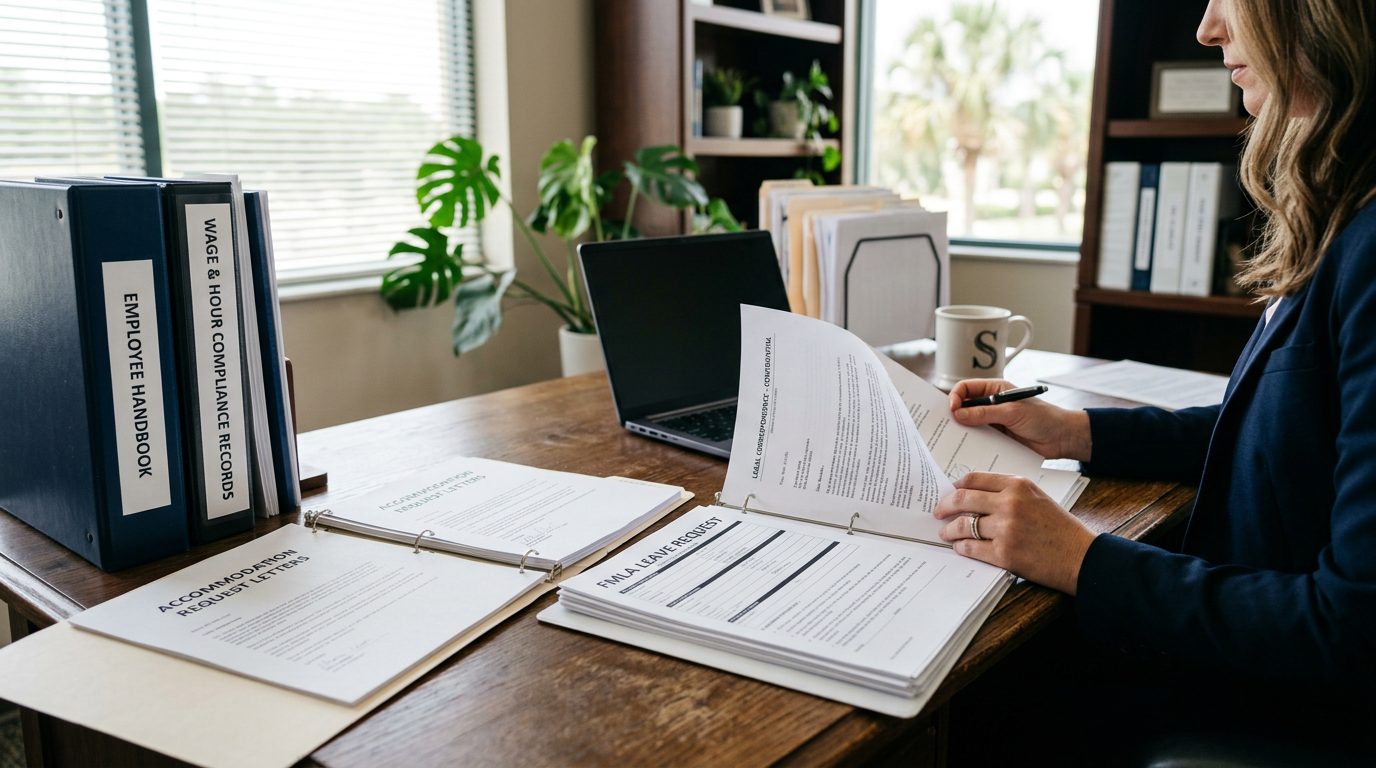
Employment Law for Employers | Coral Gables & Sunny Isles Beach
Handling an FMLA Leave Request? Respond With Confidence
KEW Legal advises Florida employers in Miami-Dade and Broward on family and medical leave requests, from recognizing a possible FMLA need to documenting a consistent, written response.
By Kristina E. Wilson · Published October 27, 2026
An FMLA leave request is a worker’s request for time off for a qualifying medical or family reason under the federal Family and Medical Leave Act (FMLA). If you’re an employer in Florida facing one, your response matters as much as your answer. This guide explains which rules may apply, the steps to take, and the mistakes that create trouble. It’s written for owners, HR staff, and managers in Miami-Dade, Broward, and South Florida. Kristina E. Wilson, one of KEW Legal’s lawyers, is the responsible lawyer for this page.
What an FMLA Leave Request Is and Who This Guide Is For
An FMLA leave request is a request for time off that may qualify under the federal FMLA. Employees often don’t use the word “FMLA.” Treat any request for medical or family leave as a possible FMLA request.
This guide is for business owners, HR staff, and supervisors who must respond now. Many are covering an absence they didn’t plan for. The rules below focus on the employer’s side, not on an employee’s claim.
Whether the request came by text, email, or a hallway conversation, write down the date and the details. Clear records make every later step easier to explain.
Not sure what your next step is?
Talk it through with our team — the first consultation is free, confidential, and carries no obligation.
Does the Federal FMLA Apply to Your Business?
The National Partnership FMLA coverage guide explains these coverage rules.
Don’t assume a small team is exempt. Start with a headcount from payroll records, then check each employee who asked for leave.
Use this quick check before you respond:
- Count employees over the relevant period.
- Note each worksite and where employees actually work.
- Confirm how long the employee has worked for you and whether their hours meet the eligibility rules.
- Save the results in the request file.
Qualifying Reasons and Leave Amounts
Your business should plan coverage and track each period of leave.
Leave is not always one block of time. Some employees take it in smaller pieces or on a reduced schedule. Log each piece, the days or hours used, and the reason.
Florida’s domestic violence leave is separate and shorter. It works under its own rules, covered in the next section.
Florida Law: What Federal FMLA Does and Does Not Cover
Florida adds its own leave rule for employees who are victims of domestic violence or sexual violence, or whose family or household member is a victim. It applies to employers with 50 or more employees and to employees who have worked for the employer for 3 or more months.
Under that statute, an employee may request and take up to 3 working days of leave in any 12-month period. You decide whether the leave is paid or unpaid. The leave can be used to seek an injunction for protection, obtain medical care or mental health counseling, obtain services from a victim services organization, such as a domestic violence shelter or rape crisis center, make the home secure or seek new housing to escape the perpetrator, or seek legal assistance or attend and prepare for court-related proceedings arising from the act of domestic violence or sexual violence.
Check these rules before you respond:
- Notice and documentation: The employee must give advance notice under your policy, with sufficient documentation. Imminent danger is an exception.
- Other leave first: The employee must use available annual, vacation, personal, and sick leave first, unless you waive that requirement.
- Confidentiality: A private employer must keep all information about the leave confidential.
Federal and state rules can overlap. Write down which rule you relied on for each decision.
Step-by-Step: How to Respond to a Leave Request
Respond in writing, check each rule that may apply, and keep a record of every decision. Follow these steps in order.
- Log the request. Record the date, who asked, what was requested, and any reason given.
- Identify the rules. Decide whether federal FMLA coverage, Florida’s domestic and sexual violence leave law, or both may apply.
- Check your written policies. Under Quaker Oats Co. v. Jewell, handbook policies usually aren’t separate contracts unless they say so clearly.
- Ask for what the rules allow. For domestic violence leave, request advance notice under your policy and sufficient documentation, unless there is imminent danger.
- Respond in writing. State what you approved, what you still need, and how the leave will be recorded.
- Keep records private. A private employer must keep all information relating to the employee’s leave under this section confidential.
- Plan coverage and the return. Arrange coverage for the absence and track leave until the employee comes back.
Common Employer Mistakes That Create Liability
The biggest risks come from retaliation, uneven treatment, and loose paperwork. Watch for these mistakes:
- Denying or delaying a request because the employee didn’t say “FMLA” or because of staffing worries.
- Punishing the leave. Under § 741.313, an employer may not discharge, demote, suspend, retaliate, or otherwise discriminate against an employee for exercising domestic violence leave rights.
- Assuming at-will means anything goes. Florida is an at-will state, which generally means either side may end an indefinite job at any time, subject to the exceptions described in this article. But an at-will employee can’t be fired for a reason the law prohibits, such as retaliation or unlawful discrimination.
- Treating people differently without a documented, lawful reason.
- Mixing leave records into general personnel files.
If a claim follows, the sole remedy under § 741.313 is a civil suit for damages or equitable relief in circuit court. The person must still try to limit their losses.
Not sure what your next step is?
Talk it through with our team — the first consultation is free, confidential, and carries no obligation.
How KEW Legal Supports Employers on Leave Requests
KEW Legal is a Florida business law firm with offices in Coral Gables and Sunny Isles Beach. It acts as outside general counsel for business owners and investors across Miami-Dade and South Florida.
Its employment law work for employers sits within that outside general counsel practice. The firm focuses on employment matters for employers, including leave policies, response letters, and documentation. Kristina E. Wilson is one of the firm’s lawyers, and Natalie Martinez is also one of the firm’s lawyers.
Support can include:
- Reviewing a specific leave request and the documents attached to it
- Drafting notices and response letters
- Advising on certification and documentation questions
- Reviewing leave and handbook language before the next request arrives
- Planning how to handle a return to work
The firm makes no promise about how any matter will turn out.
Frequently Asked Questions
How does an employee tell the employer about an FMLA need?
Employees often ask for time off in everyday words. Treat any request for medical or family leave as a possible FMLA request and respond in writing.
What are Florida’s leave of absence laws?
One Florida leave law covers domestic and sexual violence leave for employers with 50 or more employees and for employees who have been employed by the employer for 3 or more months.
What is the main disadvantage of FMLA for employers?
Keep records of dates, days or hours, and reasons.
Which states have 12-week maternity leave?
The answer can depend on federal rules, your headcount, and whether your state has its own leave statute. The U.S. EEOC pregnancy accommodation guidance is a resource on the Pregnant Workers Fairness Act.
Can an employer fire someone for taking leave in Florida?
Florida is an at-will state, but an employer can’t fire someone for a reason the law prohibits, such as retaliation. Under § 741.313, retaliation for domestic violence leave is prohibited.
Does an employee handbook create a binding contract in Florida?
Usually not. The handbook must use clear language that it is a separate employment contract.

Talk Through Your Leave Request With KEW Legal
If a leave request just landed on your desk, you may not know what your business owes or by when. An employee may have asked for time off for a medical condition or a family situation, and the next steps feel unclear. KEW Legal can help you sort them out.
Call 305-990-2300 or send us a message through the KEW Legal contact page. The first consultation is free, confidential, and carries no obligation to continue.
How KEW Legal Supports Employers
Written, Consistent Responses
We help you respond to leave requests in writing, using clear language and a process you can apply the same way to every employee.
Compliance Review
Our employment law attorneys review how a request fits within federal and Florida leave rules so your decisions are grounded in the facts.
Outside General Counsel
For businesses that do not have in-house counsel, we act as an ongoing legal resource for day-to-day employee questions.
Plain-Language Guidance
We explain your options in practical terms so managers and HR staff know what to do next.
Don't Let a Leave Request Sit
Route any request involving a medical or family need for review promptly and respond in writing.
Key Steps for Employers
Recognize the Request
Understand that leave requests often come in everyday words. Flag requests tied to a medical condition or family need for review.
Document Everything
Keep written records of communications, medical certifications received, and the decisions made at each stage.
Keep Leave Records Organized
Maintain separate, confidential medical and leave files and limit access to people who need the information.
Coordinate Other Leave Laws
FMLA often overlaps with other leave obligations. We help you sort out which rules apply to each request.
Talk With KEW Legal Before You Respond
Related practice areas
Request a Consultation
Fill out the short form and we will take it from there.