

Employment Law for Employers | Miami-Dade and Broward
Overtime Lawsuits in Miami-Dade and Broward: What Employers Should Know
How overtime claims move through the courts, and how business owners can respond with a clear plan from the start.
By Kristina E. Wilson · Published November 15, 2026
If an overtime demand letter or lawsuit just reached your business, you probably want to know where it can be heard. Here is the short answer, then the details.
Which courts hear overtime lawsuits against employers in Miami-Dade and Broward counties, and how do outcomes and settlements typically resolve?
Related state-law claims can go to a state circuit court in the county where the case belongs. Many of these cases end in a settlement or a dismissal, and a trial is less common.
Which court fits depends on how the claim is pleaded and what it asks for. Three forums come up most often in Miami-Dade and Broward. Claims under the federal Fair Labor Standards Act (FLSA) may be heard in either federal or state court. County courts hear smaller civil matters.
Both counties fall in the same federal district, so the federal forum is the same for each. State court works differently. Each county has its own circuit court, and venue rules decide which county is the proper place for a suit. Knowing the forum early helps you plan a response, because each court runs on its own rules and calendar. The sections below cover each forum, how cases end, and what an employer should do early.
If an overtime demand letter or lawsuit just reached your business, you don't have to work out the next step alone; contact KEW Legal to talk it through. Talk it through with our team — the first consultation is free, confidential, and carries no obligation.
Federal court: the Southern District of Florida and the FLSA
The FLSA’s overtime rule is the starting point. Hours beyond the federal maximum workweek must be paid at a rate of at least one and one-half times the regular rate, as set out in 29 U.S.C. § 207. Checking each pay period against that rule is the first step in any review.
Timing matters too. A claim based on a willful violation can be filed within three years (29 U.S.C. § 255). Because that look-back window can reach back years, the full payroll history matters, not just recent pay stubs.
State court: Miami-Dade and Broward circuit courts
State-law claims that come with a wage dispute are heard in state circuit court. Miami-Dade County sits in the Eleventh Judicial Circuit, and Broward County has its own circuit court. The Florida court structure document explains how circuit and county courts divide civil cases.
Venue, meaning the proper county for a suit, follows Fla. Stat. § 47.011. That statute says actions are brought in the county where the defendant resides, where the cause of action accrued, or where the property in litigation is located. It does not apply to actions against nonresidents.
Florida’s minimum wage law adds its own rules. A worker must give the employer written notice before suing for unpaid minimum wages under Fla. Stat. § 448.110. The notice must identify the minimum wage claimed, the work dates and hours, and the total alleged unpaid wages. That law covers minimum wage, not overtime, so it sits alongside a federal overtime claim.
County court and smaller wage disputes in Miami-Dade and Broward
County courts hear smaller civil matters, and circuit courts hear the rest. The Florida court-structure document says circuit courts generally hear civil matters outside county-court jurisdiction. So the size of the claim shapes which court sees it.
A dispute over a few unpaid hours is not the same case as a claim by several workers covering several years. The paperwork shows the court. Check the court name and case number on any summons or complaint before you assume anything about the forum.
Small matters still carry deadlines. A court paper, even one filed in county court, sets its own timing for a response. Waiting can narrow your options, so a smaller claim still needs a prompt answer.
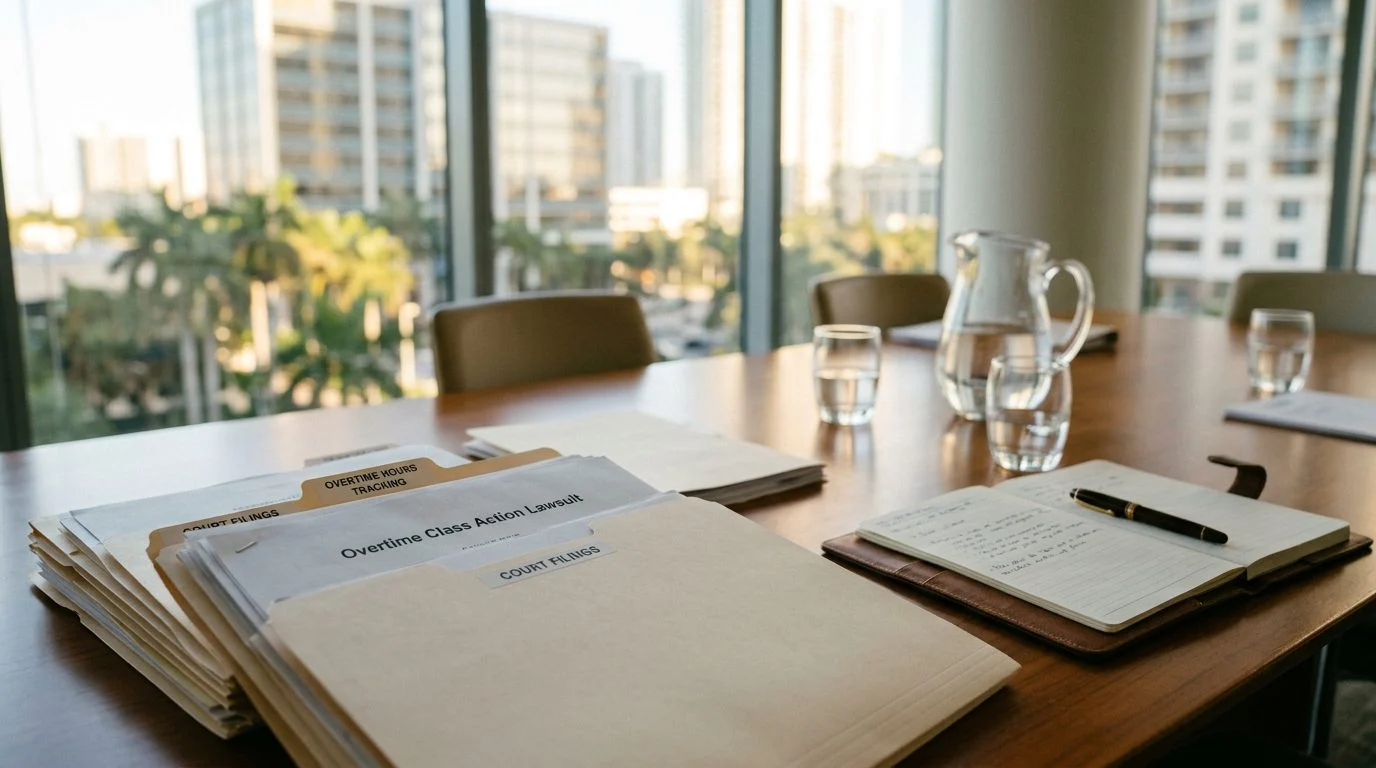
How overtime lawsuits typically resolve: settlement, dismissal, or judgment
Most overtime cases end in one of three ways: a settlement, a dismissal, or a judgment. A dismissal can be voluntary or follow a motion. A judgment comes after a trial or a ruling that resolves the case.
Settlement is common in wage disputes, but the terms vary with each case. Settlement talks often turn on the payroll records and the hours each side can document.
The money at stake has its own rules. The FLSA describes an additional equal amount as liquidated damages on top of unpaid pay (29 U.S.C. § 216). A court may award no liquidated damages, or a reduced amount, if the employer shows good faith and reasonable grounds for believing its act was not a violation (29 U.S.C. § 260).
Florida’s minimum wage law has a similar structure. A prevailing worker recovers unpaid back wages plus the same amount as liquidated damages unless the employer proves by a preponderance of the evidence that its act was in good faith and that it had reasonable grounds for believing it was not a violation, in which case the court may, in its sound discretion, award no liquidated damages or an amount not to exceed the unpaid minimum wages, along with reasonable attorney’s fees and costs (Fla. Stat. § 448.110). Florida’s unpaid-wage statute also lets a court award costs and a reasonable attorney’s fee to the prevailing party (Fla. Stat. § 448.08).
The pay records, the job classification, and the hours at issue usually shape how far a case goes. Those facts, not general rules, drive any result.
What a settlement or payment can waive before you sign
A signed settlement or payment can end a claim. Read what it gives up before you sign.
Under 29 U.S.C. § 216, when the Secretary of Labor supervises payment of unpaid minimum wages or overtime, an employee’s agreement to accept that payment, once it is paid in full, waives the employee’s right to sue for those unpaid wages and an equal amount as liquidated damages. That waiver rule applies to supervised payments, so it doesn’t describe every private agreement.
Ask which claims any release covers. Check whether it reaches only the pay periods at issue or other claims too. Make sure the amounts match your payroll records.
Keep copies of the signed agreement, the payment records, and the payroll data behind them. Those documents are what you’ll need if questions come up later.
Not sure what your next step is?
Talk it through with our team — the first consultation is free, confidential, and carries no obligation.
What an employer should understand early in an overtime claim
The early steps that matter most are keeping complete time and pay records, checking each worker’s classification, and answering every paper on time.
Job titles don’t settle classification. Under 29 U.S.C. § 206, every employer must pay each covered employee wages at the stated rates, but under 29 U.S.C. § 213 the minimum wage (other than the equal pay provision) and overtime requirements do not apply to any employee employed in a bona fide executive, administrative, or professional capacity, as the Secretary of Labor defines and delimits those terms by regulation, except that an employee of a retail or service establishment shall not be excluded from the executive or administrative definition because of the number of hours in his workweek devoted to unrelated activities if less than 40 per centum of his hours worked in the workweek are devoted to such activities. Under 29 C.F.R. § 541.2, a job title alone is insufficient. Status turns on whether the employee’s salary and duties meet the regulatory requirements. A manager title doesn’t end the question.
Retaliation is a separate risk. An at-will employee can be let go, but not for a reason the law prohibits, such as retaliation (Laguerre v. Palm Beach Newspapers). A change to pay, schedule, or job made after a complaint deserves careful review.
A demand letter, a summons, and a complaint are different documents. Each one calls for a prompt response, and court papers set their own timing.
Outside general counsel is an ongoing role for day-to-day employment and contract questions. Litigation counsel handles a case in court. A business may need one, the other, or both.
Quick answers
How long does a worker have to sue for overtime?
Generally two years, or three years for a willful violation, under 29 U.S.C. § 255.
Can liquidated damages be reduced?
Yes, in some cases. A court may reduce or remove them if the employer shows good faith and reasonable grounds (29 U.S.C. § 260).
Talk with KEW Legal about an overtime claim against your business
If an overtime demand or lawsuit just reached your company, you may be weighing your next move while still running the business.
KEW Legal is a Florida business law firm with an office in Coral Gables. Kristina E. Wilson is the responsible lawyer for this page. The initial consultation is free, confidential, and carries no obligation to continue. (La consulta inicial es gratuita, confidencial y sin compromiso de continuar.)
Call 305-990-2300 or send a message to talk through the papers, the court, and the records you’ll want to gather.
This page is general information, not legal advice. Results vary with the facts of each case, and no result can be promised. A matter may be referred to another lawyer or firm when that fits the facts.
How KEW Legal Supports Employers
Pay Practice Review
We review timekeeping, pay classifications and overtime policies so you can see how your practices read in a legal dispute.
Response Planning
We help you organize records and prepare a considered response to demand letters and filed complaints.
Clear Communication
We explain procedures, options and next steps in plain language, so you can make informed decisions for your business.
Outside General Counsel
Our lawyers work alongside owners and managers on employee issues as part of ongoing business counsel.
Act Promptly on Court Papers
Demand letters and lawsuit papers call for a timely response. Contact counsel before answering, making a payment offer or discussing the claim with the employee.
Where Overtime Cases Are Filed
Federal Court
Many wage claims are filed in the U.S.
Miami-Dade State Court
Some wage-related claims are brought in the Eleventh Judicial Circuit, which serves Miami-Dade County.
Broward State Court
Some wage-related claims are brought in the Seventeenth Judicial Circuit, which serves Broward County.
Choosing the Right Forum
The court where a case is filed affects procedure and timing, so an early case review matters.
Discuss an Overtime Claim with KEW Legal
Related practice areas
- Florida Employer Labor Compliance
- Florida Overtime Law vs Flsa
- Outside General Counsel vs Litigation Firm
Request a Consultation
Fill out the short form and we will take it from there.