

Employment Law for Employers · Coral Gables & Sunny Isles Beach
Received an EEOC Charge? Respond Carefully, With Counsel by Your Side
KEW Legal helps Florida employers in Miami-Dade and Broward counties understand an EEOC charge, organize the facts, and prepare a response that protects the business.
By Kristina E. Wilson · Published October 23, 2026
If you just received an EEOC or Florida Commission on Human Relations charge, your first job is to find the response deadline in the notice. Then you need a careful, consistent written reply. This guide explains how to respond to an EEOC charge as a Florida employer, step by step. KEW Legal, a business law firm with offices in Coral Gables and Sunny Isles Beach, concentrates in employment law for employers. Kristina E. Wilson is the responsible lawyer for this page.
What does an EEOC charge notice mean for a Florida employer?
An EEOC charge is a complaint that an employee or job applicant files with the U.S. Equal Employment Opportunity Commission. It alleges discrimination. The agency notifies the employer and asks for a response.
A charge can also go to the Florida Commission on Human Relations (FCHR). The FCHR works under the Florida Civil Rights Act of 1992.
Florida is a deferral state. Deadlines may apply to employment discrimination claims, so it is worth discussing timing with an attorney early.
Florida’s civil rights law applies to employers with 15 or more employees. The count must hold for each working day in 20 or more calendar weeks in the current or preceding calendar year (Fla. Stat. § 760.02).
A charge is an allegation, not a finding. Your written response is where you give your side of events. Your first step is simple. Read the response deadline in the notice and calendar it the day it arrives.
If your business just received an EEOC or FCHR charge notice, you don't have to work out the response alone. KEW Legal can review your file and talk through the deadline with you. Talk it through with our team — the first consultation is free, confidential, and carries no obligation.
Who should handle a charge response for an employer?
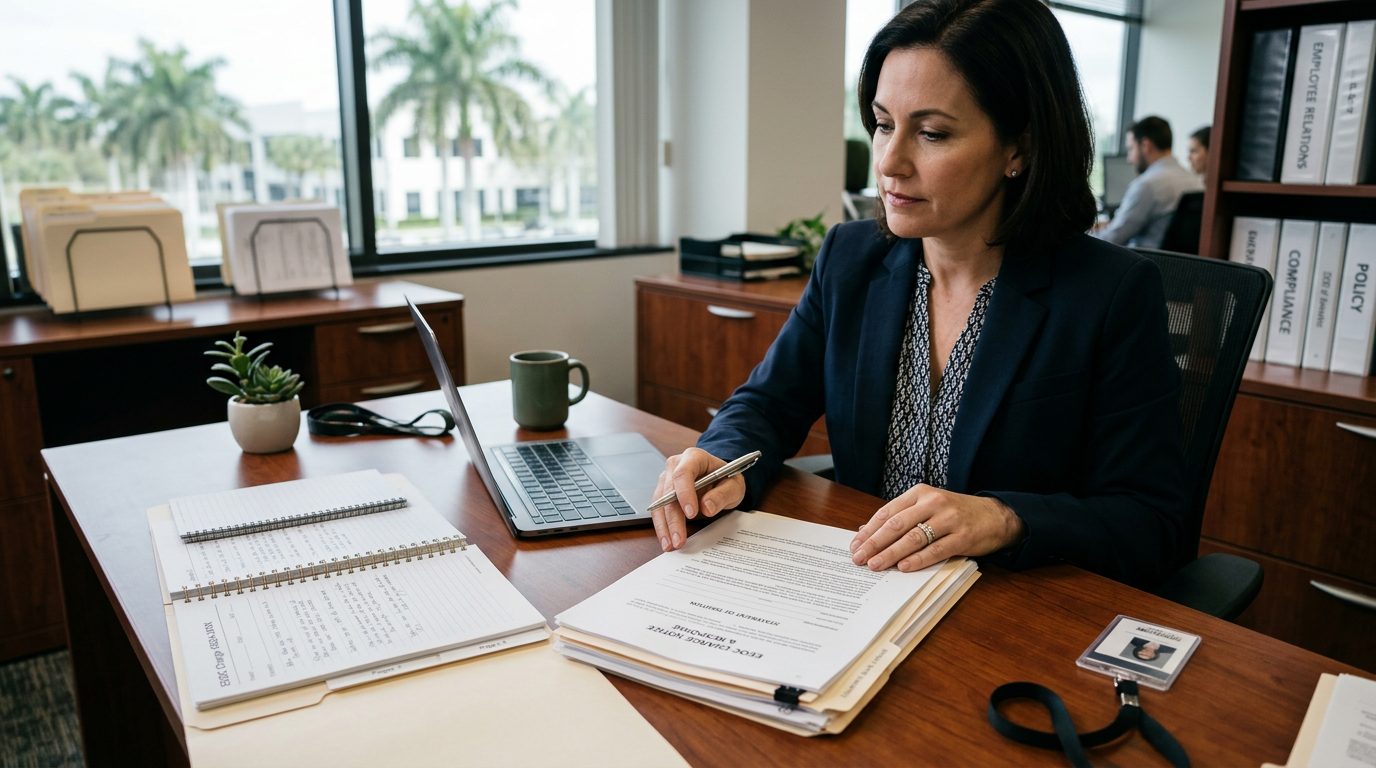
Outside general counsel for businesses usually handles the response, working alongside owners and HR staff. This keeps the reply tied to the whole employment file.
Your written response becomes part of the agency record. It can matter in later steps. Every fact in it must match your handbook, your manager emails, and your personnel file. Informal replies from managers can contradict that written record.
KEW Legal concentrates in employment law for employers. The firm handles charge responses as part of its outside general counsel work for businesses. The firm’s Sunny Isles Beach office serves business owners across Miami-Dade and South Florida, and the firm also has a Coral Gables office.
What does a charge response include?
A charge response starts with a fact review and ends with a written reply that matches the records. The main pieces are:
- Charge review: the complaint, the decision at issue, the dates, and who made the decision.
- Litigation hold: written instructions to keep emails, texts, schedules, reviews, and personnel files.
- Fact gathering: interviews with managers and witnesses to build a timeline of the events.
- Gap check: a look at whether the agency’s information requests are complete, and any follow-up submissions.
- Written position statement: a draft account built around the documents that support your side.
- Communication guidance: advice on what managers and staff should say to the employee and to each other.
What are the steps and timeline for responding?
A charge response usually moves through five steps, from intake to filing, before the deadline in the notice.
- Intake: You send the notice and related documents. The firm confirms the deadline and which agency is handling the charge.
- Preservation: The firm sends written preservation instructions to everyone who holds relevant records.
- Fact review: The firm interviews decision-makers and checks documents against each allegation.
- Drafting: A draft response is prepared and reviewed with you for accuracy before anything is filed.
- Filing: The response is submitted by the deadline, and any later agency requests are tracked.
The deadline in the notice sets the first milestone. What happens after filing depends on the facts and on the agency’s workload.
Which mistakes weaken an employer’s response?
Missing the deadline, giving conflicting explanations, and changing records are the mistakes that do the most damage. Watch for these:
- Missing the response deadline, or assuming an extension without confirming it in writing.
- Giving different reasons for the same decision across managers, emails, and the written response.
- Deleting, editing, or recreating personnel records after the charge arrives.
- Taking action against the employee or a witness. Under Florida law, it is unlawful for an employer, employment agency, joint labor-management committee, or labor organization to discriminate against any person because that person has opposed a prohibited employment practice or made a charge, testified, assisted, or participated in an investigation, proceeding, or hearing (Fla. Stat. § 760.10).
- Discussing the charge with coworkers in a way that could look like pressure on witnesses.
- Relying on a handbook without checking how it was applied to others.
Florida’s at-will rule has limits. Handbook statements also matter. Still, check that you applied each policy the same way to everyone.
What related issues can a charge expose, and what is at stake?
A charge often points to wider gaps in handbooks, worker classifications, or layoffs. Addressing them early is part of outside general counsel work. The stakes can be significant. Under the Florida Civil Rights Act, a court may order back pay and award compensatory damages, including damages for mental anguish and loss of dignity (Fla. Stat. § 760.11). The judgment for the total amount of punitive damages awarded under this section to an aggrieved person shall not exceed $100,000, and the state and its agencies and subdivisions shall not be liable for punitive damages (Fla. Stat. § 760.11). The court may also allow the prevailing party a reasonable attorney fee as part of costs.
Common related issues include:
- Handbook and policy gaps a charge can reveal.
- Whether a worker treated as an independent contractor should have been treated as an employee.
- Reductions in force or layoffs cited in the charge.
The EEOC employer guidance sets out federal anti-discrimination duties for employers.
Not sure what your next step is?
Talk it through with our team — the first consultation is free, confidential, and carries no obligation.

What do employers ask about charge responses?
The answers below cover the questions employers ask most often.
Do I have to respond to an EEOC charge?
The notice sets a response period. Read the deadline and act on it right away.
Is an EEOC charge the same as a lawsuit?
No. A charge is filed with an agency. A lawsuit is filed in court, and it has its own filing deadlines under Florida law.
Can I respond to a charge myself?
You can, but the response becomes part of the record. Review the facts and wording first.
Does the Florida Civil Rights Act apply to my business?
It applies to employers with 15 or more employees for each working day in each of 20 or more calendar weeks in the current or preceding calendar year.
How does the free consultation work?
The first consultation is free, confidential, and carries no obligation to continue.
If your business is holding an EEOC or FCHR charge notice right now, the deadline is already running. Reach out to KEW Legal through the contact page or call 305-990-2300 to talk about your file.
How KEW Legal Supports Employers Facing a Charge
Careful Review of the Notice
We read the charge and the agency's notice with you, identify the allegations, and explain what the agency is asking for.
Protection of Business Interests
Our approach keeps your company's legal position in view as you decide what to share, what to say, and how to present your records.
Outside General Counsel Perspective
Because we advise business owners on ongoing employment matters, we look at the charge in the context of your workforce, policies, and daily operations.
Clear Communication
You will receive plain-language explanations of each step, so you can make informed decisions about your business.
Do Not Ignore the Notice
An EEOC charge comes with a response date set by the agency. Read the notice as soon as it arrives, note every date it includes, and bring it to counsel before you respond.
Steps to Take Once a Charge Arrives
1. Read the Notice in Full
Confirm what was filed, who filed it, and what the agency has asked your company to provide.
2. Preserve Relevant Records
Keep personnel files, schedules, emails, and policies related to the employee and the issues raised. Do not alter or discard them.
3. Limit Informal Discussion
Avoid discussing the charge with the employee or coworkers in ways that could be seen as retaliatory or that create unhelpful records.
4. Speak With Counsel Before Responding
A lawyer can help you assess the allegations, coordinate your records, and prepare the company's written response.
Get Practical Guidance on Your EEOC Charge. Your First Consultation Is Free, Confidential, and Comes With No Obligation to Continue.
Related practice areas
- Employee Problems in Florida: What Business Owners Should Do in the First 30 Days
- Outside General Counsel for Startups Miami | KEW Legal
Request a Consultation
Fill out the short form and we will take it from there.