
Business Contract and Vendor Disputes | Doral and Miami-Dade County
Resolve Vendor and Contract Disputes Before They Stall Your Business
KEW Legal serves business owners in Doral and across Miami-Dade County from offices in Coral Gables and Sunny Isles Beach. Kristina E. Wilson focuses on business contract and vendor disputes, reviewing the agreement first and then pursuing the path that fits your situation.
By Kristina E. Wilson · Published October 14, 2026
Doral Business Contract and Vendor Dispute Attorney
When a vendor refuses to pay, delivers late, or does defective work, start with the contract and the paper trail before you send anything. Under Fla. Stat. § 95.11(2)(b), the general limitation period for claims founded on a written instrument is five years. This is a general rule. Florida has no separate UCC limitation section for sales of goods, so a four-year period under Fla. Stat. § 95.11(3)(j) applies to claims not founded on a written instrument, including actions for the sale and delivery of goods. This guide explains those first steps for businesses across Miami-Dade County.
If a vendor has refused to pay or deliver for your Doral business, you do not have to sort out the contract alone; contact KEW Legal for a free first consultation. Talk it through with our team — the first consultation is free, confidential, and carries no obligation.

What Counts as a Business Contract or Vendor Dispute in Doral?
A vendor dispute is a disagreement about what each side owed the other under a business deal. Common examples include:
- unpaid invoices
- late or defective deliveries
- missed service milestones
- disputed change orders
- disagreements over ending the relationship
Some businesses in Doral operate in logistics, warehousing, distribution, and service sectors. Many of them rely on written supply and service agreements, so one missed delivery can affect cash flow and customer orders. A dispute can also arise without a long contract. A purchase order, an emailed quote, or a pattern of past dealings may show what the parties agreed to. The first question is whether the deal involves goods, services, or both. Florida’s sale-of-goods rules apply to goods, and they differ from the general rules for services.
What Should You Gather Before Contacting the Vendor?
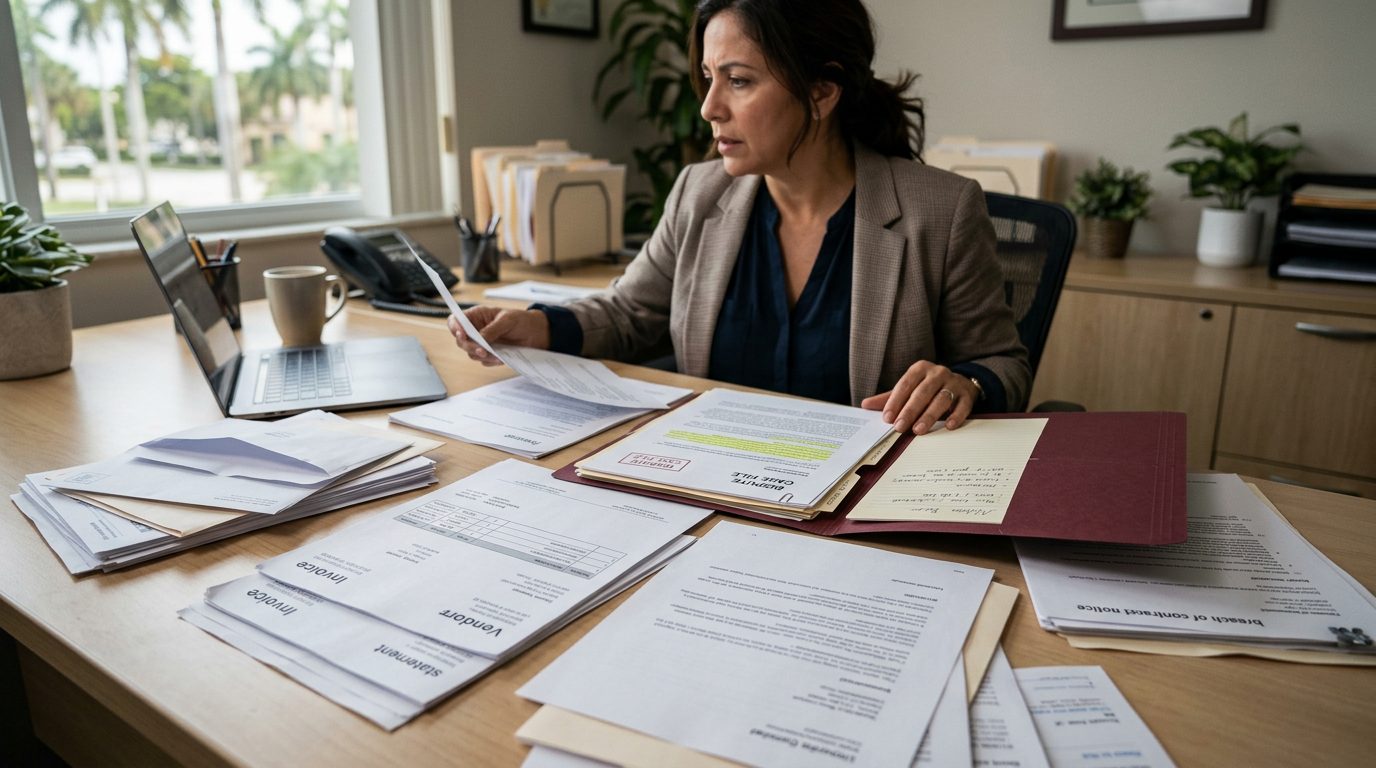
Collect every record that shows what was promised, what was delivered, and what was paid. Then put those records in date order. Start with the signed agreement and any amendments. Then gather:
- purchase orders and quotes
- invoices and payment records
- delivery receipts, bills of lading, and inspection notes
- emails, texts, and chat messages
- photos or test results showing defective work
Next, build a timeline. Write one line for each date. Note what each party promised, what it did, and what was said. Keep the entries factual and name who said what.
Avoid three common mistakes. Do not alter or delete records, even ones that seem unhelpful. Do not send angry messages that admit fault or make threats. And do not withhold payment or pause orders before you read the contract. The contract may set exactly how and when you can do that.
Which Contract Clauses Control Your Next Step?
The notice, cure, termination, and dispute clauses usually decide what you must do before you can sue. A notice clause names who must receive written notice, how it must be sent, and where. A text to the vendor’s sales rep may not count if the contract requires certified mail to a set address. A cure period gives the vendor a set time to fix the problem. If you end the contract or hold back money before that window closes, the dispute can become harder to present.
Also review these terms:
- limitation of liability, which may cap what you can recover
- indemnity, which may shift certain third-party claims
- governing law and venue, which choose the state and place for disputes
- attorney’s fees, which may decide who pays legal costs
Fee clauses work in a specific way. Under Fla. Stat. § 57.105, if a contract lets a party recover fees for enforcing it, the court may also allow fees to the other party when that party prevails.
If the contract has an arbitration clause, check it before you file. Under Fla. Stat. § 682.02, an agreement in a record to arbitrate is valid, enforceable, and irrevocable, except on grounds that exist to revoke any contract.
What Are the Florida Deadlines for Contract Claims?
Florida law generally sets a time limit for filing contract lawsuits, and a contract cannot shorten it below the statute. Florida never adopted the Uniform Commercial Code’s separate limitation rule for sales of goods, so there is no Fla. Stat. § 672.725. Under Fla. Stat. § 95.11, the period is five years for a contract founded on a written instrument and four years for an oral or unwritten contract, including an action for the sale and delivery of goods, wares and merchandise and on store accounts, and other exceptions may apply. Under Fla. Stat. § 95.03, a contract clause that shortens the time to sue below the statutory period is void, including in sale-of-goods contracts.
The clock generally starts when the last element of the claim occurs, under Fla. Stat. § 95.031. That date is not always the date of the first problem, which is why the timeline matters.
For goods you have accepted, notice comes first. Under Fla. Stat. § 672.607, the buyer must notify the seller of a breach within a reasonable time after the buyer discovers or should have discovered any breach. Otherwise, the buyer may be barred from any remedy. Give written notice early.
These are general rules. Your contract, the type of deal, and the facts decide which rule applies. Only a review of the actual agreement can confirm your dates.
What Options Exist Before a Lawsuit?
Some vendor disputes settle through a written demand, negotiation, or mediation before any court case begins. A demand letter should identify the agreement, describe the breach, state the payment or repair you want, and set a deadline to respond. Send it to the notice address the contract names.
Resolutions often take one of these forms:
- a payment plan with a written schedule
- corrective work completed by the vendor
- a mutual release that closes the dispute
Florida courts can also send some cases to mediation. Under Fla. Stat. § 44.102, when a party asks, the court is required to send a pending civil lawsuit seeking money damages to mediation, but only if the requesting party is willing and able to pay the mediation costs or those costs can be equitably divided between the parties. The rule is also subject to exceptions listed in the statute, including debt collection actions and landlord-tenant disputes that do not include a personal injury claim.
Before you send a demand, confirm the vendor’s legal name and status in the Florida Division of Corporations’ Sunbiz records. A demand sent to the wrong entity can cause delay. The Florida Division of Corporations’ Sunbiz search lists registered business entities.
Litigation is one option, not the only one. General information cannot predict how a specific dispute will turn out.
Not sure what your next step is?
Talk it through with our team — the first consultation is free, confidential, and carries no obligation.
Frequently Asked Questions About Vendor and Contract Disputes
The answers below cover the questions owners ask first about contract and vendor disputes.
Business contract and vendor disputes
How do you resolve a business dispute with a vendor?
Start with the documents, then follow the notice and cure steps in the contract. Many owners then try a written demand and negotiation before any court filing.
Can a verbal agreement be enforced?
Some oral agreements can be enforced in Florida, but proving them is harder. For goods priced at $500 or more, Fla. Stat. § 672.201 generally requires a signed record, with exceptions such as goods received and accepted.
Do I have to keep doing business with the vendor?
Not always. The contract may allow you to pause orders, or it may require you to keep performing during a dispute. Review it before you change anything.

How KEW Legal Handles Business Contract and Vendor Disputes
KEW Legal is a Florida business law firm that focuses on business contract and vendor disputes and on outside general counsel for businesses in Miami-Dade and South Florida. The firm’s offices are in Coral Gables and Sunny Isles Beach. KEW Legal does not have an office in Doral, and this page does not suggest otherwise.
Kristina E. Wilson is the lawyer responsible for this page. The firm’s support staff handle office work for the practice. Every dispute turns on its own contract and facts, so no outcome can be promised.
The first consultation is free, confidential, and carries no obligation to continue. If a vendor has refused to pay or deliver for your Doral business, call 305-990-2300 or send a message through the KEW Legal contact page.
How we approach a vendor or contract dispute
Review the contract first
We start with the signed agreement, purchase orders, invoices, and correspondence to see what each side committed to and how the contract says a dispute must be raised.
Protect your position
Early steps such as preserving records and following the contract's notice provisions can shape what options remain open to your business.
Written demand and negotiation
Many disputes are first addressed through a clear written demand and a negotiated resolution, which can avoid the cost and delay of litigation.
Court only when needed
If a vendor will not resolve the matter, we discuss litigation or other formal options with you, including their costs and likely timing.
Keep your records before you respond
Contract notice clauses can control how and when a dispute must be raised. Before you reply to a vendor, save every contract, invoice, email, text, and delivery record, and avoid making admissions in writing without advice.
Business contract and vendor matters we handle
Vendor non-performance
Suppliers or contractors who fail to deliver goods or services as the agreement requires.
Payment and invoice disputes
Unpaid invoices, disputed charges, and payment terms that have stopped being followed.
Contract review and drafting
Review of vendor, service, and supply agreements before you sign, to clarify terms, remedies, and notice requirements.
Outside general counsel
Ongoing legal guidance for business owners who need a single attorney to advise on contracts and vendor relationships.
Talk with Kristina E. Wilson about your contract dispute
Related practice areas
Request a Consultation
Fill out the short form and we will take it from there.