

Employment Law for Employers | Coral Gables & Sunny Isles Beach
Does Florida Require Employers to Use E-Verify?
Practical guidance for business owners on hiring verification, documentation, and how state rules fit into the rest of your workforce practices.
By Kristina E. Wilson · Published November 21, 2026
If you’re about to hire someone in Florida, you may have heard that a new E-Verify rule applies to your business. Does Florida require E-Verify for employers? Yes, but only for some of them. Florida requires public employers, and private employers with 25 or more employees, to use E-Verify for new hires. Missing a step can carry real penalties, so it helps to know who is covered.
Yes, but Only for Certain Florida Employers
Florida requires E-Verify for some employers, not all of them. Three facts decide coverage. Read them in order: whether you are a public agency or a private business, how many employees you have, and whether you do business with a government body. Then check the timing of each new hire. KEW Legal has offices in Coral Gables and Sunny Isles Beach. Kristina E. Wilson is the lawyer responsible for this page. Our lawyers focus on business law for owners and investors across Miami-Dade and South Florida, including employment issues for employers.
Not sure what your next step is?
Talk it through with our team — the first consultation is free, confidential, and carries no obligation.
Private Employers With 25 or More Employees
Yes, if you are a private employer with 25 or more employees, you must use E-Verify for new hires. The requirement took effect July 1, 2023, under Fla. Stat. § 448.095. You must verify each new employee’s eligibility within 3 business days after the first day that person begins working for pay. The clock starts with the first day of paid work, not the day you made the offer.
The statute’s duty is tied to new employees, so existing staff are not the focus of this requirement. Make the E-Verify step part of your onboarding checklist so the 3-day window doesn’t slip. Covered employers also certify compliance on their first return each calendar year when they pay unemployment contributions. If your headcount falls below 25, you are not required to use E-Verify under this rule, but you must still verify each new employee’s employment eligibility within 3 business days after the first day that person begins working for pay. The contract rules in the next section can still reach you.
Public Employers and State Contractors
Public agencies must use E-Verify to verify new employees. The rule reaches further through contracts. Under Fla. Stat. § 448.095, a public agency must require any contractor and subcontractor to register with and use E-Verify. Neither side may enter the contract unless each party registers with and uses the system.
The statute defines a contractor as a person or entity that has entered, or is trying to enter, a contract with a public agency to provide labor, supplies or services for pay. If you sell labor, supplies or services to a government body, the contract is where this rule shows up. The contract requirement in subsection (5) does not carry the 25-employee threshold in its text. That is why a smaller company can still face the duty. Check any government contract for E-Verify language before you sign it.
Is E-Verify Required by Federal Law?
Federal law has its own rules for verifying who may work in the United States, and Florida’s rule sits on top of them. 8 C.F.R. § 274a.2 sets the requirements and procedures for verifying employment when you hire people in the United States, or keep employing them. Those federal rules apply to your Florida business as well.
Federal law also makes it unlawful to knowingly employ workers who are not authorized to work, as 8 U.S.C. § 1324a provides.
Because the two sets of rules overlap, read Florida’s statute and the federal rules together. Neither one replaces the other.
How E-Verify Fits Into the Hiring Process
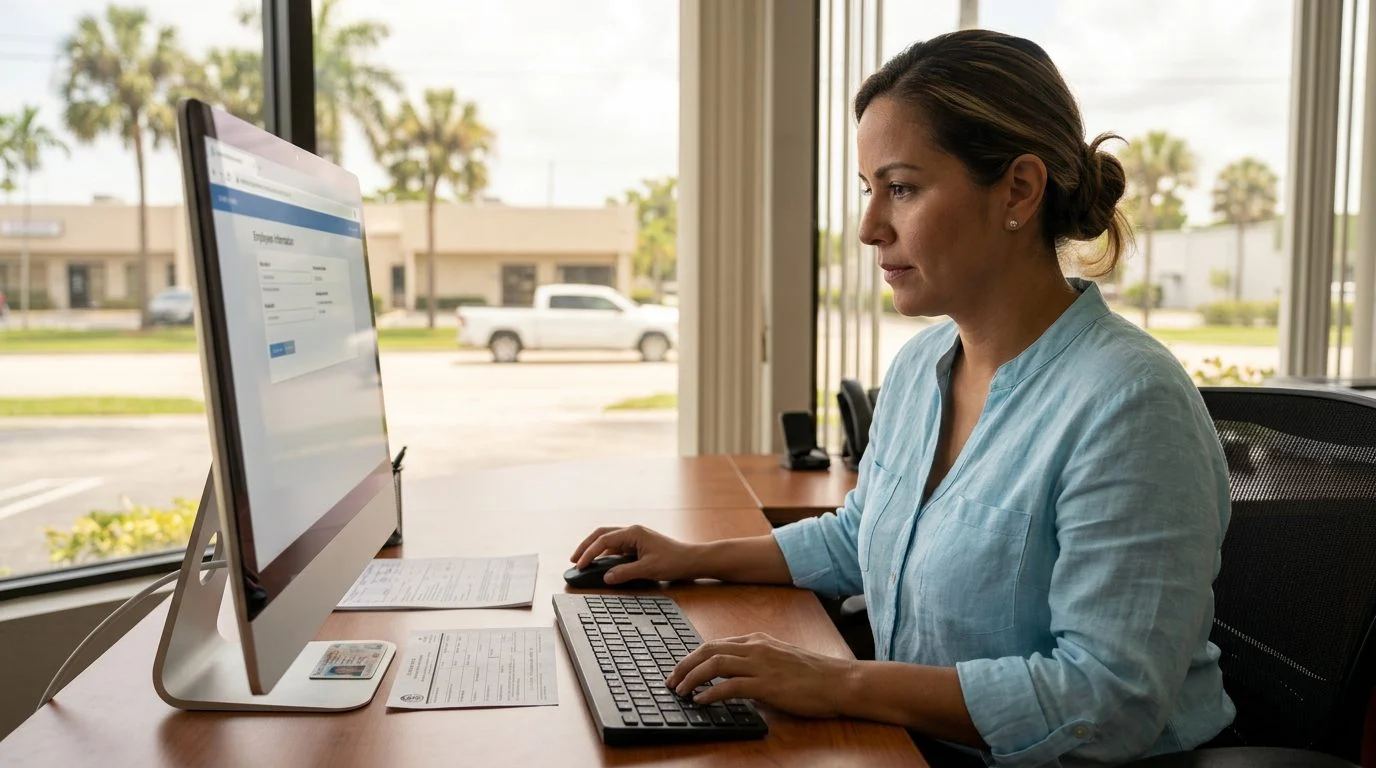
E-Verify is the electronic system the Florida statute names for checking a new employee’s work eligibility. In practice, the basic sequence runs like this. The new hire starts work for pay. You verify eligibility within 3 business days. You then keep the paperwork on file.
Keep the documents you received and any official verification the system generated. Keep them where you can find them quickly if a government agency asks for them.
Outages happen. If E-Verify is unavailable for 3 business days and you cannot access it, the statute says to use Form I-9 instead. You must document the outage. Keep a screenshot from each day showing you could not reach the system, a public announcement that E-Verify is down, or another notice you recorded. Write the dates down as you go.
Common Points of Confusion for Florida Employers
Three points are easy to misread. Each one can turn a simple hiring step into a compliance problem.
- Counting employees. The 25-employee test is the line for the private-employer rule. How you count for that test depends on the facts, so check your headcount before you assume you’re covered or exempt.
- Mixing up state and federal duties. A voluntary-sounding federal enrollment process does not decide whether Florida’s rule applies to you. Both sets of rules can apply at once.
- Judging workers by how they look or sound. Federal rules say knowledge that an employee is unauthorized may not be inferred from a foreign appearance or accent. That rule is set out in 8 C.F.R. § 274a.1(l)(2). The same section also says knowledge may be shown where the employer “Has information available to it that would indicate that the alien is not authorized to work, such as Labor Certification and/or an Application for Prospective Employer.” Treat every worker the same way during verification.
- Ignoring what you learn later. Federal law, 8 U.S.C. § 1324a(a)(2), makes it unlawful for an employer, after hiring a person, to continue to employ that person in the United States knowing the person is (or has become) an unauthorized alien with respect to that employment. Once you know, act on it.
- Federal regulations set civil penalties of not less than $288 and not more than $2,861 for each individual, for verification failures after November 2, 2015, under 8 C.F.R. § 274a.10.
Not sure what your next step is?
Talk it through with our team — the first consultation is free, confidential, and carries no obligation.
Talk Through Your Hiring Facts With KEW Legal
You may be working through this on a short timeline, with a start date already on the calendar. Your headcount, your type of employer, any government contracts and your hiring dates decide the answer. Those are facts only you can supply, and they shape what applies to your company. KEW Legal can review them with you.
The initial consultation is free, confidential, and carries no obligation to continue. To get started, call 305-990-2300 or send us a message. Bring your headcount, your contract list and the date of your next hire.
Related Employment Guidance for Florida Employers
For broader context on employment issues for employers, see our employment law attorney for employers page. It covers the employer-side issues that often come up alongside hiring rules.
Does Florida require E-Verify for a company with fewer than 25 employees?
The private-employer rule starts at 25 employees. A public agency must require in any government contract that the contractor, and any subcontractor, register with and use E-Verify, whatever your headcount, except in any federal fiscal year in which the federal government does not fund the E-Verify system.
How soon must I verify a new hire?
Within 3 business days after the new employee’s first day of paid work, under Florida’s statute.
How long must I keep E-Verify records?
Florida’s statute requires you to keep the documentation and verification for at least 3 years.
How KEW Legal supports employers
Hiring practice review
We review your onboarding forms, verification steps and recordkeeping so your procedures match your business and your obligations.
Outside general counsel
Our team serves as ongoing legal counsel for owners and managers who need answers on workforce questions as they come up.
Employment disputes
We help employers respond to workplace claims and prepare for conflicts before they escalate.
Clear, direct advice
We explain the options in plain language so you can make informed decisions about your hiring process.
Don't rely on a rule of thumb
Verification obligations can depend on factors such as company size, contract type and funding status. Review your specific situation with counsel before changing your hiring practices.
Areas we can help with
Government contracts
Contract terms can add verification requirements. We help businesses identify what their agreements require and how to comply.
Hiring and documentation
We help you build consistent records and procedures that support your hiring decisions and reduce compliance risk.
Workforce disputes
When an employment issue arises, we assess the facts, explain your options and work to protect your business.
Talk with KEW Legal about your hiring obligations. The first consultation is free, confidential and carries no obligation to continue.
Related practice areas
Request a Consultation
Fill out the short form and we will take it from there.