
Employment Law for Employers | Coral Gables and Sunny Isles Beach
Keeping Payroll Records in Order
A practical guide for Miami-Dade and Broward employers on what payroll records to keep and why they matter if a dispute arises.
By Kristina E. Wilson · Published November 4, 2026
Keep payroll records at least until a wage claim about them can no longer be brought. The exact time depends on the facts of your business, so plan for the longer window when you are unsure. This page gives general information, not legal advice. Kristina E. Wilson is responsible for this page. KEW Legal is a Florida business law firm with offices in Coral Gables and Sunny Isles Beach.
The short answer: keep records until the claim window closes
Florida’s minimum wage amendment sets the main deadline. Section 95.11 allows four years for a violation that is not willful, and lists a willful violation under a separate provision. Section 95.11 allows four years for a violation that is not willful, and lists a willful violation under a separate provision.
For a minimum wage claim, that deadline runs from the date the alleged violation occurred. Under Fla. Stat. § 95.031, a cause of action accrues when its last element occurs. The clock does not simply start on the hire date.
For your records plan, this means payroll files should last at least as long as the claim window for the pay periods they cover. For federal employment records, the U.S. Equal Employment Opportunity Commission publishes recordkeeping requirements for employers, including retention periods for personnel and employment records.
If a former employee has questioned a paycheck or a demand letter has arrived, we can talk through which records to hold and for how long. Talk it through with our team — the first consultation is free, confidential, and carries no obligation.

Which payroll records to keep for wage claims
Keep every record that shows what each worker did and what they were paid. A wage dispute turns on these facts, so these files matter most.
Start with each employee’s name, address, job, pay rate, hours worked each day and week, wages paid each pay period, and payment dates. Keep time cards and timesheets with them, along with wage rate tables and work schedules.
Also keep any signed written contract that sets working hours. Under Fla. Stat. § 448.01, a signed written contract can change the default daily-hours rule, so the contract is evidence you may need. Keep it in the payroll file, not in a separate drawer.
Records of deductions, bonuses, and reimbursements also help explain a paycheck. Keep them with the pay records for the same period.
Who keeps track of employee hours, and why it matters
Employers should own the hours records, because hours drive the pay owed. The Florida minimum wage amendment says employers shall pay employees a minimum wage for all hours worked in Florida, but only those individuals entitled to receive the federal minimum wage under the federal Fair Labor Standards Act, as amended, and its implementing regulations are eligible to receive it.
Florida also treats ten hours as a legal day’s work for a person employed to perform manual labor of any kind by the day, week, month or year, unless a signed written contract requires a different number of hours. Under Fla. Stat. § 448.01, a person employed to perform manual labor of any kind is entitled to extra pay for work required beyond 10 hours in a day, unless a written contract signed by the employee and the employer provides otherwise.
Hours written down when the work happens are easier to explain later. Hours rebuilt after a complaint are harder to defend, because they rest on memory rather than a record made at the time.
How the retention clock is counted and how Florida law fits in
The clock starts when the last element of a claim occurs, which is often tied to a specific pay period. That is why one retention date does not fit every file.
Florida also requires written notice before a wage suit. Under Fla. Stat. § 448.110, a person must notify the employer in writing before bringing a claim for unpaid minimum wages. The notice must identify the minimum wage claimed, the actual or estimated work dates and hours, and the total alleged unpaid wages through the notice date.
That notice gives you a concrete list to check. When one arrives, pull the records for the dates and hours it names. Keep those records, and keep them unchanged.
When to keep records longer than the usual schedule
Keep records longer whenever a claim, demand, or agency inquiry is possible. The stakes are real. Under the Florida minimum wage amendment, a worker who prevails recovers the unpaid back wages plus the same amount as liquidated damages, along with reasonable attorney’s fees and costs, unless the employer proves by a preponderance of the evidence that its act or omission was in good faith and that it had reasonable grounds for believing its act or omission was not a violation, in which case the court may, in its discretion, award no liquidated damages or a reduced amount. Willful violations also expose the employer to a fine of $1,000 per violation, payable to the state, which the Attorney General may seek to impose in a civil action.
A court may also award costs and a reasonable attorney’s fee to the prevailing party in a wage action, under Fla. Stat. § 448.08.
When a demand letter, complaint, or agency notice arrives, pause the disposal of related files. Do not shred or overwrite anything until the matter is resolved.
Be careful with decisions about an employee who raised a pay question. Under Fla. Stat. § 448.110, an employer may not take adverse action against a person in retaliation for exercising minimum wage rights, including filing a complaint.
Practical retention checklist for Florida employers
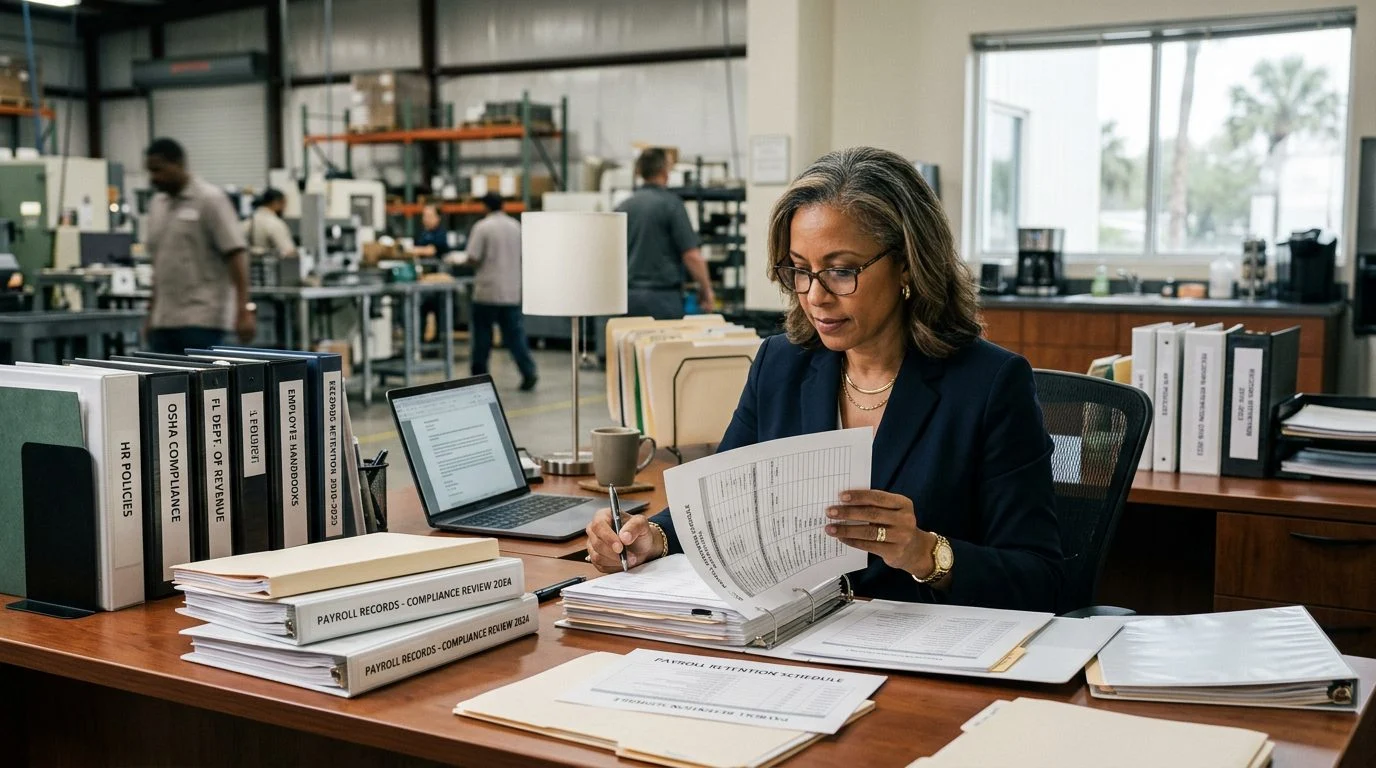
Write one retention schedule. It should list each record, how long you keep it, and who may approve disposal.
- Assign one person to own the schedule and review it each year.
- List each payroll and HR record type with its keep period and the earliest date it may be discarded.
- Add a hold step so a demand letter, complaint, or agency notice pauses disposal of related files.
- Confirm that electronic copies are backed up and can be read when needed.
- Display the Florida minimum wage notice poster where covered employees work. Under Fla. Stat. § 448.109, each employer who must pay the Florida minimum wage shall prominently display the poster.
Frequently asked questions
Which payroll records should Florida employers keep?
Record-keeping obligations depend on the facts of each situation, so employers can review their own obligations with our team.
Does an employee have to give notice before suing for unpaid minimum wages?
Yes. Florida law requires written notice that identifies the wages claimed, the work dates and hours, and the total unpaid amount.
Can an employer punish an employee for asking about pay?
Florida law bars adverse action taken in retaliation for exercising minimum wage rights, including filing a complaint.
Not sure what your next step is?
Talk it through with our team — the first consultation is free, confidential, and carries no obligation.

Talk with KEW Legal about your payroll records
If a former employee has questioned a paycheck, or an agency has asked for hours records, you may need to decide what to keep right now. We can help you think through that decision.
KEW Legal is a Florida business law firm in Coral Gables and Sunny Isles Beach. We act as outside general counsel for business owners and investors across Miami-Dade and South Florida, and we handle employment law for employers. Our lawyers include Kristina E. Wilson and Natalie Martinez.
Your first consultation is free, confidential, and comes with no obligation to continue.
Call 305-990-2300 or use our contact page to request a consultation.
Records employers often keep
Time and attendance
Clock-in and clock-out data, schedules, and overtime approvals are often the first records reviewed when hours are questioned.
Pay rates and deductions
Rate history, bonus and commission calculations, and written authorizations for deductions help explain what was paid and why.
Tax and withholding forms
Payroll tax filings and employee withholding forms support the figures reported on pay statements and to government agencies.
Agreements and notices
Offer letters, pay policies, signed acknowledgments, and any written wage notices give context to the working relationship.
How KEW Legal helps employers
Records review
We look at the payroll and personnel files your business already has and identify gaps before a problem surfaces.
Dispute preparation
When a wage claim or employee complaint arrives, we help you respond carefully and protect the records you will need.
Policy updates
We help align timekeeping, pay practices, and document retention with your current operations.
Outside general counsel
Business owners can call us as an ongoing resource for employment questions, not just one-time emergencies.
Do not discard payroll files on a rule of thumb alone
Record-keeping obligations depend on the facts of each situation, including the type of record and the kind of claim that may be raised. Before you shred or purge payroll files, ask a lawyer to review your obligations.
Get clear answers about your payroll records
Related practice areas
- Employer Legal Risks in Miami-Dade: A Plain-English Guide for Business Owners
- FLSA Wage and Hour Compliance Review for Florida Employers
- Responding to an Employee Demand Letter at a Florida Business
Request a Consultation
Fill out the short form and we will take it from there.