
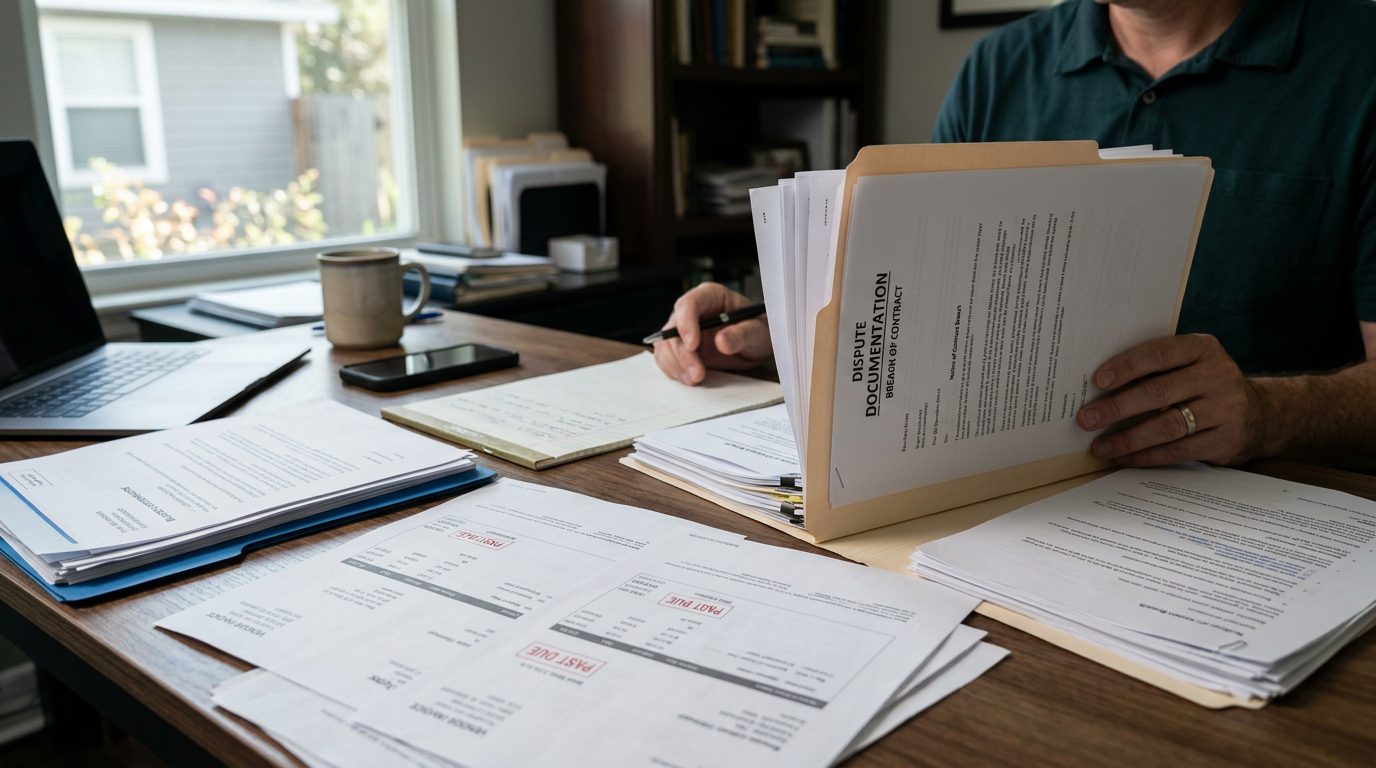
Contract Breach Remedies for Florida Business Owners
When a vendor, partner or client stops performing, KEW Legal helps Miami-Dade and South Florida business owners review the contract, assess their options and decide on the next step. Kristina E. Wilson leads the business law practice, with support from our team.
KEW Legal at a Glance
Free
First consultation, confidential and with no obligation to continue
2
Offices in Coral Gables and Sunny Isles Beach
Business Law
Practice focused on Florida business and commercial matters
By Kristina E. Wilson · Published October 19, 2026
When a vendor or business partner breaks a contract, the usual path has five steps. Read the contract, send written notice, give the other side a chance to fix the problem, try to settle through talks or mediation, and then arbitrate or sue. Florida law sets rules and deadlines at each step, so the order and timing matter.
This guide explains those contract breach remedies for Florida business owners. It is general information. KEW Legal is a business law firm with offices in Coral Gables and Sunny Isles Beach. We serve business owners and investors across Miami-Dade and Broward counties.
What counts as a breach of contract?
In a contract dispute, the written terms of the agreement and the reasons a party gives for not performing are often central questions. A breach can be late payment, a missed delivery, poor work, or a partner who takes money the contract does not allow.
Not every problem is a breach. Some contracts give a party a right to end the deal or withhold payment. The exact words in the contract decide that question.
If a vendor or business partner has stopped following your agreement, you don't have to work out your options alone. Talk with KEW Legal about your contract. Talk it through with our team — the first consultation is free, confidential, and carries no obligation.

Step one: read the contract before you act
The contract is the starting point for every remedy. Look for the clauses that control what happens next.
- Notice clause. It may say how and where to send a breach notice, such as by certified mail or to a specific address.
- Cure clause. It may give the other side a set number of days to fix the problem.
- Dispute clause. It may require mediation or arbitration before a lawsuit.
- Fee clause. It may say who pays attorney’s fees if a dispute goes to court.
- Limitation clause. It may try to set a short deadline for suing.
A common mistake is to rely on a short deadline written into the contract. Florida law voids that kind of clause. Under Fla. Stat. § 95.03, a contract provision that sets a shorter period than the statute of limitations for actions from that contract is void. Do not assume a short clause ends your right to sue.
Step two: send written notice of the breach
Written notice creates a clear record of the problem. It also shows the other side exactly what you say they did wrong. Send it in the way the contract requires, and keep proof of delivery.
For sales of goods, the law sets a firm rule on timing. Under Fla. Stat. § 672.607, when a buyer has accepted goods, the buyer must notify the seller of the breach within a reasonable time after discovering it or when it should have been discovered, or the buyer is barred from any remedy.
This rule matters most for defective equipment, inventory, or supplies. Accepting the goods does not end your claim. But it does start a clock. The statute also says the buyer carries the burden to prove any breach in goods already accepted.
Step three: give the other side a chance to cure
Many contracts give the other side a period to fix the problem. This is often called a cure period. Follow the cure period in the contract exactly. A notice that skips it can weaken your position.
Your demand should be specific. Say what the contract requires, what is missing, and what fix you want. Set a clear date for the fix. Keep the tone factual, not angry. A calm letter is easier to show a judge or arbitrator later.
Step four: try talks or mediation
Many business disputes settle before a court date. Talks can be direct, through lawyers, or through a neutral mediator. Mediation can save time and cost, and it lets both sides keep control of the outcome.
If the contract requires mediation first, you must follow that step before you file a case. Skipping a required step can give the other side a reason to ask the court to pause or dismiss your claim.
Deadlines: how long you have to sue
The time limit for a lawsuit depends on the type of claim and whether the agreement is written. Florida’s limitations statute, Fla. Stat. § 95.11, lists a legal or equitable action on a contract, obligation, or liability not founded on a written instrument among the actions it covers, including an action for the sale and delivery of goods, wares, and merchandise, and on store accounts. The same statute also lists claims founded on fraud and on negligence, each with its own time limit.
Because the periods differ, identify the type of claim early. Waiting while you talk through a dispute can use up time you need. Do not let negotiations run without tracking the deadline.
Not sure what your next step is?
Talk it through with our team — the first consultation is free, confidential, and carries no obligation.
Sales of goods and written terms
Whether an agreement for goods must be in writing depends on its specific terms and circumstances, and the applicable rules include exceptions.
Between merchants, a written confirmation can satisfy the writing rule. If you receive a confirmation of an order you did not agree to, respond in writing right away.
Arbitration clauses: what they do
An arbitration clause sends disputes to a private decision-maker instead of a judge. Florida enforces these clauses. Under Fla. Stat. § 682.02, an agreement in a record to arbitrate existing or future disputes is valid, enforceable and irrevocable, except on a ground that exists at law or in equity for revoking a contract.
The court decides whether an agreement to arbitrate exists. An arbitrator decides certain other questions, such as whether a condition before arbitration has been met.
If the other side disputes whether an agreement to arbitrate exists, the court decides that question under Fla. Stat. § 682.02. Under Fla. Stat. § 682.03, a party that shows an agreement to arbitrate and a refusal can ask the court to order arbitration. If the other side opposes, the court decides the issue quickly. Fla. Stat. § 682.03 reads: “(b) If the refusing party opposes the motion, the court shall proceed summarily to decide the issue and order the parties to arbitrate unless it finds that there is no enforceable agreement to arbitrate.” The court may not refuse to order arbitration because the claim lacks merit. If the court orders arbitration, it generally pauses the court case on the same claim.
This means an arbitration clause is more than a formality. Read it closely before you file anything in court.
Attorney’s fees and sanctions
Who pays legal fees can change the value of a dispute. Florida’s fee rules depend on the contract and the conduct of the parties.
Check the facts behind every claim before you file it. How a fee rule applies depends on the facts of your case.
Offers of judgment: a 30-day clock
In a civil case for damages, a formal offer can change the fee picture. Under Fla. Stat. § 768.79, a defendant’s offer of judgment that the plaintiff does not accept within 30 days can shift reasonable costs and attorney’s fees to the plaintiff. This applies if the judgment is one of no liability or the plaintiff’s judgment is at least 25 percent less than the offer.
The same rule works the other way. A plaintiff’s demand for judgment that the defendant does not accept within 30 days can shift fees to the defendant if the plaintiff’s judgment is at least 25 percent greater than the demand. An offer can be withdrawn in writing before a written acceptance is filed. Once withdrawn, it is void.
Read every offer carefully and note the 30-day period. Missing it can cost money.
Judgment interest
If a court awards money, interest may apply. Under Fla. Stat. § 687.01, where interest accrues without a special contract for the rate, the rate is the rate provided for in s. 55.03. Under that section, the Chief Financial Officer sets the rate each quarter.
A written contract or obligation can set its own interest rate. Check the contract for that language before you assume the statutory rate applies.
If a vendor or business partner has stopped following your agreement, you don't have to work out your options alone. Talk with KEW Legal about your contract. Talk it through with our team — the first consultation is free, confidential, and carries no obligation.
Protecting a claim when assets may move
Sometimes a party starts moving money or property out of reach while a dispute is pending. Florida law addresses some of those transfers.
Under Fla. Stat. § 726.106, a transfer by a debtor is fraudulent as to an earlier creditor if the debtor made it without reasonably equivalent value while insolvent, or if the transfer made the debtor insolvent. A transfer made to an insider for an antecedent debt is also fraudulent as to an earlier creditor if the debtor was insolvent at that time and the insider had reasonable cause to believe that the debtor was insolvent.
Under Fla. Stat. § 726.108, a creditor may seek avoidance of the transfer to the extent needed to satisfy its claim. A creditor may also seek an injunction against further transfer of the asset, or the appointment of a receiver. If you suspect a counterparty is moving assets, act quickly.
Partnership disputes
Partner disputes add another layer. Under Fla. Stat. § 620.8103, the partnership agreement controls how partners deal with one another and with the partnership, except for the matters subsection (2) says the agreement may not change, and Florida’s partnership act applies to the extent the agreement does not otherwise provide. A partnership agreement, if you have one, often controls how partners share profits, decisions, and exits.
Check the partnership agreement for the same items listed above: notice, cure, dispute resolution, and fees. Many partnership agreements also include buy-sell terms or exit rules. Those clauses can set steps that must be followed before any lawsuit.
Common mistakes business owners make
- Waiting too long. Time limits run while talks continue. Track the deadline from the start.
- Relying only on a verbal promise.
- Skipping the notice clause. A notice sent to the wrong address or by the wrong method can be challenged.
- Ignoring a confirmation email.
- Accepting defective goods without notifying the seller. The notice rule in § 672.607 can bar a remedy if you do not notify the seller of the breach within a reasonable time after you discover it.
- Going to court when the contract requires arbitration. This can delay the case and add cost.
- Ignoring an offer of judgment. The 30-day window can shift fees.
Vendor disputes and partner disputes
Vendor disputes usually turn on the sale terms, delivery dates, and whether goods met the contract. Partner disputes often turn on the operating agreement, capital contributions, and decision-making rights. Both types can end in arbitration or court.
Either way, the first steps are the same. Read the contract, send clear written notice, follow the cure and dispute steps, and track every deadline.
Frequently asked questions
What should I do first when a vendor breaks a contract?
Read the contract and note the notice, cure, and dispute clauses. Then send a written notice that describes the breach clearly.
How long do I have to sue for breach of contract in Florida?
Florida’s limitations statute sets separate periods for written and unwritten contracts. Identify the type of claim early so you know which period applies.
Can a contract shorten the time to sue?
No. Under Florida law, a contract clause that sets a shorter period than the statute of limitations is void.
Must I give notice before I sue for defective goods?
Yes, for goods you have accepted. You must notify the seller within a reasonable time after you discover, or should have discovered, the breach, or you can be barred from a remedy.
Can a court force arbitration?
A court can order arbitration when a party shows a valid arbitration agreement and the other side refuses. The court cannot refuse because the claim lacks merit.

Talk with KEW Legal about your contract
If a vendor, client, or business partner has stopped meeting your agreement, you do not have to sort through the steps alone. KEW Legal focuses on business law for owners and investors in Coral Gables, Sunny Isles Beach, and across Miami-Dade and Broward counties. Kristina E. Wilson is the lawyer responsible for this page.
The first consultation is free, confidential, and comes with no obligation to continue. You can call 305-990-2300, send a message through our contact page, or reach out with your questions about the contract in front of you.
How KEW Legal Approaches a Breach of Contract
Contract review first
We read the full agreement, including notice, cure, dispute resolution and remedy clauses, before recommending a course of action.
Clear written communication
We help you prepare a written notice that accurately describes the breach and what is needed to resolve it.
Outside general counsel perspective
We advise business owners on the whole relationship, not just the dispute, so decisions fit your operations and long-term plans.
Confidential, no-obligation start
Your first consultation is free, confidential and comes with no obligation to continue.
Protect Your Position Early
Before you respond to a breach, avoid informal admissions, do not withhold or change performance without reviewing the contract, and preserve emails, invoices and other records. Speak with counsel before you make a demand or stop paying.
Common Paths to Resolving a Contract Breach
Negotiated resolution
Many disputes are resolved through a documented negotiation, including a cure plan, payment arrangement or amended terms.
Formal notice and demand
A carefully drafted notice can clarify the issue, put the other party on record and create leverage for a settlement.
Mediation or arbitration
If the contract requires or allows an alternative dispute process, we review how it works and prepare your position.
Litigation in court
When other options do not resolve the matter, we evaluate whether a lawsuit is appropriate and what remedies the contract and Florida law may support.
Talk With KEW Legal About Your Contract Dispute
Request a Consultation
Fill out the short form and we will take it from there.