
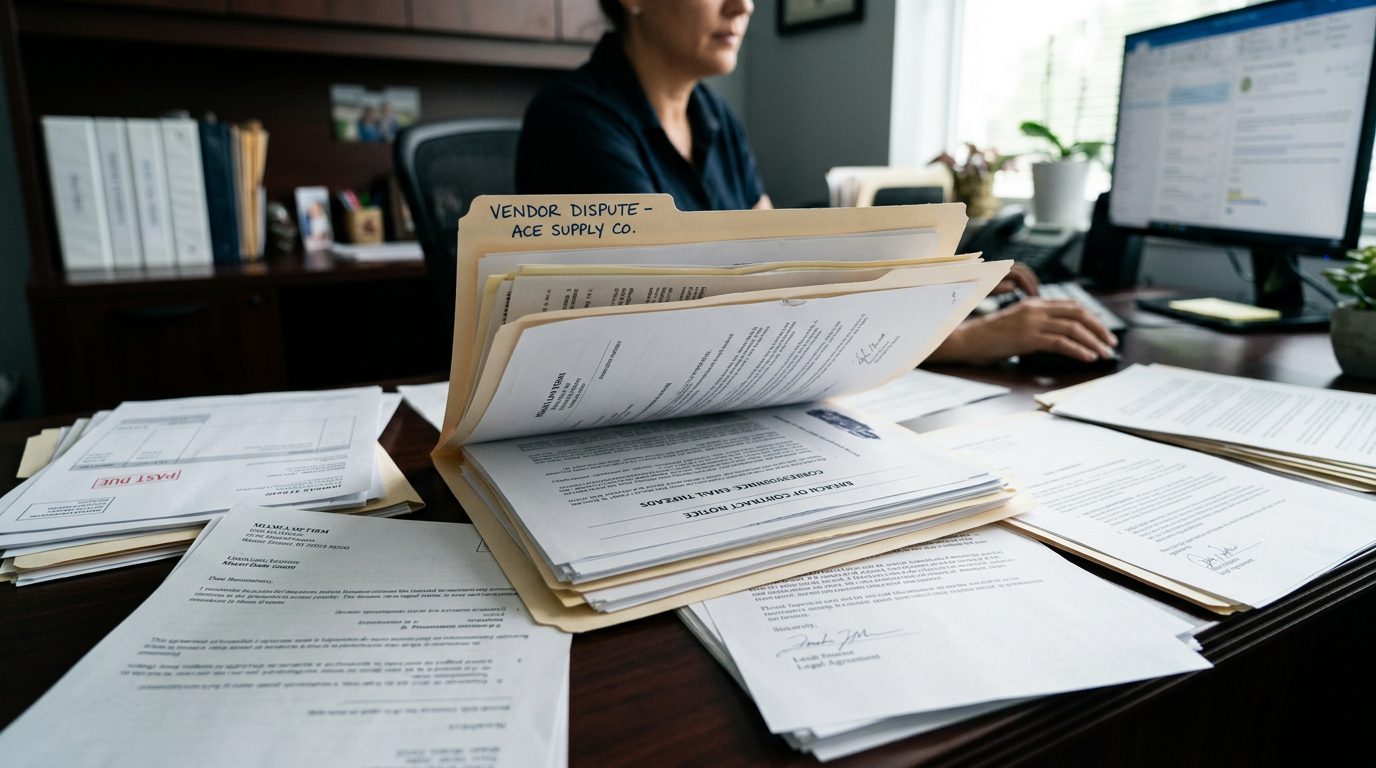
Business Contract & Vendor Disputes | Coral Gables and Sunny Isles Beach
Stuck in a Vendor Dispute? Get Clear Legal Direction for Your Business
KEW Legal serves as outside general counsel for business owners and investors across Miami-Dade and South Florida. We focus on contract and vendor disputes, helping you understand your options and protect your business.
Why Business Owners Bring Contract Disputes to KEW Legal
Confidential First Consultation
Your first consultation is free, confidential, and carries no obligation to continue.
Practical Contract Review
We read the agreement, the purchase terms, and the communications that matter, so you know where you stand before you respond.
Clear Communication
We explain your position in plain language and keep you informed about the steps ahead.
Rooted in South Florida
Our offices in Coral Gables and Sunny Isles Beach serve businesses throughout Miami-Dade and Broward Counties.
By Kristina E. Wilson · Published October 19, 2026
Business Contract and Vendor Dispute Attorney in South Florida
By Kristina E. Wilson, KEW Legal, Coral Gables, Florida. Kristina E. Wilson focuses on business contract and vendor disputes for business owners and investors in Miami-Dade and South Florida. This page is general information about Florida law, not advice on your specific contract.
A business contract and vendor dispute in Florida usually turns on three things. Those are what the agreement says, whether it can be proven, and how quickly you act. This guide explains the main Florida rules that shape these disputes, so you can see what to watch for early.
If a supplier stopped delivering goods you already paid for, you may have a claim, and our team can review your contract with you. Talk it through with our team — the first consultation is free, confidential, and carries no obligation.
How long do you have to act on a contract dispute in Florida?
Florida sets different deadlines based on whether the agreement is written or unwritten. Florida law sets a deadline for bringing a legal or equitable action on a contract, obligation, or liability not founded on a written instrument, including an action for the sale and delivery of goods, wares, and merchandise.
That split matters before you send any demand. Many owners assume they have a long time to act, but the category of the agreement can change the clock. Whether a deal is written, oral, or partly both can also be disputed, so the facts of your deal decide which period applies.
Is an oral or unsigned vendor agreement enforceable in Florida?
For a sale of goods priced at $500 or more, Florida generally requires a record that shows a contract was made. That record must be signed by the party you are trying to hold to it, or by that party’s authorized agent or broker (Fla. Stat. § 672.201).
The statute has exceptions. A contract can be enforced in a few narrow cases, such as:
- Goods made specially for the buyer that are not suitable for sale to others in the seller’s ordinary business, if, before notice of repudiation is received and under circumstances which reasonably indicate the goods are for the buyer, the seller has made a substantial beginning of their manufacture or commitments for their procurement.
- The party against whom enforcement is sought admits in a pleading, testimony, or otherwise in court that a contract was made. Enforcement then reaches only the quantity admitted. Enforcement then reaches only the quantity admitted.
- Goods were paid for and accepted, or received and accepted.
The same statute has a merchant rule. Between merchants, a written confirmation sent by the other party, sufficient against that sender and received within a reasonable time, can satisfy the signed-record requirement against the party who receives it if that party has reason to know its contents. That rule applies unless the receiving party gives written notice of objection within 10 days after receiving the confirmation (Fla. Stat. § 672.201).
Practical point: if a vendor sends you a confirmation email and you disagree with it, put your objection in writing quickly. Waiting can make the confirmation harder to challenge later.
What happens when a vendor’s reply has different terms?
A clear reply that accepts your order can form a contract even if it adds or changes terms. The exception is when the acceptance is expressly made conditional on your agreement to those new terms (Fla. Stat. § 672.207).
Between merchants, the extra terms are treated as proposals. They become part of the contract unless the offer expressly limited acceptance to its own terms, the new terms materially alter the deal, or you gave notice of objection to them. A notice of objection can be given within a reasonable time after you receive them (Fla. Stat. § 672.207).
This is where many disputes start. A business owner signs or pays an invoice that has fine print, then later learns that the fine print limits remedies. Read the vendor’s paperwork before you pay, not after a problem appears.
What must you do if the goods you received are defective?
If you accept goods, you must notify the seller of a breach within a reasonable time after you discover it, or should have discovered it. If you do not, you may be barred from any remedy (Fla. Stat. § 672.607).
Acceptance also matters. Accepting goods precludes rejecting the goods you accepted. Fla. Stat. § 672.607 reads: “(2) Acceptance of goods by the buyer precludes rejection of the goods accepted and if made with knowledge of a nonconformity cannot be revoked because of it unless the acceptance was on the reasonable assumption that the nonconformity would be seasonably cured but acceptance does not of itself impair any other remedy provided by this chapter for nonconformity.” Under Fla. Stat. § 672.607, the burden is on the buyer to establish any breach with respect to the goods accepted (Fla. Stat. § 672.607).
Buyers often wait to see whether a defect gets better. That wait can cost the right to a remedy. Put the notice in writing, describe the problem, and keep proof of the date you found it.
The buyer must also pay at the contract rate for goods accepted (Fla. Stat. § 672.607). Withholding payment is a serious step that should be planned, not improvised.
Is an arbitration clause in a vendor contract enforceable?
An arbitration agreement in a record is generally valid, enforceable, and irrevocable. The exception is a ground that exists at law or in equity to revoke a contract (Fla. Stat. § 682.02).
The court decides whether an agreement to arbitrate exists. An arbitrator decides some questions, such as whether a condition before arbitration has been met and whether the contract is enforceable (Fla. Stat. § 682.02).
The court may not refuse to order arbitration because the claim lacks merit or because its grounds have not been established (Fla. Stat. § 682.03).
So the forum question comes early. Whether a dispute goes to court or to an arbitrator can shape cost, speed, and what evidence is seen. Check the clause before you file or respond.
Not sure what your next step is?
Talk it through with our team — the first consultation is free, confidential, and carries no obligation.
How long do you have to challenge an arbitration award?
A motion to vacate an arbitration award must generally be filed within 90 days after you receive notice of the award. If the award was procured by corruption, fraud, or other undue means, the 90 days run from when the ground is known or would have been known with reasonable care (Fla. Stat. § 682.13).
The statute lists specific grounds for vacating an award. These include an award procured by corruption, fraud, or other undue means, evident partiality by an arbitrator appointed as a neutral arbitrator, an arbitrator exceeding the arbitrator’s powers, and no agreement to arbitrate, unless the party participated in the arbitration proceeding without raising that objection by the beginning of the arbitration hearing.
Because the window is short, calendar the notice date the day you receive it.
Who pays attorney’s fees in a Florida business contract dispute?
Fees depend on what the contract and the statutes say. Some contracts allow fees to a party that must act to enforce the contract. Under Florida law, the court may then allow reasonable fees to the other side if that side prevails, whether as plaintiff or defendant. This applies to contracts entered on or after October 1, 1988 (Fla. Stat. § 57.105).
That applies to a claim or defense the party knew or should have known was not supported by the material facts or, unless it was presented as a good faith argument for the extension, modification, or reversal of existing law, would not be supported by existing law (Fla. Stat. § 57.105).
Read the fee clause in your contract. It may help or hurt you, and it can change how you value a claim.

What are settlement offers and offers of judgment?
Under Fla. Stat. § 45.061, an offer remains open for 45 days unless it is withdrawn sooner by a writing served before acceptance, and an offer that is neither withdrawn nor accepted within 45 days is deemed rejected. The statute’s own text also states that Fla. Stat. § 45.061 does not reach any cause of action accruing after the effective date of the act.
Under Fla. Stat. § 45.061, which does not apply to causes of action that accrue after its effective date, an offer is presumed unreasonably rejected by a defendant if the judgment is at least 25 percent greater than the offer (Florida Statutes § 45.061).
In a civil action for damages, under § 768.79, an offer is deemed rejected if it is not accepted within 30 days after service, and the offering party may become entitled to recover reasonable costs and attorney’s fees incurred from the date of the offer if the judgment meets the statute’s percentage test: for a defendant’s offer, a judgment of no liability or one at least 25 percent less than the offer; for a plaintiff’s offer, a judgment at least 25 percent greater than the offer. That can apply if the judgment the plaintiff recovers is at least 25 percent greater than the amount of the plaintiff’s offer (Fla. Stat. § 768.79).
These tools put pressure on both sides. They are not a reason to accept or reject an offer by themselves. Each offer should be measured against your records, your deadlines, and your business goals.
Does Florida’s consumer law apply to business vendor disputes?
Florida’s Deceptive and Unfair Trade Practices Act allows fee awards in certain civil litigation.
That applies only to litigation that results from an act or practice that violates the Act. A dispute between two businesses may or may not fall under it.
How does the Uniform Commercial Code affect vendor and supplier deals?
The Florida sale-of-goods rules discussed above follow that framework. When you negotiate a supply deal, the code’s structure is often the background rule that applies if the contract is silent.
If a supplier stopped delivering goods you already paid for, you may have a claim, and our team can review your contract with you. Talk it through with our team — the first consultation is free, confidential, and carries no obligation.
How do partnership disputes differ from vendor disputes?
A partner dispute can involve both a contract question and a partnership question. Both should be sorted out early, because they can point to different rules and different deadlines.
For entity questions, the Florida Division of Corporations (Sunbiz) is the official filing system for Florida business entities. Check the status and filings of the other business before you act on a claim against it.
Common mistakes in contract and vendor disputes
Several habits create problems in these cases:
- Waiting too long. Deadlines differ by contract type, and they keep running while you talk.
- Relying on oral promises. A key price or delivery term that lives only in a phone call is harder to prove.
- Paying without objecting. Silence can be treated as acceptance of new terms or of goods.
- Missing the defect notice. A buyer who accepts goods and says nothing may lose the right to a remedy.
- Ignoring the arbitration clause. The forum decision can affect the whole case.
Each mistake is fixable if you act early. Keep emails, invoices, delivery records, and signed documents in one place.
Frequently asked questions
How long do I have to sue a vendor for breach of contract in Florida?
Your facts decide which period fits.
Is a verbal agreement with a supplier enforceable in Florida?
For a sale of goods priced at $500 or more, Florida generally requires a signed record, with exceptions. Goods paid for and accepted are one exception.
What happens if a vendor accepts my order but adds different terms?
A clear acceptance can still form a contract, even with added terms. Between merchants, those terms usually do not become part of the deal if you objected within a reasonable time.
Can I challenge an arbitration award in Florida?
Yes, but a motion to vacate generally must be filed within 90 days after you receive notice of the award. The statute lists specific grounds.
Who pays attorney’s fees in a contract dispute?
Fees depend on the contract’s fee clause and on certain statutes. The court may award fees to the prevailing party under some contracts.
Get help with your business contract or vendor dispute
If a supplier stopped delivering goods you already paid for, you may have a claim. Our team can review the contract, the invoices, and the messages with you, and we can talk through your options. The first consultation is free, confidential, and without obligation. Contact KEW Legal in Coral Gables or call 305-990-2300.
Before You Respond to a Vendor
Keep the signed agreement, invoices, delivery records, and all written communications in one place. Avoid making admissions or promises in writing until you have reviewed the situation with counsel.
Common Business Contract and Vendor Disputes
Non-Delivery or Late Delivery
A supplier fails to deliver goods or services on the agreed terms, disrupting your operations and customer commitments.
Defective Goods or Work
Products or services do not meet the specifications in your contract, and the vendor disagrees about the fix or the refund.
Unpaid Invoices and Payment Disputes
A client, vendor, or partner withholds payment, or you are facing a demand for payment you believe is incorrect.
Disagreements Over Scope and Termination
The parties dispute what the contract requires, whether it was properly terminated, or what is owed after it ends.
Get Clarity on Your Vendor or Contract Dispute. Your First Consultation Is Free, Confidential, and Without Obligation.
Request a Consultation
Fill out the short form and we will take it from there.