
Business Contracts | Coral Gables, Sunny Isles Beach and South Florida
When a Business Contract Goes Wrong in Florida, Start With the Right Steps
KEW Legal focuses on business contract and vendor disputes for owners, investors and managers across Miami-Dade and Broward County. Review your options before you respond.
By Kristina E. Wilson · Published October 13, 2026
If you’re asking what to do when a business contract goes wrong in Florida, start by pausing, saving your records, and reading the contract’s notice and dispute terms before you respond. Those steps shape every option that follows, from a formal notice to a lawsuit.
This guide covers the decisions business owners, investors and managers in Miami-Dade, Broward and across South Florida often face. This page offers general information and practical points to review. It does not predict how any dispute will end, and it is general information, not legal advice.
KEW Legal, with offices in Coral Gables and Sunny Isles Beach, focuses on business contracts, partnership disputes, leases and related matters.
What to Do First When a Business Contract Goes Wrong
The first move is to stop, write nothing in anger, and gather the record. Angry texts and emails can be quoted back to you later, so keep early messages short and factual.
Avoid written admissions such as “it was our fault” and threats you may not carry out. Those lines can weaken your position before anyone reads the contract.
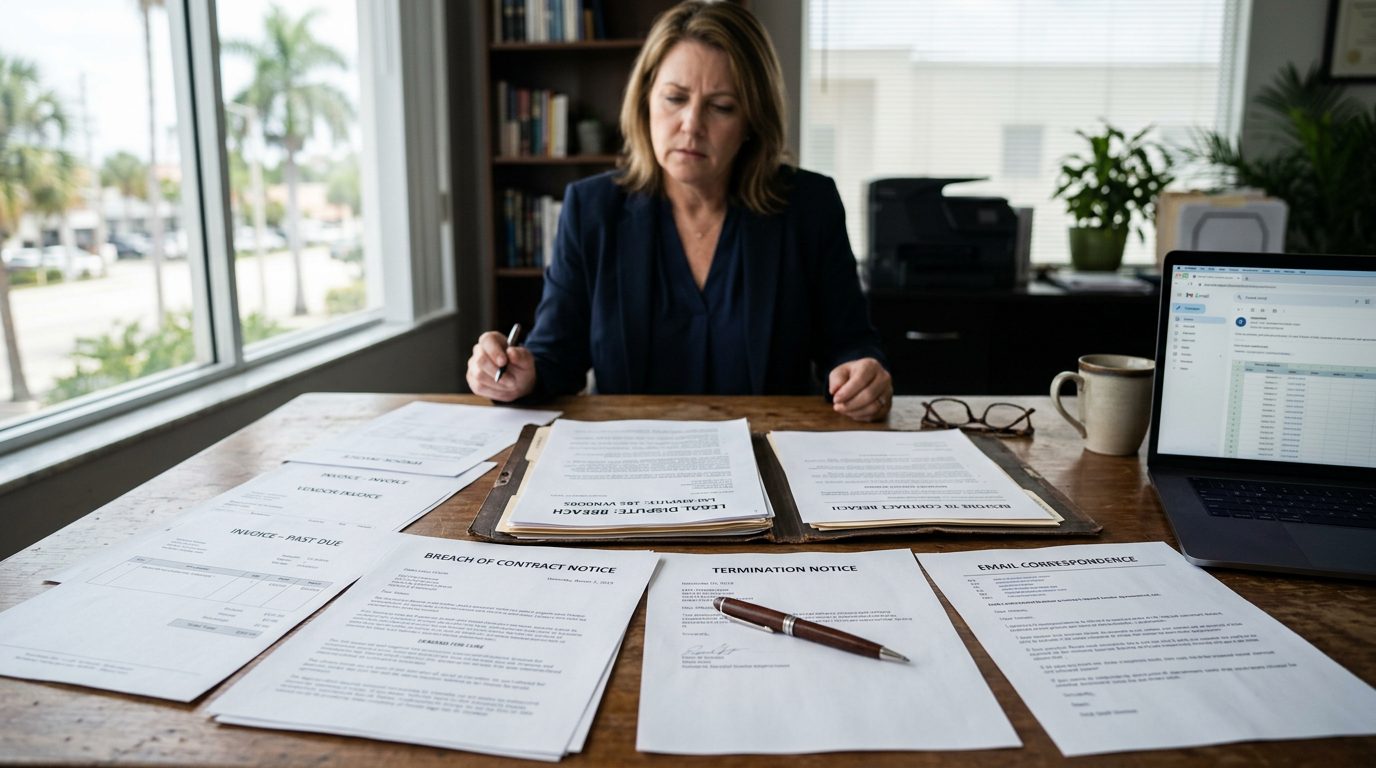
Next, collect everything in one place. That includes the signed contract, amendments, purchase orders, invoices, emails, texts and notes from calls. Keep original files unchanged and save copies in a separate folder.
Then build a dated timeline. List when each duty was due, what happened, what you paid, and what arrived late, short or not at all. Gaps in dates are common, and a timeline shows them quickly.
Finally, measure your losses so far. Count cash paid, replacement costs and lost revenue, and back each number with a receipt or invoice. Hold off on labeling the problem a “breach” until the facts are complete. This is the stage where a business contract and vendor dispute attorney can help you organize the record. The most common mistake is relying on memory or on verbal promises nobody wrote down.
Not sure what your next step is?
Talk it through with our team — the first consultation is free, confidential, and carries no obligation.
Read the Contract for Notice, Cure, Dispute and Fee Clauses
The contract sets the first rules, so read it before you act. Four clause types matter most at the start.
Notice terms say how you must tell the other side about a problem. They may name a delivery method, an address and required wording. A casual email may not count if the contract calls for certified mail to a specific address.
Cure periods give the other party a set number of days to fix the problem. Remedies may not be open until that window closes, so track it carefully.
Dispute clauses may require mediation or arbitration first. They also set the venue and the governing law. Florida enforces written arbitration agreements under Fla. Stat. § 682.02, so a clause like that deserves close reading.
Fee clauses decide who pays legal fees. Under Fla. Stat. § 57.105, if a contract lets one party recover fees for enforcing it, the court may allow the other side fees when that side prevails.
Check the limitation-of-liability language too, since it may cap what you can recover. Skipping a required notice or cure step can weaken a later claim.
Oral Agreements and Partly Written Deals: What Still Counts
A deal that is only partly in writing can still matter, but it’s harder to prove. Florida law requires a signed writing for some agreements, so the type of deal changes the answer.
Florida law can require certain business agreements to be in writing and signed before a court will enforce them, so it is worth confirming whether an agreement you rely on falls into that category. Multi-year supply or service deals often fall under this rule.
For sales of goods, Fla. Stat. § 672.201 says a contract for goods priced at $500 or more is not enforceable unless a signed record shows a sale was made. Between merchants, a written confirmation can satisfy that rule against the person who received it, unless that person objects in writing within 10 days.
Other evidence includes emails, texts, invoices, payment records and the way both sides actually performed. Those records often show what was agreed.
If the terms are disputed, send a written summary of your understanding. Phrase it as your understanding, and ask the other side to correct errors within a set time. A common mistake is a casual text that restates the deal in a way that concedes a point you never agreed to.
What Makes a Contract Void, Voidable or Unenforceable in Florida
A contract can be challenged on several grounds, and the right one depends on the documents and the timing. Florida has statutes that can make a deal or a term unenforceable.
The writing rules above are one example. A signed-writing requirement can bar enforcement of certain oral deals, and a record requirement can limit sales-of-goods claims.
Another example is Fla. Stat. § 95.03, which voids any contract clause that sets a shorter time to sue than the statute of limitations. Many owners rely on a short deadline written into their own deal, and that clause may not hold.
Other grounds people raise include fraud, illegal terms and certain mistakes. Which one fits depends on the facts.
Challenges to a deal can come up even when you want to enforce it. The other side may raise them, so review your own agreement as well. A common mistake is assuming a signed deal is always enforceable or always void. Both assumptions can be costly.
The Four Elements of a Breach of Contract Claim and the Types of Breach
Contract disputes often turn on what the agreement says, how each side performed, and what loss followed.
Each part should match documents you can show, not assumptions.
The type of breach matters:
- A material breach goes to the heart of the deal. A minor breach does not. The difference can affect whether you may stop performing, so don’t decide it on a hunch.
- An anticipatory breach happens when a party says in advance that it won’t perform.
- A partial breach covers late, incomplete or defective performance. Many vendor disputes fall into this group.
Each type points to different evidence. A late delivery needs delivery dates and notices. A refusal needs the written statement. A common mistake is stopping payments or performance before matching the facts to the terms. That move can turn you into the party in breach.
Can You Sue for an Unfair Contract?
A bad deal is usually not the same as a breach. An unwise contract can still be enforceable, even when it turns out badly for you.
Unfairness arguments do come up in disputes. Courts look at how a deal was made and what its terms say. Whether such an argument helps depends on the facts, and it may be raised as a defense rather than as a standalone claim.
Contracts between businesses are often enforced as written, especially when both sides negotiated the terms. Useful questions include: Did you review and mark up the draft? Did you have a chance to ask about terms? Were any terms hidden or misstated? The answers shape the analysis.
The common mistake is treating a bad business result as proof of an unfair contract. Separate two questions. Did the other side fail to perform? That is a breach question. Are the terms themselves unfair? That is a different question.
Have questions about what happened?
Ask our team directly. The first conversation is free, confidential, and there is no obligation to continue.
Pre-Suit Options: Notice, Demand Letters, Negotiation and Mediation
Most business disputes start with formal notice, a demand letter or direct talks before anyone files suit. Each step can narrow the issues, but none can promise a result.
A formal notice of default follows the contract’s delivery and cure rules. It should state the problem, the clause involved and the cure period.
A demand letter sets out the facts, names the contract terms that were breached, requests a specific cure, sets a deadline and reserves your rights. Keep it factual. A court may later read the letter, so avoid insults and overstated threats.
Negotiation can produce a payment plan, a credit, a corrected delivery or a mutual exit. Put any agreement in writing and have it signed.
If a lawsuit seeks money damages, a court must refer it to mediation when one party asks, unless an exception applies, under Fla. Stat. § 44.102. Landlord and tenant disputes without a personal injury claim are excluded. Your contract may require mediation or arbitration first. Both sides can also agree in writing to pause deadlines during talks. Get that agreement signed before the window closes.
Remedies and Damages: What Recovery Can Look Like
What you can recover depends on the contract, the losses you can prove and what the law allows. No result can be promised, and any figures should come from your own records.
Settlement offers shape cost. Under Fla. Stat. § 768.79 and Fla. R. Civ. P. 1.442, an offer of judgment that is not accepted in writing within the time those provisions set is deemed rejected. Under Fla. Stat. § 768.79, in a civil damages action, a defendant’s offer of judgment not accepted within 30 days can shift reasonable costs and attorney’s fees if the plaintiff’s judgment is at least 25 percent less than the offer.
For goods you accepted, Fla. Stat. § 672.607 requires you to notify the seller of breach within a reasonable time after you discover or should have discovered it. Otherwise you may be barred from any remedy. This is a common trap in vendor disputes.
Fee recovery turns on the contract’s fee clause, as covered above. Your documented losses set the starting point for any damages figure. Keep receipts, invoices and replacement quotes organized. The common mistake is estimating losses from memory.
Deadlines: Florida Statutes of Limitations and Contract Notice Periods
Oral contracts generally carry a four-year deadline. These are starting points, not final answers for your case.
Fla. Stat. § 95.11 sets these general limitation periods. Under Fla. Stat. § 95.031, a cause of action generally accrues when its last element occurs. That can differ from a date the contract names, so don’t assume one.
Your contract may contain its own notice provisions, so it is worth reviewing them early. A notice requirement or claim window in your agreement may run first, so act by the earliest date that applies. A clause that tries to set a shorter time to sue than the statute allows is void under Fla. Stat. § 95.03.
Goods disputes add another layer. Notice of breach under § 672.607 must be given within a reasonable time. Waiting while talks continue can cost you the remedy. The common mistake is waiting for negotiations to end before checking dates.
If It Comes to Litigation: The Process, Costs and Questions to Ask
A lawsuit usually moves through filing, service, a response, discovery, motions, mediation and trial. It can settle at any stage, and each stage adds time and cost.
Cost drivers include how many documents are exchanged, how many motions are filed and how long a trial runs. Weigh the expected cost against the amount in dispute and the risk that the other side cannot pay a judgment.
Some disputes follow their own paths. Commercial lease defaults and evictions that involve possession are one example, and landlord and tenant disputes are excluded from the mediation referral rule discussed above. Under Fla. Stat. § 620.8307, a partnership may sue and be sued in the name of the partnership, and a judgment against a partnership is not by itself a judgment against a partner. A partnership or lease dispute may need its own review.
Before you sign anything or send a demand, check the other side’s status with the Florida Division of Corporations (Sunbiz). It shows whether an entity is registered and active.
Frequently asked questions
How long do you have to sue for breach of contract in Florida? Written contracts generally carry a five-year deadline, and oral contracts generally carry four. Your facts control when the clock starts.
Is an oral contract enforceable in Florida? Some oral deals can be enforced. Agreements that cannot be performed within one year generally need a signed writing.
Do I have to try mediation before suing? Not always. A court may send a damages case to mediation when one party asks, but your contract may require mediation first.
Can I stop performing when the other side breaches? Possibly, but stopping too soon can create a breach of your own. Review the terms first.
If you’ve just found a breach, received a demand, or see a deadline coming, you can describe those facts to the KEW Legal team. Call 305-990-2300 or send us a message to talk through which steps fit your contract.
Five Steps to Take Before You Respond
Save every record
Keep the signed contract, amendments, emails, texts, invoices, payment records and meeting notes in one place. Do not delete or edit anything.
Read the notice and dispute terms
Look for notice requirements, cure periods, dispute resolution steps, governing law and any venue or arbitration clause.
Limit what you say in writing
Keep written messages factual and brief. Avoid admissions, threats or accusations until you understand your position.
Identify your goal
Decide whether you want to enforce the contract, negotiate a resolution, exit the relationship or protect an ongoing business interest.
Involve counsel early
Talk with a business attorney before you send a demand, withhold performance or file a claim, so each step fits the contract and your broader goals.
Key Warning: Do Not Ignore a Notice
A demand letter, default notice or termination notice can set deadlines and trigger rights under the contract. Read it carefully, keep a copy, and speak with counsel before you stop performing or send a substantive reply.
Want to know where you stand?
Tell us what happened and our team will walk you through the options available to you, at no cost.
Contract Problems KEW Legal Handles for Business Clients
Vendor and supplier disputes
Late deliveries, defective goods, unpaid invoices and disagreements over scope of work under a vendor or service agreement.
Partnership and ownership disputes
Disagreements among partners or co-owners over operating agreements, capital contributions, distributions and decision-making.
Commercial lease issues
Lease default notices, disputes over repairs or charges, and the commercial eviction process for owners of commercial property.
Sale and acquisition agreements
Problems after closing, earn-out or purchase price disputes, and disagreements over representations and warranties in a business sale.
Talk With KEW Legal About Your Business Contract
Request a Consultation
Fill out the short form and we will take it from there.