
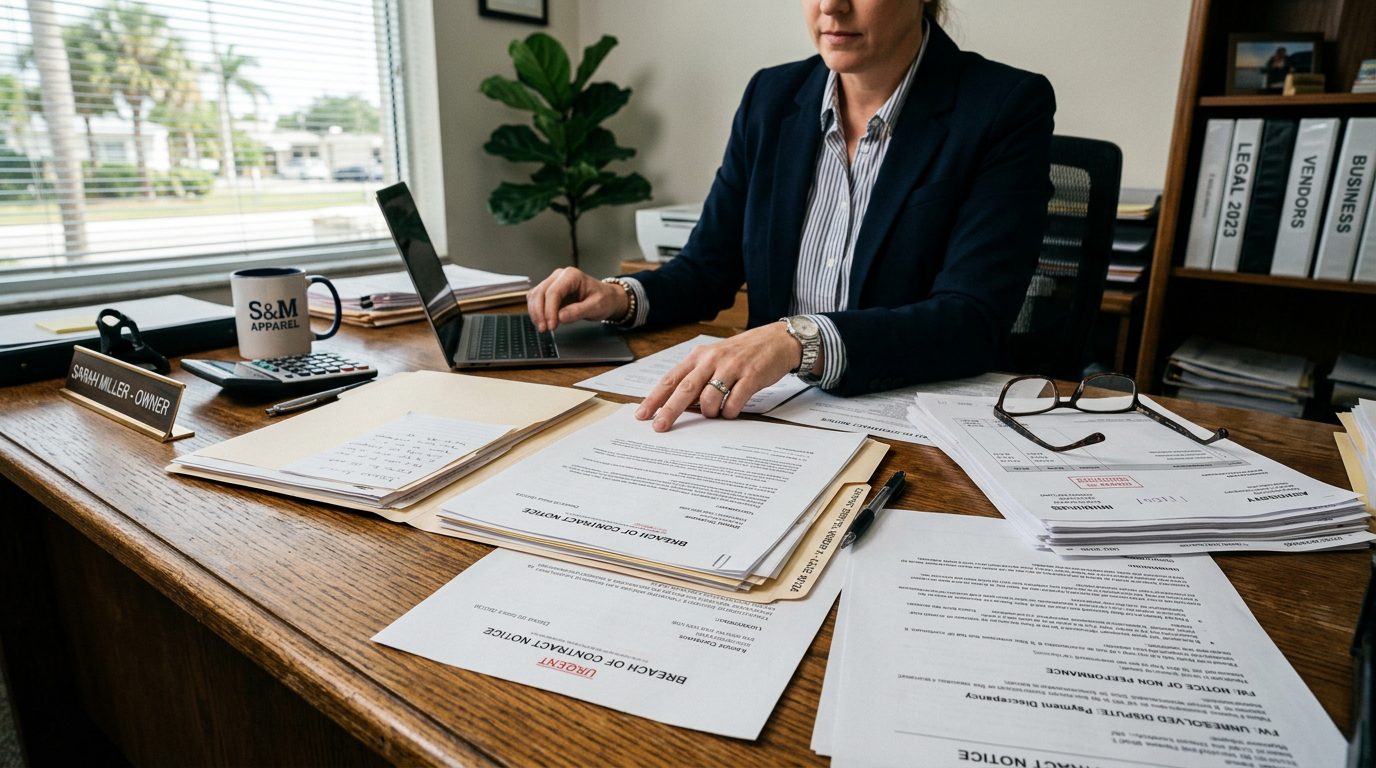
Business Contract Disputes | Coral Gables and Sunny Isles Beach
Business Contract Disputes in Florida: Protect Your Position Before You Respond
KEW Legal acts as outside general counsel for business owners and investors across Miami-Dade and South Florida, including breach claims, unpaid invoices, vendor disagreements, and disputes over ending a deal.
By Kristina E. Wilson · Published October 12, 2026
If a business contract goes wrong in Florida, pause, keep every record, read the signed agreement, and check the deadlines before you respond. Most business contract disputes involve a breach, unpaid invoices, late or defective work, or a disagreement over ending the deal. This guide explains what to do first and what to avoid. It is general information, not legal advice about your contract. Your agreement’s exact words and facts control.
What to Do First When a Business Contract Goes Wrong in Florida
Your first move is to slow down, save everything, and avoid putting blame in writing. A contract dispute starts when one side doesn’t do what the deal requires. That can mean a missed payment, late delivery, work that doesn’t meet the terms, or a fight over whether the contract was properly ended.
Before you reply, take four steps. First, pause instead of sending an angry response. Second, preserve emails, texts, invoices, purchase orders, and delivery records. Third, read the agreement from start to finish. Fourth, write down the key dates while your memory is fresh.
Be careful with casual messages. A quick text saying “that was our mistake” can be read later as an admission. Keep your messages short, factual, and free of promises you may not be able to keep.

If you hold a breach notice, an unpaid invoice, or a termination you didn't expect, you don't have to sort it out alone. Talk it through with our team — the first consultation is free, confidential, and carries no obligation.
Read the Contract Before You Respond
Read the signed contract closely before you reply. Its wording answers many of the first questions. Start with the basics. Confirm the exact legal name of each party. You can check a business’s registration and status on the Florida Division of Corporations (Sunbiz).
Next, find these clauses:
- Governing law: which state’s law applies to the deal.
- Venue or forum: where a lawsuit has to be filed.
- Notice: who must receive notice, where it must go, and how it must be sent.
- Cure period: how much time the other side has to fix the problem.
Notice rules matter a lot. An email may not count if the contract requires certified mail. Also check amendments, exhibits, statements of work, and side letters. A later document can change the terms you’re relying on.
How Long You Have to Act: Florida Limitations Periods
Under section 95.11(2)(b), Florida Statutes, a claim on a written contract generally has a five-year filing period, so reviewing the deadline that applies to your agreement early can help. Under section 95.11(3), Florida Statutes, a claim on a contract not founded on a written instrument generally has a four-year filing period. Florida never adopted a separate Uniform Commercial Code deadline for sales of goods, so a claim on a sale of goods follows these same section 95.11 periods. Those are the starting points, not a promise that you have time to spare.
The clock doesn’t always start on the day you signed. Under Fla. Stat. § 95.031, a cause of action accrues when the last element of that cause of action occurs. For many owners, that point is the breach itself. The exact date is fact-specific, and it can differ from the day you noticed the problem. Waiting to see if a problem fixes itself can cost you time.
A contract generally can’t shorten the filing window in a way that cuts off your claim early. Under Fla. Stat. § 95.03, a contract provision that sets a shorter period to sue than the statute allows is void. Contracts for the sale of goods are not an exception. Florida never adopted the Uniform Commercial Code’s separate limitation section for sales of goods, so there is no section 672.725, Florida Statutes, and the deadline for those claims comes from section 95.11. A one-year clause in a goods contract that shortens that period is void like any other. Separate notice or claim deadlines in the contract are a different issue, so check those on their own.
Is a shorter deadline in my contract enforceable?
A clause that sets a shorter filing period than the statute is generally void under Florida law. That rule also covers a contract for the sale of goods: Florida never adopted the Uniform Commercial Code’s separate limitation section for sales of goods, so there is no section 672.725, Florida Statutes, that lets the parties shorten the period, and that kind of clause is void. Any notice or claim deadline in the contract still needs a separate review.
Withholding Payment or Terminating a Contract: Rights and Risks
Withholding payment or ending a contract can be a valid response. It works only when the contract or the other side’s breach supports it. Acting too early or without a clear reason can turn you into the party in breach.
Termination for cause means you end the deal because the other side broke a term. Termination for convenience means the contract lets either side end it for any reason, usually with notice. The two paths carry different notice steps, and mixing them up is a common error.
Before you withhold payment or terminate, write down the reason, the clause you rely on, and the key dates. Send written notice using the method the contract requires.
Watch for a quiet risk. If you keep accepting work while you dispute the bill, your position gets harder to argue. Put any reservation of rights in writing when the relationship continues.
Conflicting Vendor Terms, Purchase Orders, and Invoices
When a purchase order and a vendor invoice disagree, Florida’s commercial code may decide which terms apply. Lawyers call this the battle of the forms. The rules below apply to sales of goods, not every service contract.
Under Fla. Stat. § 672.207, a definite acceptance can form a contract even when it adds or changes terms. Between merchants, those extra terms usually become part of the deal. The exceptions include an offer that limited acceptance to its own terms, a change that materially alters the deal, and a timely objection. Conduct by both sides that shows a contract exists can also create one.
Buyers also face a writing rule. Under Fla. Stat. § 672.201, a contract for goods priced at $500 or more generally needs a record signed by the party you’re enforcing against. Between merchants, a written confirmation can count unless the receiver objects in writing within 10 days.
Gather these documents now: quotes, purchase orders, invoices, emails, delivery records, and any signed acceptance. Put them in date order.
Not sure what your next step is?
Talk it through with our team — the first consultation is free, confidential, and carries no obligation.
Liability Caps, Indemnities, and Consequential Damages
Liability caps and indemnity clauses decide how much one side can recover and who pays outside claims. These clauses often matter more than the headline price of the deal.
A liability cap limits the total amount one party can owe. Look for the cap amount, what it covers, and any exceptions. A cap that leaves out certain claims works differently from a general cap.
An indemnity clause makes one party cover losses or lawsuits from third parties. Ask whether it covers only outside claims or also losses between the two sides.
Damages come in two main types. Direct damages flow naturally from the breach, like the cost to replace defective goods. Consequential damages flow from the breach indirectly, such as lost profits from a delayed project. Many contracts limit consequential damages. Whether you can recover lost profits depends on the contract wording and the evidence.
Some caps or exclusions can be challenged in certain situations. Whether that applies to your clause depends on its exact words and the facts, so it needs a full review.
Attorney Fee Clauses and the Cost of a Dispute
An attorney fee clause can make the losing side pay the other side’s legal bills. Florida law can apply that clause in both directions, which many owners don’t expect.
Under Fla. Stat. § 57.105, when a contract lets a party recover fees for enforcing it, the court may also allow reasonable fees to the other party when that party prevails. A clause that seems one-sided on paper can therefore reach both sides. The same statute also lets a court award fees when a claim or defense was not supported by the facts or the law.
Weigh the cost of a dispute against the amount in dispute. Filing fees, discovery, and witness and record costs add up quickly. A small invoice may not justify a long fight, while a major contract loss may.
How much does a lawyer charge for a contract dispute?
Fee structures vary. Some lawyers charge by the hour, some use a flat fee, and some combine the two. Ask for the fee and cost terms in writing before you hire any lawyer.
Demand Letters, Notice, and Mediation Before Litigation
A demand letter is usually the first formal step. It should state the breach, the contract clause involved, the fix you want, and a deadline. Keep it factual and tied to the contract.
Avoid three common errors. Don’t threaten action the contract doesn’t support. Don’t admit facts you aren’t sure of. Don’t state anything inaccurate, because the letter can become evidence later.
Mediation can happen before or during a lawsuit. Under Fla. Stat. § 44.102, a court must refer a filed civil action for monetary damages to mediation on one party’s request, unless a listed exception applies. The exceptions include a landlord and tenant dispute without a personal injury claim and an action filed to collect a debt.
Your contract may also require arbitration. Under Fla. Stat. § 682.03, if the other side opposes a motion to compel arbitration, the court decides whether an enforceable agreement exists. If one exists, the court orders arbitration. A court may not refuse arbitration just because the claim lacks merit.
Check the dispute-resolution clause early. It can decide where and how the fight happens.
Remedies a Florida Business Owner May Pursue
Which one fits depends on the contract and the evidence.
Money damages are the most common request. They aim to put you where the contract would have put you. Specific performance is less common and usually fits deals involving unique property.
Some contracts set damages in advance, called liquidated damages. Whether such a clause holds up depends on its wording and the facts.
If you bought goods, notice matters. Under Fla. Stat. § 672.607, after you accept goods, you must notify the seller of a breach within a reasonable time after you discover it. Otherwise you may be barred from any remedy. The buyer also carries the burden to prove any breach in goods already accepted.
What are the remedies for breach of contract in Florida?
The usual options are money damages, restitution, specific performance, and cancelling the contract. Which ones apply depends on the contract terms and the evidence, so no outcome can be predicted from general information.
Have questions about what happened?
Ask our team directly. The first conversation is free, confidential, and there is no obligation to continue.
Common Mistakes That Weaken an Owner’s Position
Most weak positions come from a few avoidable mistakes. Watch for these five.
- Deleting records. Emails, texts, and messaging apps hold the proof. Turn off auto-delete now.
- Sending admissions. A casual message can read as fault or as a change to the deal.
- Missing notice steps. Notice sent late or by the wrong method may not count.
- Continuing without a reservation of rights. If you keep working while disputing payment, say so in writing.
- Relying on a handshake. A memo or text may not change a signed agreement that requires written amendments.
Each mistake is easy to make under pressure. Slowing down and checking the contract first prevents most of them.
Talk Through Your Contract Dispute with KEW Legal
KEW Legal is a Florida business law firm with offices in Coral Gables and Sunny Isles Beach. The firm focuses on business contract and vendor disputes, along with partnership disputes, commercial leases, and employment issues for employers. KEW Legal is responsible for this page.
Some matters may be referred to another lawyer or firm, and we will say so when that applies. No outcome can be promised from general information like this page.
If you hold a breach notice, an unpaid invoice, or a termination you didn’t expect, you don’t have to sort it out alone. Call 305-990-2300 or send us a message through our contact page.
How KEW Legal Approaches a Contract Dispute
Preserve the Record
Keep emails, invoices, texts, delivery records, and signed copies in one place so the facts are clear from the start.
Read the Signed Agreement
Review the exact terms, notice provisions, payment rules, and termination language that govern your situation.
Communicate Carefully
Measured written responses can shape how a dispute develops, so every message should be reviewed before it is sent.
Plan the Next Step
Weigh options such as negotiation, a demand response, or formal proceedings based on the contract and the business goals involved.
Warning: Do Not Act on Impulse
Do not ignore a demand letter, and do not stop performing, withhold payment, or send an angry reply before reviewing the contract. An early misstep can weaken your position.
Common Business Contract Disputes We Handle
Breach of Contract
One party believes the other failed to perform a material obligation under the agreement.
Unpaid Invoices
A client, customer, or vendor has not paid for goods or services, and the amount is disputed or overdue.
Late or Defective Work
Deliverables arrived late, did not meet the agreed specifications, or need correction under the contract.
Disputes Over Ending the Deal
The parties disagree about termination rights, notice requirements, or the obligations that continue after a contract ends.
Talk With KEW Legal About Your Business Contract Dispute
Request a Consultation
Fill out the short form and we will take it from there.