
Business Contract & Vendor Disputes | Coral Gables and Miami-Dade
Stuck in a Vendor Dispute? Get Clear Answers About Your Business Contract
KEW Legal, a Florida business law firm in Coral Gables, helps business owners and investors across Miami-Dade and South Florida address breached contracts, unpaid invoices and vendor disagreements. Start with a free first consultation that is confidential and comes with no obligation to continue.
By Kristina E. Wilson · Published October 19, 2026
Business Contract and Vendor Dispute Attorney in Miami
A vendor dispute is a disagreement over what a business contract requires, such as late delivery, defective goods, or an unpaid invoice. KEW Legal helps business owners and investors in Miami-Dade and Broward County understand their rights and choices, and it acts as outside general counsel for these matters. Kristina E. Wilson is the attorney responsible for this page.
KEW Legal has offices in Coral Gables and Sunny Isles Beach. The firm serves businesses across Miami-Dade and South Florida.
If a vendor stopped delivering or owes you money you are not getting back, you may have a claim worth reviewing soon. Our team can talk it through in a free first consultation. Talk it through with our team — the first consultation is free, confidential, and carries no obligation.

What a Business Contract and Vendor Dispute Covers
A business contract and vendor dispute happens when a company and a supplier, contractor, or service provider disagree about their deal. Common examples include:
- A vendor delivers goods that do not match the order.
- A supplier stops performing before the contract ends.
- A customer refuses to pay an invoice for goods or services.
- A seller makes claims about a product that the contract does not support.
- Both sides disagree about what the written terms mean.
Some of these issues fall under Florida’s sales-of-goods rules in Chapter 672. Others fall under general contract law. The type of deal often decides which rules apply, so the facts matter early.
Know the Deadline Before You Sue a Vendor
Florida sets time limits for filing a lawsuit on a contract. For a contract founded on a written instrument, the statute of limitations is five years. For an oral or unwritten contract, including an action for the sale and delivery of goods, Florida law sets the limitations period at four years (s. 95.11(3)(j), Florida Statutes).
Many business owners assume a contract can set its own deadline. Whether a particular step is permitted depends on the facts of each situation, so it is worth reviewing it with counsel before acting. Under Fla. Stat. § 95.03, a contract clause that sets a shorter time to sue than the statute allows is void.
Waiting also has a cost. A claim that is not filed in time can be lost, even if the vendor clearly breached the deal.
Written Notice: The Step That Can Decide Your Claim
If you accepted goods that have a problem, notice matters. Under Fla. Stat. § 672.607, a buyer who accepted a delivery must notify the seller of the breach within a reasonable time after discovering it or should have discovered it, or the buyer is barred from any remedy.
Accepting goods also limits your options. Acceptance of goods precludes rejecting the goods you accepted. Under Fla. Stat. § 672.607, acceptance of goods by the buyer precludes rejection of the goods accepted, but acceptance does not of itself impair any other remedy provided by this chapter for nonconformity. However, the buyer must notify the seller of the breach within a reasonable time after discovering it, or after the buyer should have discovered it, or be barred from any remedy. The buyer carries the burden to prove any breach in accepted goods.
Common mistakes include:
- Paying the invoice and staying silent about defects.
- Waiting months to say something after a problem appears.
Orders of $500 or More Need a Written Record
Florida has a writing rule for larger sales of goods. Under Fla. Stat. § 672.201, a contract for goods priced at $500 or more is not enforceable unless there is a record that shows a contract was made. That record must be signed by the party against whom enforcement is sought, or by that party’s authorized agent or broker.
This rule has a practical twist between merchants. Between merchants, if a written confirmation arrives within a reasonable time and the recipient has reason to know its contents, it can satisfy the rule against the recipient. The recipient must object in writing within 10 days after receiving it, or the confirmation can bind them. The statute also says a contract that lacks the required record can still be enforced for goods that were paid for and accepted, or received and accepted.
Read every confirmation you receive. Respond quickly if the terms are wrong.
Additional Terms and “As Is” Language
Vendors often send acceptance forms with extra terms. Between merchants, Fla. Stat. § 672.207 provides that additional terms become part of the contract unless the offer limits acceptance to its terms, the terms materially alter the deal, or objection was or is given within a reasonable time. Conduct by both sides that shows a deal exists can also create a contract, even when the paperwork does not match.
Warranty language also matters. Under Fla. Stat. § 672.316, excluding the implied warranty of merchantability requires language that mentions merchantability, and the language must be conspicuous in a writing. Phrases such as “as is” or “with all faults” can exclude all implied warranties, unless the circumstances indicate otherwise. Read the fine print before you sign a purchase order.
Not sure what your next step is?
Talk it through with our team — the first consultation is free, confidential, and carries no obligation.
Arbitration Clauses and Court
Many vendor contracts send disputes to arbitration. Under Fla. Stat. § 682.02, a written agreement to arbitrate existing or future disputes is generally valid, enforceable, and irrevocable. The exception is a ground that exists in law or equity to revoke a contract.
If the other side refuses to arbitrate, Fla. Stat. § 682.03 lets the court order arbitration. The court cannot refuse to order arbitration only because the claim lacks merit. When a motion to compel arbitration is made, the court on just terms must stay the court case on the arbitrable claim.
Who Pays the Legal Bills
Fee clauses change the cost of a dispute. Under Fla. Stat. § 57.105(7), if a contract lets one party recover attorney’s fees for enforcing it, the court may also award reasonable fees to the other party when that party prevails. This rule applies to contracts entered into on or after October 1, 1988.
Offers of judgment matter too. Under Fla. Stat. § 768.79, in a civil action for damages, a rejected offer can shift costs and fees if the judgment is far enough from the offer. The statute uses a 30-day acceptance window and a 25 percent threshold.
If a judgment is entered, the rate of interest comes from Fla. Stat. § 55.03. That section sets a quarterly statutory rate and does not change a rate set by written contract.
How a Vendor Dispute Usually Moves Forward
Each matter is different, and the timeline depends on the facts. A typical path looks like this:
- Free first consultation. You describe the contract, the problem, and the dates. The consultation is confidential, with no obligation to continue.
- Document review. The team reviews purchase orders, invoices, emails, warranty terms, fee clauses, and any arbitration language.
- Deadline check. The attorney checks the limitations period and any notice requirements under Florida law.
- Written notice and demand. A clear written notice often comes before any lawsuit or arbitration filing.
- Negotiation or a formal filing. The next step may be a settlement talk, arbitration, or a court case, depending on the contract and the facts.
Mistakes that slow a case include missing records, late written notice, and signing a vendor’s new terms without review.
Why Clients Work With KEW Legal on Vendor Disputes
KEW Legal is a Florida business law firm. It acts as outside general counsel for business owners and investors. The practice handles partnership and vendor disputes, employee issues, business sales and succession, commercial leases, and investment property.
Kristina E. Wilson is the attorney responsible for this page. Our team supports the practice with assistants and office staff who keep your documents and deadlines organized.
Frequently Asked Questions
How long do I have to sue a vendor for breach of contract in Florida?
For a contract founded on a written instrument, the statute of limitations is five years. Section 55.03 sets the interest rate payable on judgments or decrees. It does not set the filing deadlines for contract claims or sales of goods, which are governed by s. 95.11.
If a vendor stopped delivering or owes you money you are not getting back, you may have a claim worth reviewing soon. Our team can talk it through in a free first consultation. Talk it through with our team — the first consultation is free, confidential, and carries no obligation.

Talk With KEW Legal About Your Vendor Dispute
If a supplier stopped performing, or a vendor refuses to pay or fix a problem, the clock may already be running. Contact KEW Legal through our contact page or call 305-990-2300. The first consultation is free, confidential, and without obligation to continue.
How KEW Legal Supports Your Business
Contract Review
We read the agreement, its amendments and the related correspondence to understand what each party promised and how the terms apply to what happened.
Outside General Counsel Perspective
Our team works with business owners on an ongoing basis, so vendor issues are handled with the rest of your company's legal needs in mind.
Clear Communication
We explain your options in plain language and keep you informed as the matter moves forward.
Practical Options
Depending on the facts, we discuss negotiation, demand letters, mediation or litigation so you can choose a path that fits your business goals.
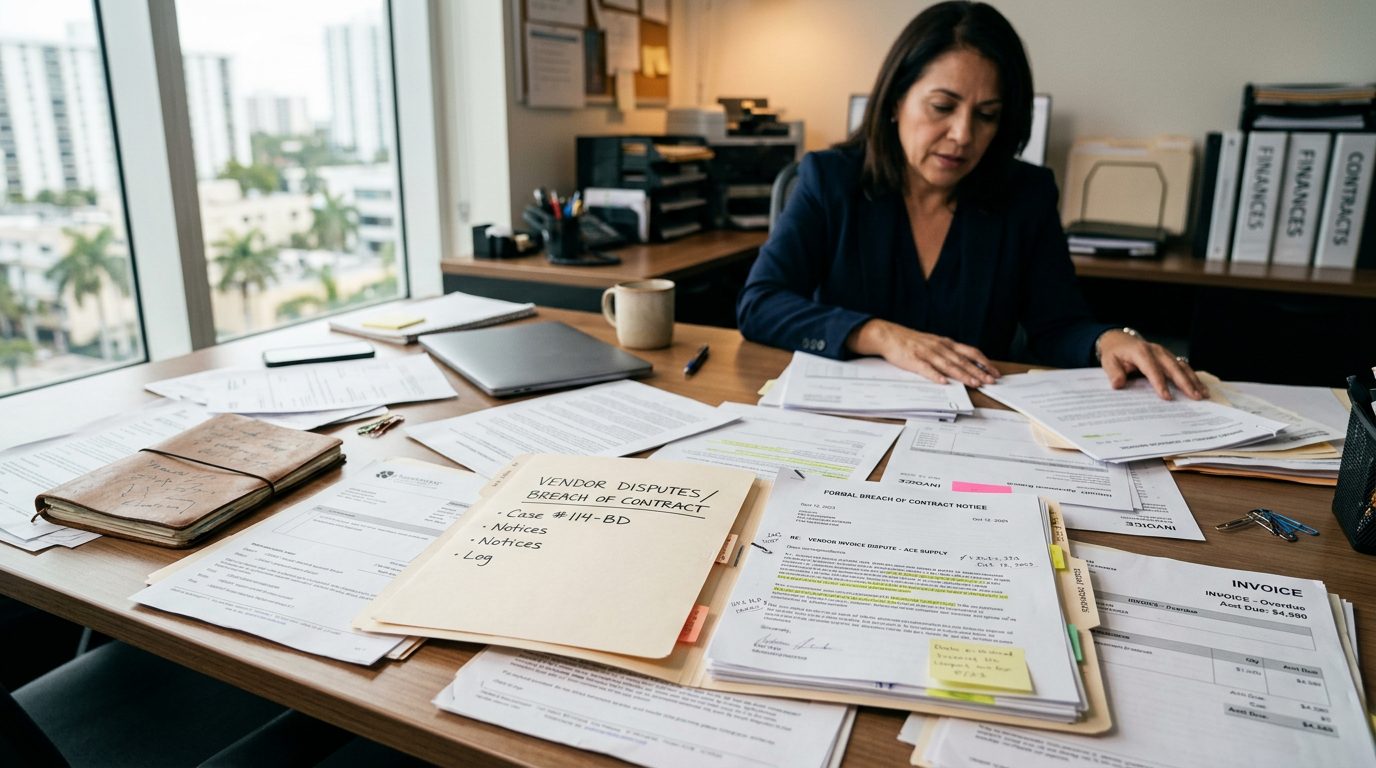
Keep Your Paper Trail Organized
Gather signed contracts, purchase orders, invoices, delivery records, payment history and written communications with the vendor, including emails and text messages. Well-organized records help us evaluate your position early.
How We Approach a Vendor Dispute
1. Free First Consultation
We discuss what happened, review the documents you have and identify the questions that matter most. The consultation is confidential and comes with no obligation to continue.
2. Contract and Document Review
We analyze the agreement's terms, payment provisions, performance obligations and notice requirements alongside your records.
3. Strategy and Negotiation
We work to resolve the dispute efficiently, whether through direct negotiation, a demand letter or a settlement proposal tailored to your business.
4. Resolution or Litigation
If the vendor will not resolve the matter, we discuss court proceedings and prepare your case while keeping you informed at each step.
Dealing with a Vendor Who Is Not Living Up to the Contract? Talk with Kristina E. Wilson.
Related practice areas
- Business Acquisition And Sale Lawyers Broward County
- Business Acquisition And Sale Law Firm Fort Lauderdale
- Business Acquisition and Sale Attorney Doral | KEW Legal
Request a Consultation
Fill out the short form and we will take it from there.