
Business Contract & Vendor Disputes | Fort Lauderdale
Clear Answers for Fort Lauderdale Businesses in Vendor and Contract Disputes
KEW Legal focuses on business contract and vendor dispute matters for owners in Fort Lauderdale and Broward County, with offices in Coral Gables and Sunny Isles Beach. Our free first consultation is confidential and comes with no obligation to continue.
By Kristina E. Wilson · Published October 19, 2026
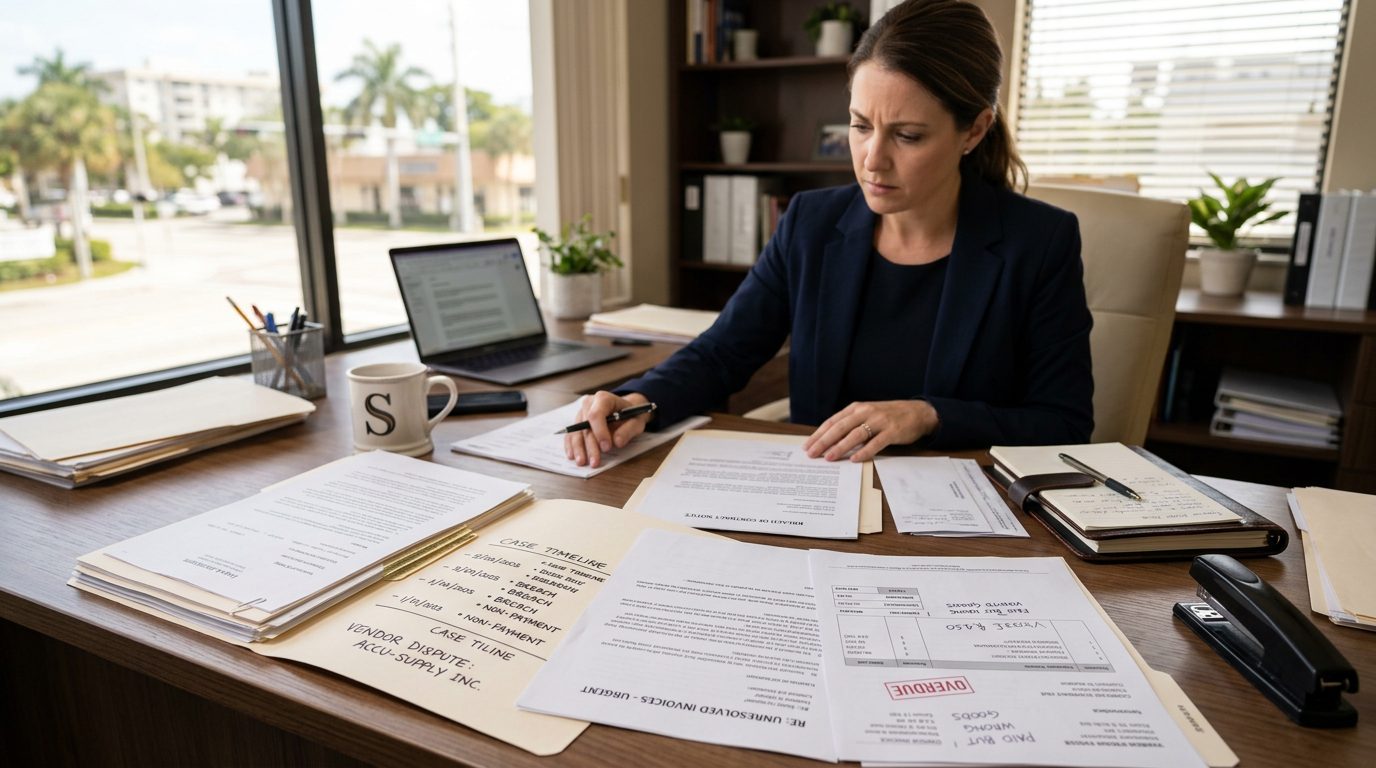
When a vendor stops performing, your first move is to gather the contract and check its notice terms before you reply. Fort Lauderdale business owners looking for a business contract and vendor dispute attorney can start with those steps. A late shipment or a change nobody wrote down can grow into a full dispute, so early organization matters.
KEW Legal is a Florida business law firm with offices in Coral Gables and Sunny Isles Beach. We serve business owners and investors across Miami-Dade and Broward County, including Fort Lauderdale. Kristina E. Wilson is the lawyer responsible for this page. Our support staff assists with business contract and vendor dispute matters, which are part of KEW Legal’s outside general counsel work for businesses.
For the full overview of this service, see our business contract and vendor dispute attorney page.
Common Contract and Vendor Disputes in Fort Lauderdale
Most vendor disputes come down to three questions: what was promised, what was delivered, and who owes money for it. Typical problems include:
- Goods that arrive late, short, or damaged
- Services that miss the agreed scope or standard
- Disagreements over change orders and extra work
- Invoices one side says are wrong
- Termination or default notices sent with little warning
Broward businesses in marine, construction, hospitality, and logistics often rely on outside vendors and subcontractors. That’s why these disputes come up so often in this area.
A dispute usually turns on two things at once. The written contract sets the rules. The way both sides acted, such as accepting deliveries or approving changes, can change how those rules apply. Both need review.
Some problems can be solved through careful written correspondence. Others call for a formal demand letter, a mediation request, or a lawsuit. Which path fits depends on the facts, so decide before you send anything.
Not sure what your next step is?
Talk it through with our team — the first consultation is free, confidential, and carries no obligation.

First Steps Before You Respond to a Breach Notice
Before you answer a breach notice, collect every record of the deal and read the contract’s notice clause. Work through these steps in order:
- Gather the paperwork. Pull the signed contract, amendments, purchase orders, statements of work, invoices, delivery receipts, emails, and text messages into one folder.
- Check the notice clause. It names where notices go, who receives them, and how they must be delivered. A notice sent the wrong way may not count.
- Look for a cure period. Many contracts give the other side time to fix a problem before default or termination takes effect.
- Review payment and set-off terms. Holding back money without contract authority can expose your business to a claim of its own.
- Watch what you put in writing. A casual admission or an angry text can become part of the record. Routing your response through counsel helps keep it consistent.
If your business accepted goods, a separate rule applies. Under Fla. Stat. § 672.607, a buyer who has accepted a tender must notify the seller of a breach within a reasonable time after discovering it or should have discovered it, or be barred from any remedy. The buyer also carries the burden of proving a breach in goods already accepted.
Florida Deadlines and Where a Broward Dispute Can Be Filed
Florida sets a time limit for filing suit, and a contract cannot make that limit shorter than the statute allows. Here are the rules that matter most:
- Oral or unwritten contracts. Florida law sets its own filing deadline for a claim on a contract, obligation, or liability not founded on a written instrument, which includes claims for the sale and delivery of goods, wares, and merchandise and claims on store accounts. Written contracts have their own time limit in the same statute, so the form of your agreement matters.
- Shortened deadlines. Under Fla. Stat. § 95.03, a contract provision that sets a shorter time to sue than the statute allows is void.
- When the clock starts. Under Fla. Stat. § 95.031, a cause of action accrues when the last element of the claim occurs. Track dates from the start.
- Where to file. Under Fla. Stat. § 47.011, actions are brought only in the county where the defendant resides, where the cause of action accrued, or where the property in litigation is located. For a Fort Lauderdale business, Broward County may be the right county if the defendant lives there or the breach happened there. The statute does not apply to actions against nonresidents, so an out-of-state vendor needs separate review.
- Fee clauses cut both ways. Under Fla. Stat. § 57.105, when a contract lets a party recover fees for enforcing it, the court may allow fees to the other side if that side prevails. This applies to any contract entered into on or after October 1, 1988. Check that clause before you file or defend.
Breach of contract claims can seek money damages, and some cases involve asking a court to order performance. Results turn on the contract and the proof, and no outcome can be promised.
How Outside General Counsel Helps Before a Dispute Starts
Outside general counsel means a lawyer reviews vendor contracts, renewal dates, and standard purchase terms before a problem becomes a dispute. This review often gives a business clearer options and fewer surprises. Key clauses to check include:
- Scope and acceptance
- Delivery and performance standards
- Notice and cure
- Limitation of liability
- Indemnification
- Payment terms
- Governing law and venue
- Termination for convenience
Dispute clauses matter too. Under Fla. Stat. § 682.02, an agreement in a record to arbitrate existing or future controversies is valid, enforceable, and irrevocable, except on grounds that exist to revoke any contract. Under Fla. Stat. § 44.102, a court must, on one party’s request, refer a filed civil action for money damages to mediation. That applies when the requesting party is willing and able to pay the costs or the costs can be split fairly between the parties, unless an exception applies, such as an agreement to binding arbitration. A clause you sign today can shape how a fight plays out later.
For regional context, see our Broward County contract dispute help page.
How Working With KEW Legal Begins
Your first step is a consultation about the specific contract, vendor, invoices, and correspondence you already have. Bring the signed agreement, any amendments, notices, invoices, and messages. Together, you and the lawyer can review the notice terms, payment clauses, and deadlines.
The first consultation is free, confidential, and carries no obligation to continue.
You can reach KEW Legal at 305-990-2300 or through our contact page. Our offices are in Coral Gables and Sunny Isles Beach, and we serve Fort Lauderdale and Broward businesses from those offices.
Business Contract and Vendor Dispute Attorney Fort Lauderdale: Common Questions
Can my business stop paying a vendor during a dispute?
Whether a particular step is appropriate depends on the specific facts of your situation, so it is worth discussing those facts with a lawyer before you act. Review the payment terms before you hold back any money.
Do I need a formal demand letter?
Many contracts require written notice by a set method, and that notice can start a cure period. Check the notice clause first.
How long do I have to sue a vendor in Florida?
Florida law sets time limits for filing a claim on a contract, and the deadline can differ depending on whether the agreement was written or oral. A contract clause cannot shorten the statutory period.
Is a verbal agreement enforceable in Florida?
Some are. Florida’s rule for goods priced at $500 or more generally requires a signed record, with exceptions under Fla. Stat. § 672.201.
Must a vendor dispute go to court?
Not always. Some contracts require arbitration or mediation first, so review those clauses as part of the contract analysis.
Not sure what your next step is?
Talk it through with our team — the first consultation is free, confidential, and carries no obligation.

Talk to KEW Legal About Your Vendor Dispute
If a supplier has stopped delivering, a contractor has sent a default notice, or an invoice is in dispute, you may need to choose your next step now. Call 305-990-2300 or send your contract and correspondence through our contact page, so KEW Legal can review the notice terms, payment clauses, and deadlines with you.
How KEW Legal Approaches Vendor Disputes
Contract Review
We start by reading the agreement, purchase orders, invoices and correspondence together so the dispute is measured against the actual written terms.
Protecting Your Position
Our attorney helps you understand your options before you withhold payment, end a relationship or send a formal notice.
Clear Communication
We keep you informed at every step and explain the practical trade-offs of each approach in plain language.
Responsive Support
Our team supports the attorney with document handling and scheduling, so your questions and deadlines stay organized.
Check Before You Stop Paying
Review the payment terms and any notice requirements in your contract before you withhold money or stop performance. Acting too quickly can change your position in a dispute.
Vendor and Contract Disputes We Handle
Late or Defective Deliveries
Disagreements over delivery timing, product quality or whether goods meet the agreed specifications.
Disputed Invoices
Questions about charges, billing errors or whether the amount owed matches the contract and the work performed.
Services Not Performed as Agreed
Situations where a vendor's work falls short of the scope, schedule or standards in the written agreement.
Scope and Pricing Changes
Disputes over unapproved changes, added costs or new terms that were never formally agreed.
Discuss Your Vendor or Contract Dispute with KEW Legal
Request a Consultation
Fill out the short form and we will take it from there.